Question 1
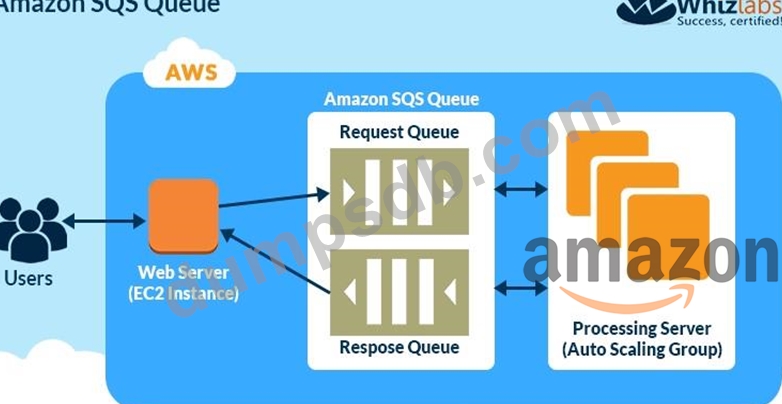
Your firm has uploaded a large amount of aerial image data to S3. In the past, in your on-premises environment, you used a dedicated group of servers to process this data and used Rabbit MQ - An open source messaging system to get job information to the servers. Once processed the data would go to tape and be shipped offsite. Your manager told you to stay with the current design, and leverage AWS archival storage and messaging services to minimize cost. Which is correct?
Question 2
Your company is getting ready to do a major public announcement of a social media site on AWS. The
website is running on EC2 instances deployed across multiple Availability Zones with a Multi-AZ RDS
MySQL Extra Large DB Instance. The site performs a high number of small reads and writes per second and
relies on an eventual consistency model. After comprehensive tests you discover that there is read contention
on RDS MySQL. Which are the best approaches to meet these requirements?
Choose 2 answers from the options below
Question 3
A retail company is currently hosting a Java-based application in its on-premises data center. Management wants the DevOps Engineer to move this application to AWS. Requirements state that while keeping high availability, infrastructure management should be as simple as possible. Also, during deployments of new application versions, while cost is an important metric, the Engineer needs to ensure that at least half of the fleet is available to handle user traffic.
What option requires the LEAST amount of management overhead to meet these requirements?
Question 4
A retail company wants to use AWS Elastic Beanstalk to host its online sales website running on Java. Since this will be the production website, the CTO has the following requirements for the deployment strategy:
*Zero downtime. While the deployment is ongoing, the current Amazon EC2 instances in service should remain in service. No deployment or any other action should be performed on the EC2 instances because they serve production traffic.
*A new fleet of instances should be provisioned for deploying the new application version.
*Once the new application version is deployed successfully in the new fleet of instances, the new instances should be placed in service and the old ones should be removed.
*The rollback should be as easy as possible. If the new fleet of instances fail to deploy the new application version, they should be terminated and the current instances should continue serving traffic as normal.
*The resources within the environment (EC2 Auto Scaling group, Elastic Load Balancing, Elastic Beanstalk DNS CNAME) should remain the same and no DNS change should be made.
Which deployment strategy will meet the requirements?
Question 5
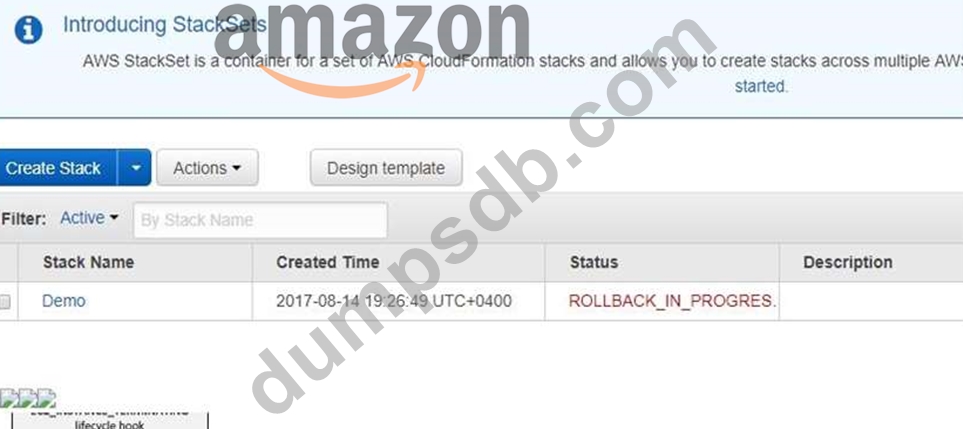
You have deployed a Cloudformation template which is used to spin up resources in your account. Which of the following status in Cloudformation represents a failure.