AWS Transit Gateway is a service that enables customers to connect their Amazon Virtual Private Clouds (VPCs) and their on-premises networks to a single gateway. As you grow the number of workloads running on AWS, you need to be able to scale your networks across multiple accounts and Amazon VPCs to keep up with the growth.
Today, you can connect pairs of Amazon VPCs using peering. However, managing point-to-point connectivity across many Amazon VPCs without the ability to centrally manage the connectivity policies can be operationally costly and cumbersome. For on-premises connectivity, you need to attach your AWS VPN to each individual Amazon VPC. This solution can be time-consuming to build and hard to manage when the number of VPCs grows into the hundreds.
With AWS Transit Gateway, you only have to create and manage a single connection from the central gateway to each Amazon VPC, on-premises data center, or remote office across your network. Transit Gateway acts as a hub that controls how traffic is routed among all the connected networks which act like spokes. This hub and spoke model significantly simplifies management and reduces operational costs because each network only has to connect to the Transit Gateway and not to every other network.
Any new VPC is simply connected to the Transit Gateway and is then automatically available to every other network that is connected to the Transit Gateway. This ease of connectivity makes it easy to scale your network as you grow.

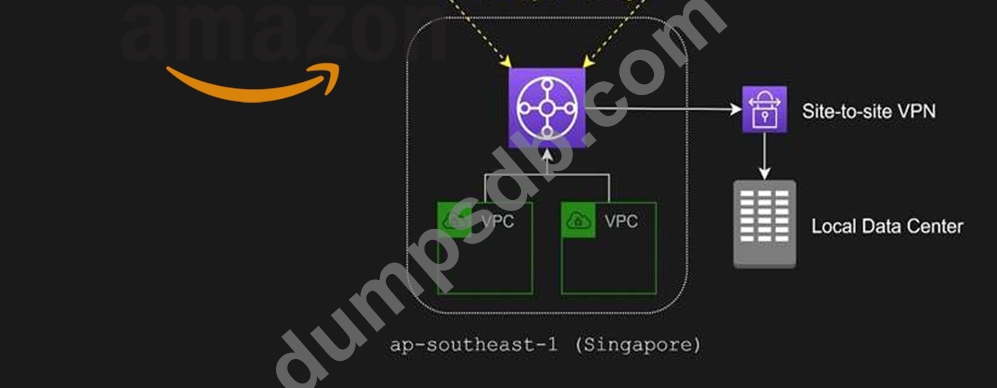
It acts as a Regional virtual router for traffic flowing between your virtual private clouds (VPC) and VPN connections. A transit gateway scales elastically based on the volume of network traffic. Routing through a transit gateway operates at layer 3, where the packets are sent to a specific next-hop attachment, based on their destination IP addresses.
A transit gateway attachment is both a source and a destination of packets. You can attach the following resources to your transit gateway:
- One or more VPCs
- One or more VPN connections
- One or more AWS Direct Connect gateways
- One or more transit gateway peering connections
If you attach a transit gateway peering connection, the transit gateway must be in a different Region.
Hence, the correct answer is: Set up an AWS Transit Gateway in each region to interconnect all networks within it. Then, route traffic between the transit gateways through a peering connection.
The option that says: Set up an AWS Direct Connect Gateway to achieve inter-region VPC access to all of the AWS resources and on-premises data centers. Set up a link aggregation group (LAG) to aggregate multiple connections at a single AWS Direct Connect endpoint in order to treat them as a single, managed connection. Launch a virtual private gateway in each VPC and then create a public virtual interface for each AWS Direct Connect connection to the Direct Connect Gateway is incorrect. You can only create a private virtual interface to a Direct Connect gateway and not a public virtual interface.
Using a link aggregation group (LAG) is also irrelevant in this scenario because it is just a logical interface that uses the Link Aggregation Control Protocol (LACP) to aggregate multiple connections at a single AWS Direct Connect endpoint, allowing you to treat them as a single, managed connection.
The option that says: Enable inter-region VPC peering which allows peering relationships to be established between VPCs across different AWS regions. This will ensure that the traffic will always stay on the global AWS backbone and will never traverse the public Internet is incorrect. This would require a lot of manual set up and management overhead to successfully build a functional, error-free inter-region VPC network compared with just using a Transit Gateway. Although the Inter-Region VPC Peering provides a cost-effective way to share resources between regions or replicate data for geographic redundancy, its connections are not dedicated and highly available. Moreover, it doesn't support the company's on-premises data centers in multiple AWS Regions.
The option that says: Set up an AWS VPN CloudHub for inter-region VPC access and a Direct Connect gateway for the VPN connections to the on-premises data centers. Create a virtual private gateway in each VPC, then create a private virtual interface for each AWS Direct Connect connection to the Direct Connect gateway is incorrect. This option doesn't meet the requirement of interconnecting all of the company's on-premises networks, VPNs, and VPCs into a single gateway, which includes support for inter-region peering across multiple AWS regions. As its name implies, the AWS VPN CloudHub is only for VPNs and not for VPCs. It is also not capable of managing hundreds of VPCs with multiple VPN connections to their data centers that span multiple AWS Regions. References:
https://aws.amazon.com/transit-gateway/
https://docs.aws.amazon.com/vpc/latest/tgw/how-transit-gateways-work.html
https://aws.amazon.com/blogs/networking-and-content-delivery/building-a-global-network-using-aws-tran sit-gateway-inter-region-peering/ Check out this AWS Transit Gateway Cheat Sheet:
https://tutorialsdojo.com/aws-transit-gateway/

