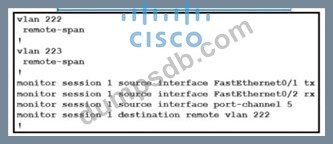
Refer to the exhibit. These commands have been added to the configuration of a switch. Which command flags an error If It is added to this configuration?
Correct Answer: B
Question 397
What does this EEM applet event accomplish? "event snmp oid 1.3.6.1.3.7.1.5.1.2.4.2.9 get-type next entry-op g entry-val 75 poll-interval 5"
Correct Answer: B
EEM offers the ability to monitor events and take informational or corrective action when the monitored events occur or reach a threshold. An EEM policy is an entity that defines an event and the actions to be taken when that event occurs. There are two types of EEM policies: an applet or a script. An applet is a simple form of policy that is defined within the CLI configuration. To specify the event criteria for an Embedded Event Manager (EEM) applet that is run by sampling Simple Network Management Protocol (SNMP) object identifier values, use the event snmp command in applet configuration mode. event snmp oid oid-value get-type {exact | next} entry-op operator entry-val entryvalue [exit-comb {or | and}] [exit-op operator] [exit-val exit-value] [exit-time exit-timevalue] poll-interval poll-int-value + oid: Specifies the SNMP object identifier (object ID) + get-type: Specifies the type of SNMP get operation to be applied to the object ID specified by the oid-value argument. - next - Retrieves the object ID that is the alphanumeric successor to the object ID specified by the oid-value argument. + entry-op: Compares the contents of the current object ID with the entry value using the specified operator. If there is a match, an event is triggered and event monitoring is disabled until the exit criteria are met. + entry-val: Specifies the value with which the contents of the current object ID are compared to decide if an SNMP event should be raised. + exit-op: Compares the contents of the current object ID with the exit value using the specified operator. If there is a match, an event is triggered and event monitoring is reenabled. + poll-interval: Specifies the time interval between consecutive polls (in seconds) Reference: QUESTION 2 Cisco TrustSec uses tags to represent logical group privilege. This tag, called a Security Group Tag (SGT), is used in access policies. The SGT is understood and is used to enforce traffic by Cisco switches, routers and firewalls . Cisco TrustSec is defined in three phases: classification, propagation and enforcement. When users and devices connect to a network, the network assigns a specific security group. This process is called classification. Classification can be based on the results of the authentication or by associating the SGT with an IP, VLAN, or port-profile (-> Answer 'security group tag ACL assigned to each port on a switch' and answer 'security group tag number assigned to each user on a switch' are not correct as they say "assigned ... on a switch" only. Answer 'security group tag ACL assigned to each router on a network' is not correct either as it says "assigned to each router").
Question 398
During deployment, a network engineer notices that voice traffic is not being tagged correctly as it traverses the network. Which COS to DSCP map must be modified to ensure that voice traffic is treated properly?
Correct Answer: A
Explanation CoS value 5 is commonly used for VOIP and CoS value 5 should be mapped to DSCP 46. DSCP 46 is defined as being for EF (Expedited Forwarding) traffic flows and is the value usually assigned to all interactive voice and video traffic. This is to keep the uniformity from end-to-end that DSCP EF (mostly for VOICE RTP) is mapped to COS 5. Note: + CoS is a L2 marking contained within an 802.1q tag,. The values for CoS are 0 - 7 + DSCP is a L3 marking and has values 0 - 63 + The default DSCP-to-CoS mapping for CoS 5 is DSCP 40
Question 399
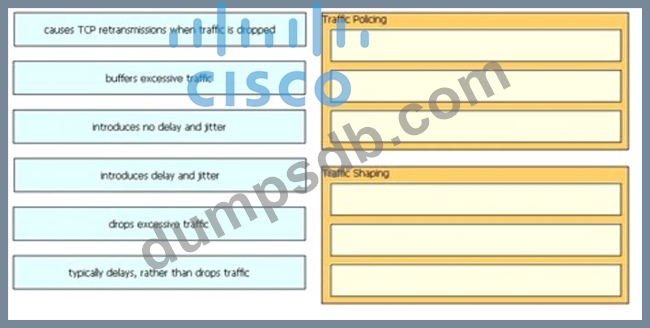
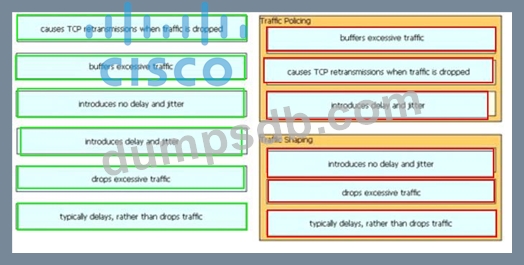
Drag and drop the descriptions from the left onto the QoS components on the right.
Correct Answer:
Question 400
How do agent-based versus agentless configuration management tools compare?