Latest 350-701 Exam Premium Dumps provide by TrainingQuiz.com to help you Passing 350-701 Exam! TrainingQuiz.com offers the updated 350-701 exam dumps, the TrainingQuiz.com 350-701 exam questions has been updated to correct Answer. Get the latest TrainingQuiz.com 350-701 pdf dumps with Exam Engine here:
(727 Q&As Dumps, 40%OFF Special Discount: DumpsDB)
Phishing is a form of social engineering. Phishing attacks use email or malicious web sites to solicit personal, often financial, information. Attackers may send email seemingly from a reputable credit card company or financial institution that requests account information, often suggesting that there is a problem.
Question 112
Which benefit is provided by ensuring that an endpoint is compliant with a posture policy configured in Cisco ISE?
Correct Answer: A
Question 113
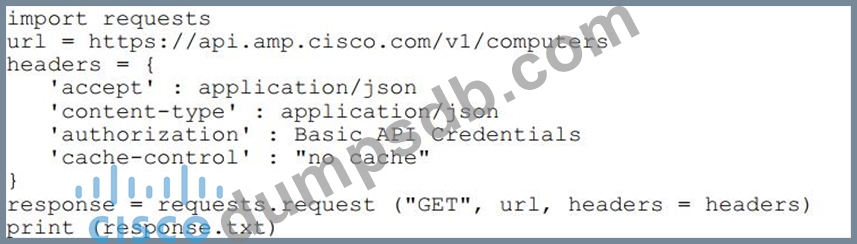
Refer to the exhibit. What will happen when this Python script is run?
Correct Answer: D
The call to API of "https://api.amp.cisco.com/v1/computers" allows us to fetch list of computers across your organization that Advanced Malware Protection (AMP) sees The call to API of "https://api.amp.cisco.com/v1/computers" allows us to fetch list of computers across your organization that Advanced Malware Protection (AMP) sees Reference: 2Fcomputers&api_host=api.apjc.amp.cisco.com&api_resource=Computer&api_version=v1
Question 114
Which two conditions are prerequisites for stateful failover for IPsec? (Choose two.)
Correct Answer: A,D
Question 115
Which method is used to deploy certificates and configure the supplicant on mobile devices to gain access to network resources?
Correct Answer: A
When supporting personal devices on a corporate network, you must protect network services and enterprise data by authenticating and authorizing users (employees, contractors, and guests) and their devices. Cisco ISE provides the tools you need to allow employees to securely use personal devices on a corporate network. Guests can add their personal devices to the network by running the native supplicant provisioning (Network Setup Assistant), or by adding their devices to the My Devices portal. Because native supplicant profiles are not available for all devices, users can use the My Devices portal to add these devices manually; or you can configure Bring Your Own Device (BYOD) rules to register these devices. When supporting personal devices on a corporate network, you must protect network services and enterprise data by authenticating and authorizing users (employees, contractors, and guests) and their devices. Cisco ISE provides the tools you need to allow employees to securely use personal devices on a corporate network. Guests can add their personal devices to the network by running the native supplicant provisioning (Network Setup Assistant), or by adding their devices to the My Devices portal. Because native supplicant profiles are not available for all devices, users can use the My Devices portal to add these devices manually; or you can configure Bring Your Own Device (BYOD) rules to register these devices. When supporting personal devices on a corporate network, you must protect network services and enterprise data by authenticating and authorizing users (employees, contractors, and guests) and their devices. Cisco ISE provides the tools you need to allow employees to securely use personal devices on a corporate network. Guests can add their personal devices to the network by running the native supplicant provisioning (Network Setup Assistant), or by adding their devices to the My Devices portal. Because native supplicant profiles are not available for all devices, users can use the My Devices portal to add these devices manually; or you can configure Bring Your Own Device (BYOD) rules to register these devices. Reference: m_ise_devices_byod.html m_ise_devices_byod.html