What is a prerequisite when integrating a Cisco ISE server and an AD domain?
Correct Answer: D
The following are the prerequisites to integrate Active Directory with Cisco ISE. + Use the Network Time Protocol (NTP) server settings to synchronize the time between the Cisco ISE server and Active Directory. You can configure NTP settings from Cisco ISE CLI. + If your Active Directory structure has multidomain forest or is divided into multiple forests, ensure that trust relationships exist between the domain to which Cisco ISE is connected and the other domains that have user and machine information to which you need access. For more information on establishing trust relationships, refer to Microsoft Active Directory documentation. + You must have at least one global catalog server operational and accessible by Cisco ISE, in the domain to which you are joining Cisco ISE. Reference: /b_ISE_AD_integration_2x.html#reference_8DC463597A644A5C9CF5D582B77BB24F
Question 22
An organization is trying to implement micro-segmentation on the network and wants to be able to gain visibility on the applications within the network. The solution must be able to maintain and force compliance. Which product should be used to meet these requirements?
Correct Answer: D
Micro-segmentation secures applications by expressly allowing particular application traffic and, by default, denying all other traffic. Micro-segmentation is the foundation for implementing a zero-trust security model for application workloads in the data center and cloud. Cisco Tetration is an application workload security platform designed to secure your compute instances across any infrastructure and any cloud. To achieve this, it uses behavior and attribute-driven microsegmentation policy generation and enforcement. It enables trusted access through automated, exhaustive context from various systems to automatically adapt security policies. To generate accurate microsegmentation policy, Cisco Tetration performs application dependency mapping to discover the relationships between different application tiers and infrastructure services. In addition, the platform supports "what-if" policy analysis using real-time data or historical data to assist in the validation and risk assessment of policy application pre-enforcement to ensure ongoing application availability. The normalized microsegmentation policy can be enforced through the application workload itself for a consistent approach to workload microsegmentation across any environment, including virtualized, bare-metal, and container workloads running in any public cloud or any data center. Once the microsegmentation policy is enforced, Cisco Tetration continues to monitor for compliance deviations, ensuring the segmentation policy is up to date as the application behavior change. Micro-segmentation secures applications by expressly allowing particular application traffic and, by default, denying all other traffic. Micro-segmentation is the foundation for implementing a zero-trust security model for application workloads in the data center and cloud. Cisco Tetration is an application workload security platform designed to secure your compute instances across any infrastructure and any cloud. To achieve this, it uses behavior and attribute-driven microsegmentation policy generation and enforcement. It enables trusted access through automated, exhaustive context from various systems to automatically adapt security policies. To generate accurate microsegmentation policy, Cisco Tetration performs application dependency mapping to discover the relationships between different application tiers and infrastructure services. In addition, the platform supports "what-if" policy analysis using real-time data or historical data to assist in the validation and risk assessment of policy application pre-enforcement to ensure ongoing application availability. The normalized microsegmentation policy can be enforced through the application workload itself for a consistent approach to workload microsegmentation across any environment, including virtualized, bare-metal, and container workloads running in any public cloud or any data center. Once the microsegmentation policy is enforced, Cisco Tetration continues to monitor for compliance deviations, ensuring the segmentation policy is up to date as the application behavior change. Micro-segmentation secures applications by expressly allowing particular application traffic and, by default, denying all other traffic. Micro-segmentation is the foundation for implementing a zero-trust security model for application workloads in the data center and cloud. Cisco Tetration is an application workload security platform designed to secure your compute instances across any infrastructure and any cloud. To achieve this, it uses behavior and attribute-driven microsegmentation policy generation and enforcement. It enables trusted access through automated, exhaustive context from various systems to automatically adapt security policies. To generate accurate microsegmentation policy, Cisco Tetration performs application dependency mapping to discover the relationships between different application tiers and infrastructure services. In addition, the platform supports "what-if" policy analysis using real-time data or historical data to assist in the validation and risk assessment of policy application pre-enforcement to ensure ongoing application availability. The normalized microsegmentation policy can be enforced through the application workload itself for a consistent approach to workload microsegmentation across any environment, including virtualized, bare-metal, and container workloads running in any public cloud or any data center. Once the microsegmentation policy is enforced, Cisco Tetration continues to monitor for compliance deviations, ensuring the segmentation policy is up to date as the application behavior change.
Question 23
A network engineer has entered the snmp-server user andy myv3 auth sha cisco priv aes 256 cisc0380739941 command and needs to send SNMP information to a host at 10.255.254.1. Which command achieves this goal?
Correct Answer: B
Question 24
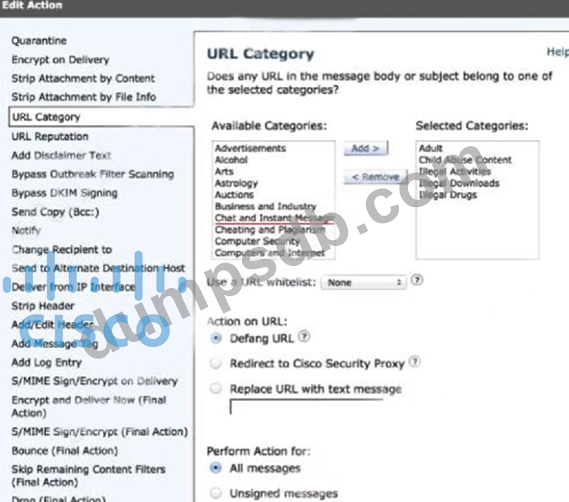
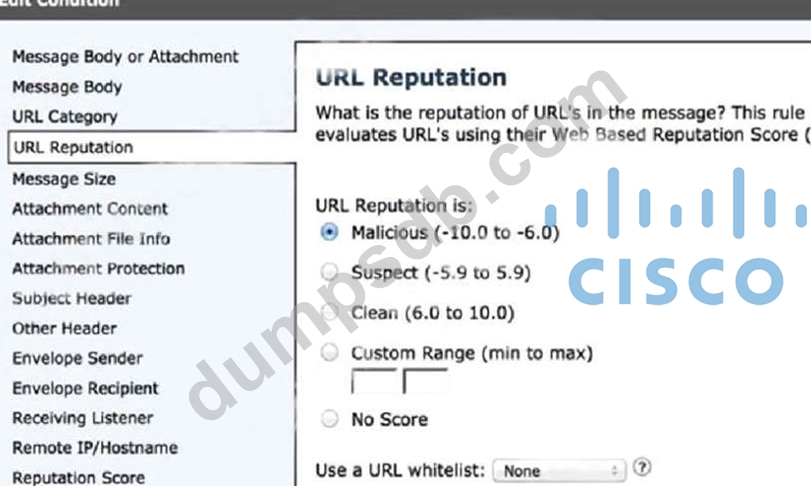
A network administrator is configuring a rule in an access control policy to block certain URLs and selects the "Chat and Instant Messaging" category. Which reputation score should be selected to accomplish this goal?
Correct Answer: D
Explanation We choose "Chat and Instant Messaging" category in "URL Category": To block certain URLs we need to choose URL Reputation from 6 to 10.
Question 25
Which compliance status is shown when a configured posture policy requirement is not met?
Correct Answer: D
Explanation Posture is a service in Cisco Identity Services Engine (Cisco ISE) that allows you to check the state, also known as posture, of all the endpoints that are connecting to a network for compliance with corporate security policies. A posture policy is a collection of posture requirements that are associated with one or more identity groups and operating systems. Posture-policy requirements can be set to mandatory, optional, or audit types in posture policies. + If a mandatory requirement fails, the user will be moved to Non-Compliant state + If an optional requirement fails, the user is allowed to skip the specified optional requirements and the user is moved to Compliant state This Qdid not clearly specify the type of posture policy requirement (mandatory or optional) is not met so the user can be in Non-compliant or compliant state. But "noncompliant" is the best answer here. Reference: https://www.cisco.com/c/en/us/td/docs/security/ise/1-3/admin_guide/b_ise_admin_guide_13/ b_ise_admin_guide_sample_chapter_010111.html Posture is a service in Cisco Identity Services Engine (Cisco ISE) that allows you to check the state, also known as posture, of all the endpoints that are connecting to a network for compliance with corporate security policies. A posture policy is a collection of posture requirements that are associated with one or more identity groups and operating systems. Posture-policy requirements can be set to mandatory, optional, or audit types in posture policies. + If a mandatory requirement fails, the user will be moved to Non-Compliant state + If an optional requirement fails, the user is allowed to skip the specified optional requirements and the user is moved to Compliant state This Qdid not clearly specify the type of posture policy requirement (mandatory or optional) is not met so the user can be in Non-compliant or compliant state. But "noncompliant" is the best answer here. Reference: Explanation Posture is a service in Cisco Identity Services Engine (Cisco ISE) that allows you to check the state, also known as posture, of all the endpoints that are connecting to a network for compliance with corporate security policies. A posture policy is a collection of posture requirements that are associated with one or more identity groups and operating systems. Posture-policy requirements can be set to mandatory, optional, or audit types in posture policies. + If a mandatory requirement fails, the user will be moved to Non-Compliant state + If an optional requirement fails, the user is allowed to skip the specified optional requirements and the user is moved to Compliant state This Qdid not clearly specify the type of posture policy requirement (mandatory or optional) is not met so the user can be in Non-compliant or compliant state. But "noncompliant" is the best answer here. Reference: https://www.cisco.com/c/en/us/td/docs/security/ise/1-3/admin_guide/b_ise_admin_guide_13/ b_ise_admin_guide_sample_chapter_010111.html