A Cisco FTD engineer is creating a new IKEv2 policy called s2s00123456789 for their organization to allow for additional protocols to terminate network devices with. They currently only have one policy established and need the new policy to be a backup in case some devices cannot support the stronger algorithms listed in the primary policy. What should be done in order to support this?
Correct Answer: B
All IKE policies on the device are sent to the remote peer regardless of what is in the selected policy section. The first IKE Policy matched by the remote peer will be selected for the VPN connection. Choose which policy is sent first using the priority field. Priority 1 will be sent first. All IKE policies on the device are sent to the remote peer regardless of what is in the selected policy section. The first IKE Policy matched by the remote peer will be selected for the VPN connection. Choose which policy is sent first using the priority field. Priority 1 will be sent first. Reference: All IKE policies on the device are sent to the remote peer regardless of what is in the selected policy section. The first IKE Policy matched by the remote peer will be selected for the VPN connection. Choose which policy is sent first using the priority field. Priority 1 will be sent first.
Question 67
How does Cisco Workload Optimization portion of the network do EPP solutions solely performance issues?
Correct Answer: C
Question 68
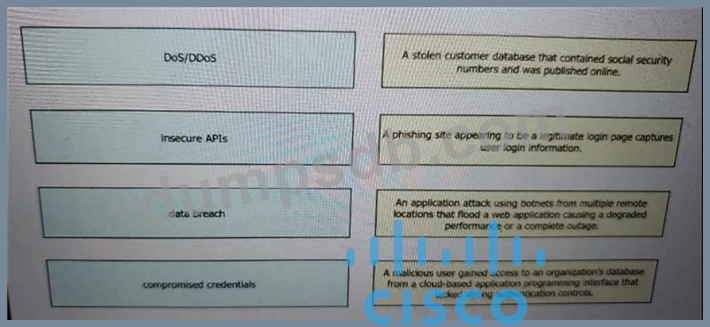
Drag and drop the threats from the left onto examples of that threat on the right
Correct Answer:
Question 69
An engineer has been tasked with configuring a Cisco FTD to analyze protocol fields and detect anomalies in the traffic from industrial systems. What must be done to meet these requirements?
Correct Answer: A
The Modbus, DNP3, and CIP SCADA preprocessors detect traffic anomalies and provide data to intrusion rules. Therefore in this question only answer A or answer C is correct. The DNP3 preprocessor detects anomalies in DNP3 traffic and decodes the DNP3 protocol for processing by the rules engine, which uses DNP3 keywords to access certain protocol fields. The Common Industrial Protocol (CIP) is a widely used application protocol that supports industrial automation applications. EtherNet/IP is an implementation of CIP that is used on Ethernet-based networks.The CIP preprocessor detects CIP and ENIP traffic running on TCP or UDP and sends it to the intrusion rules engine. You can use CIP and ENIP keywords in custom intrusion rules to detect attacks in CIP and ENIP traffic. The Modbus, DNP3, and CIP SCADA preprocessors detect traffic anomalies and provide data to intrusion rules. Therefore in this question only answer A or answer C is correct. The DNP3 preprocessor detects anomalies in DNP3 traffic and decodes the DNP3 protocol for processing by the rules engine, which uses DNP3 keywords to access certain protocol fields. The Common Industrial Protocol (CIP) is a widely used application protocol that supports industrial automation applications. EtherNet/IP is an implementation of CIP that is used on Ethernet-based networks.The CIP preprocessor detects CIP and ENIP traffic running on TCP or UDP and sends it to the intrusion rules engine. You can use CIP and ENIP keywords in custom intrusion rules to detect attacks in CIP and ENIP traffic. Reference: Both DNP3 and CIP preprocessors can be used to detect traffic anomalies but we choose CIP as it is widely used in industrial applications. Note: + An intrusion rule is a specified set of keywords and arguments that the system uses to detect attempts to exploit vulnerabilities in your network. As the system analyzes network traffic, it compares packets against the conditions specified in each rule, and triggers the rule if the data packet meets all the conditions specified in the rule. + Preprocessor rules, which are rules associated with preprocessors and packet decoder detection options in the network analysis policy. Most preprocessor rules are disabled by default. The Modbus, DNP3, and CIP SCADA preprocessors detect traffic anomalies and provide data to intrusion rules. Therefore in this question only answer A or answer C is correct. The DNP3 preprocessor detects anomalies in DNP3 traffic and decodes the DNP3 protocol for processing by the rules engine, which uses DNP3 keywords to access certain protocol fields. The Common Industrial Protocol (CIP) is a widely used application protocol that supports industrial automation applications. EtherNet/IP is an implementation of CIP that is used on Ethernet-based networks.The CIP preprocessor detects CIP and ENIP traffic running on TCP or UDP and sends it to the intrusion rules engine. You can use CIP and ENIP keywords in custom intrusion rules to detect attacks in CIP and ENIP traffic. Both DNP3 and CIP preprocessors can be used to detect traffic anomalies but we choose CIP as it is widely used in industrial applications. Note: Both DNP3 and CIP preprocessors can be used to detect traffic anomalies but we choose CIP as it is widely used in industrial applications. Note: + An intrusion rule is a specified set of keywords and arguments that the system uses to detect attempts to exploit vulnerabilities in your network. As the system analyzes network traffic, it compares packets against the conditions specified in each rule, and triggers the rule if the data packet meets all the conditions specified in the rule. + Preprocessor rules, which are rules associated with preprocessors and packet decoder detection options in the network analysis policy. Most preprocessor rules are disabled by default.
Question 70
Which technology enables integration between Cisco ISE and other platforms to gather and share network and vulnerability data and SIEM and location information?