What are two differences between a Cisco WSA that is running in transparent mode and one running in explicit mode? (Choose two)
Correct Answer: D,E
The Cisco Web Security Appliance (WSA) includes a web proxy, a threat analytics engine, antimalware engine, policy management, and reporting in a single physical or virtual appliance. The main use of the Cisco WSA is to protect users from accessing malicious websites and being infected by malware. You can deploy the Cisco WSA in two different modes: - Explicit forward mode - Transparent mode In explicit forward mode, the client is configured to explicitly use the proxy, subsequently sending all web traffic to the proxy. Because the client knows there is a proxy and sends all traffic to the proxy in explicit forward mode, the client does not perform a DNS lookup of the domain before requesting the URL. The Cisco WSA is responsible for DNS resolution, as well. When you configure the Cisco WSA in explicit mode, you do not need to configure any other network infrastructure devices to redirect client requests to the Cisco WSA. However, you must configure each client to send traffic to the Cisco WSA. -> Therefore in explicit mode, WSA only checks the traffic between client & web server. WSA does not use its own IP address to request -> Answer B is not correct. When the Cisco WSA is in transparent mode, clients do not know there is a proxy deployed. Network infrastructure devices are configured to forward traffic to the Cisco WSA. In transparent mode deployments, network infrastructure devices redirect web traffic to the proxy. Web traffic redirection can be done using policybased routing (PBR)-available on many routers -or using Cisco's Web Cache Communication Protocol (WCCP) on Cisco ASA, Cisco routers, or switches. The Web Cache Communication Protocol (WCCP), developed by Cisco Systems, specifies interactions between one or more switches) and one or more web-caches. The purpose of the interaction is to establish and maintain the transparent redirectio of traffic flowing through a group of routers. Reference: https://www.cisco.com/c/en/us/tech/content-networking/web-cache-communications-protocol-wccp/index.html ->Therefore answer D is correct as redirection can be done on Layer 3 device only. In transparent mode, the client is unaware its traffic is being sent to a proxy (Cisco WSA) and, as a result, the client uses DNS to resolve the domain name in the URL and send the web request destined for the web server (not the proxy). When you configure the Cisco WSA in transparent mode, you need to identify a network choke point with a redirection device (a Cisco ASA) to redirect traffic to the proxy. infrastructure devices to redirect client requests to the Cisco WSA. However, you must configure each client to send traffic to the Cisco WSA. -> Therefore in explicit mode, WSA only checks the traffic between client & web server. WSA does not use its own IP address to request -> Answer B is not correct. When the Cisco WSA is in transparent mode, clients do not know there is a proxy deployed. Network infrastructure devices are configured to forward traffic to the Cisco WSA. In transparent mode deployments, network infrastructure devices redirect web traffic to the proxy. Web traffic redirection can be done using policybased routing (PBR)-available on many routers -or using Cisco's Web Cache Communication Protocol (WCCP) on Cisco ASA, Cisco routers, or switches. The Web Cache Communication Protocol (WCCP), developed by Cisco Systems, specifies interactions between one or more switches) and one or more web-caches. The purpose of the interaction is to establish and maintain the transparent redirectio of traffic flowing through a group of routers. Reference: ->Therefore answer D is correct as redirection can be done on Layer 3 device only. When you configure the Cisco WSA in explicit mode, you do not need to configure any other network infrastructure devices to redirect client requests to the Cisco WSA. However, you must configure each client to send traffic to the Cisco WSA. -> Therefore in explicit mode, WSA only checks the traffic between client & web server. WSA does not use its own IP address to request -> Answer B is not correct. When the Cisco WSA is in transparent mode, clients do not know there is a proxy deployed. Network infrastructure devices are configured to forward traffic to the Cisco WSA. In transparent mode deployments, network infrastructure devices redirect web traffic to the proxy. Web traffic redirection can be done using policybased routing (PBR)-available on many routers -or using Cisco's Web Cache Communication Protocol (WCCP) on Cisco ASA, Cisco routers, or switches. The Web Cache Communication Protocol (WCCP), developed by Cisco Systems, specifies interactions between one or more switches) and one or more web-caches. The purpose of the interaction is to establish and maintain the transparent redirectio of traffic flowing through a group of routers. Reference: https://www.cisco.com/c/en/us/tech/content-networking/web-cache-communications-protocol-wccp/index.html ->Therefore answer D is correct as redirection can be done on Layer 3 device only. In transparent mode, the client is unaware its traffic is being sent to a proxy (Cisco WSA) and, as a result, the client uses DNS to resolve the domain name in the URL and send the web request destined for the web server (not the proxy). When you configure the Cisco WSA in transparent mode, you need to identify a network choke point with a redirection device (a Cisco ASA) to redirect traffic to the proxy. WSA in Transparent mode -> Therefore in Transparent mode, WSA uses its own IP address to initiate a new connection the Web Server (in step 4 above) -> Answer E is correct. Answer C is surely not correct as WSA cannot be configured in a web browser in either mode. Answer A seems to be correct but it is not. This answer is correct if it states "When the Cisco WSA is running in transparent mode, it uses the WSA's own IP address as the HTTP request source" (not destination).
Question 292
A network engineer has been tasked with adding a new medical device to the network. Cisco ISE is being used as the NAC server, and the new device does not have a supplicant available. What must be done in order to securely connect this device to the network?
Correct Answer: A
Explanation As the new device does not have a supplicant, we cannot use 802.1X. MAC Authentication Bypass (MAB) is a fallback option for devices that don't support 802.1x. It is virtually always used in deployments in some way shape or form. MAB works by having the authenticator take the connecting device's MAC address and send it to the authentication server as its username and password. The authentication server will check its policies and send back an Access-Accept or Access-Reject just like it would with 802.1x. Cisco ISE Profiling Services provides dynamic detection and classification of endpoints connected to the network. Using MAC addresses as the unique identifier, ISE collects various attributes for each network endpoint to build an internal endpoint database. The classification process matches the collected attributes to prebuilt or user-defined conditions, which are then correlated to an extensive library of profiles. These profiles include a wide range of device types, including mobile clients (iPads, Android tablets, Chromebooks, and so on), desktop operating systems (for example, Windows, Mac OS X, Linux, and others), and numerous non-user systems such as printers, phones, cameras, and game consoles. Once classified, endpoints can be authorized to the network and granted access based on their profile. For example, endpoints that match the IP phone profile can be placed into a voice VLAN using MAC Authentication Bypass (MAB) as the authentication method. Another example is to provide differentiated network access to users based on the device used. For example, employees can get full access when accessing the network from their corporate workstation but be granted limited network access when accessing the network from their personal iPhone.
Question 293
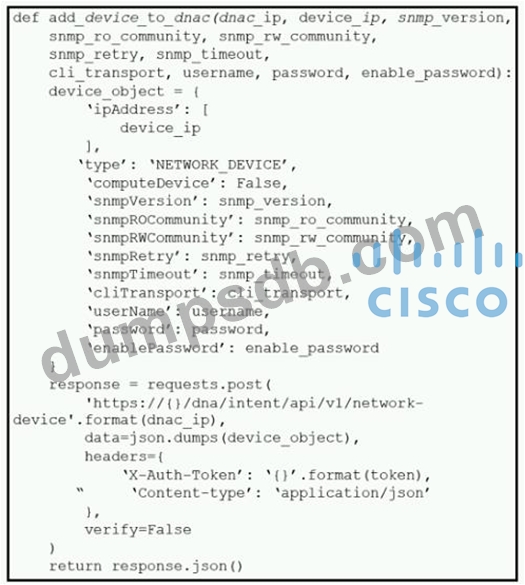
Refer to the exhibit. What is the result of this Python script of the Cisco DNA Center API?
Correct Answer: C
Question 294
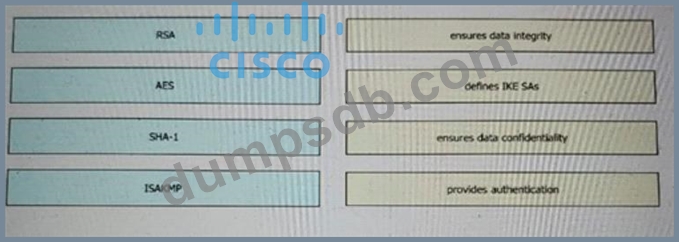
Drag and drop the VPN functions from the left onto the description on the right.
Correct Answer:
Question 295
Which kind of API that is used with Cisco DNA Center provisions SSIDs, QoS policies, and update software versions on switches?