Latest 350-701 Exam Premium Dumps provide by TrainingQuiz.com to help you Passing 350-701 Exam! TrainingQuiz.com offers the updated 350-701 exam dumps, the TrainingQuiz.com 350-701 exam questions has been updated to correct Answer. Get the latest TrainingQuiz.com 350-701 pdf dumps with Exam Engine here:
(727 Q&As Dumps, 40%OFF Special Discount: DumpsDB)
What does Cisco AMP for Endpoints use to help an organization detect different families of malware?
Correct Answer: A
ETHOS is the Cisco file grouping engine. It allows us to group families of files together so if we see variants of a malware, we mark the ETHOS hash as malicious and whole families of malware are instantly detected. ETHOS is the Cisco file grouping engine. It allows us to group families of files together so if we see variants of a malware, we mark the ETHOS hash as malicious and whole families of malware are instantly detected. Reference: ETHOS = Fuzzy Fingerprinting using static/passive heuristics ETHOS is the Cisco file grouping engine. It allows us to group families of files together so if we see variants of a malware, we mark the ETHOS hash as malicious and whole families of malware are instantly detected. ETHOS = Fuzzy Fingerprinting using static/passive heuristics
Question 58
An engineer has been tasked with configuring a Cisco FTD to analyze protocol fields and detect anomalies in the traffic from industrial systems. What must be done to meet these requirements?
Correct Answer: A
Explanation The Modbus, DNP3, and CIP SCADA preprocessors detect traffic anomalies and provide data to intrusion rules. Therefore in this question only answer A or answer C is correct. The DNP3 preprocessor detects anomalies in DNP3 traffic and decodes the DNP3 protocol for processing by the rules engine, which uses DNP3 keywords to access certain protocol fields. The Common Industrial Protocol (CIP) is a widely used application protocol that supports industrial automation applications. EtherNet/IP is an implementation of CIP that is used on Ethernet-based networks.The CIP preprocessor detects CIP and ENIP traffic running on TCP or UDP and sends it to the intrusion rules engine. You can use CIP and ENIP keywords in custom intrusion rules to detect attacks in CIP and ENIP traffic. Reference: https://www.cisco.com/c/en/us/td/docs/security/firepower/630/configuration/guide/fpmc-configguide-v63/scada_preprocessors.html Both DNP3 and CIP preprocessors can be used to detect traffic anomalies but we choose CIP as it is widely used in industrial applications. Note: + An intrusion rule is a specified set of keywords and arguments that the system uses to detect attempts to exploit vulnerabilities in your network. As the system analyzes network traffic, it compares packets against the conditions specified in each rule, and triggers the rule if the data packet meets all the conditions specified in the rule. + Preprocessor rules, which are rules associated with preprocessors and packet decoder detection options in the network analysis policy. Most preprocessor rules are disabled by default. The Modbus, DNP3, and CIP SCADA preprocessors detect traffic anomalies and provide data to intrusion rules. Therefore in this question only answer A or answer C is correct. The DNP3 preprocessor detects anomalies in DNP3 traffic and decodes the DNP3 protocol for processing by the rules engine, which uses DNP3 keywords to access certain protocol fields. The Common Industrial Protocol (CIP) is a widely used application protocol that supports industrial automation applications. EtherNet/IP is an implementation of CIP that is used on Ethernet-based networks.The CIP preprocessor detects CIP and ENIP traffic running on TCP or UDP and sends it to the intrusion rules engine. You can use CIP and ENIP keywords in custom intrusion rules to detect attacks in CIP and ENIP traffic. Reference: Both DNP3 and CIP preprocessors can be used to detect traffic anomalies but we choose CIP as it is widely used in industrial applications. Note: Explanation The Modbus, DNP3, and CIP SCADA preprocessors detect traffic anomalies and provide data to intrusion rules. Therefore in this question only answer A or answer C is correct. The DNP3 preprocessor detects anomalies in DNP3 traffic and decodes the DNP3 protocol for processing by the rules engine, which uses DNP3 keywords to access certain protocol fields. The Common Industrial Protocol (CIP) is a widely used application protocol that supports industrial automation applications. EtherNet/IP is an implementation of CIP that is used on Ethernet-based networks.The CIP preprocessor detects CIP and ENIP traffic running on TCP or UDP and sends it to the intrusion rules engine. You can use CIP and ENIP keywords in custom intrusion rules to detect attacks in CIP and ENIP traffic. Reference: https://www.cisco.com/c/en/us/td/docs/security/firepower/630/configuration/guide/fpmc-configguide-v63/scada_preprocessors.html Both DNP3 and CIP preprocessors can be used to detect traffic anomalies but we choose CIP as it is widely used in industrial applications. Note: + An intrusion rule is a specified set of keywords and arguments that the system uses to detect attempts to exploit vulnerabilities in your network. As the system analyzes network traffic, it compares packets against the conditions specified in each rule, and triggers the rule if the data packet meets all the conditions specified in the rule. + Preprocessor rules, which are rules associated with preprocessors and packet decoder detection options in the network analysis policy. Most preprocessor rules are disabled by default.
Question 59
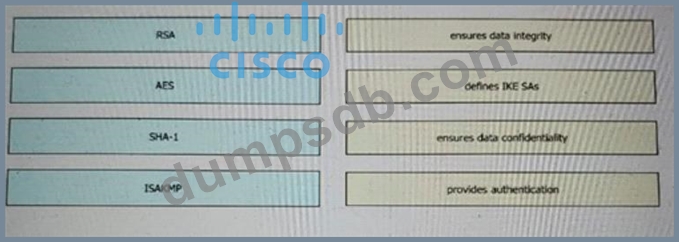
Drag and drop the VPN functions from the left onto the description on the right.
Correct Answer:
Question 60
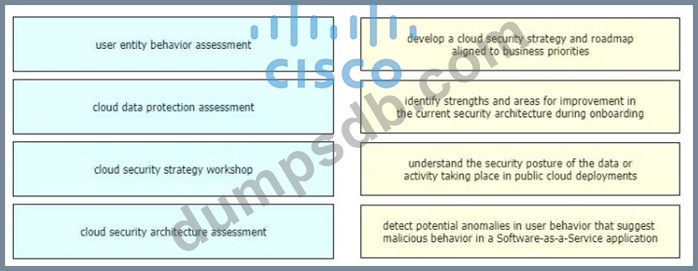
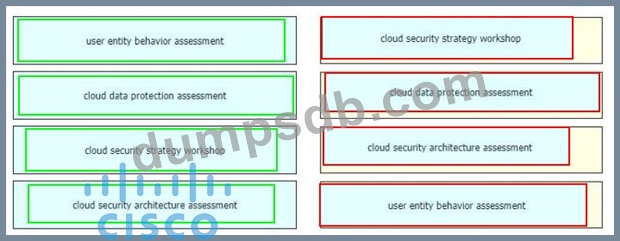
Drag and drop the cloud security assessment components from the left onto the definitions on the right.