Which protocol provides the strongest throughput performance when using Cisco AnyConnect VPN?
Correct Answer: A
Question 22
An organization wants to provide visibility and to identify active threats in its network using a VM. The organization wants to extract metadata from network packet flow while ensuring that payloads are not retained or transferred outside the network Which solution meets these requirements?
Correct Answer: A
Question 23
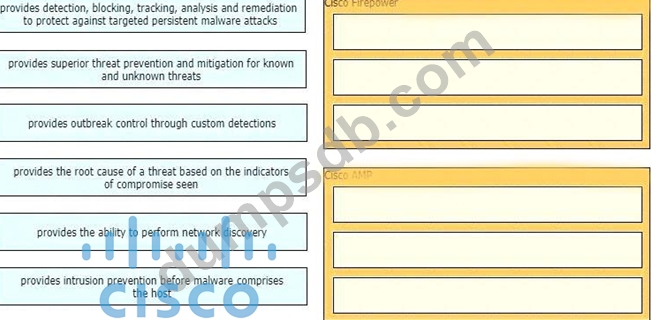
Drag and drop the capabilities of Cisco Firepower versus Cisco AMP from the left into the appropriate category on the right.
Which method is used to deploy certificates and configure the supplicant on mobile devices to gain access to network resources?
Correct Answer: A
Explanation Explanation When supporting personal devices on a corporate network, you must protect network services and enterprise data by authenticating and authorizing users (employees, contractors, and guests) and their devices. Cisco ISE provides the tools you need to allow employees to securely use personal devices on a corporate network. Guests can add their personal devices to the network by running the native supplicant provisioning (Network Setup Assistant), or by adding their devices to the My Devices portal. Because native supplicant profiles are not available for all devices, users can use the My Devices portal to add these devices manually; or you can configure Bring Your Own Device (BYOD) rules to register these devices. Reference: https://www.cisco.com/c/en/us/td/docs/security/ise/2-4/admin_guide/b_ISE_admin_guide_24/ m_ise_devices_byod.html Explanation When supporting personal devices on a corporate network, you must protect network services and enterprise data by authenticating and authorizing users (employees, contractors, and guests) and their devices. Cisco ISE provides the tools you need to allow employees to securely use personal devices on a corporate network. Guests can add their personal devices to the network by running the native supplicant provisioning (Network Setup Assistant), or by adding their devices to the My Devices portal. Because native supplicant profiles are not available for all devices, users can use the My Devices portal to add these devices manually; or you can configure Bring Your Own Device (BYOD) rules to register these devices. Reference: Explanation Explanation When supporting personal devices on a corporate network, you must protect network services and enterprise data by authenticating and authorizing users (employees, contractors, and guests) and their devices. Cisco ISE provides the tools you need to allow employees to securely use personal devices on a corporate network. Guests can add their personal devices to the network by running the native supplicant provisioning (Network Setup Assistant), or by adding their devices to the My Devices portal. Because native supplicant profiles are not available for all devices, users can use the My Devices portal to add these devices manually; or you can configure Bring Your Own Device (BYOD) rules to register these devices. Reference: https://www.cisco.com/c/en/us/td/docs/security/ise/2-4/admin_guide/b_ISE_admin_guide_24/ m_ise_devices_byod.html
Question 25
An administrator is trying to determine which applications are being used in the network but does not want the network devices to send metadata to Cisco Firepower. Which feature should be used to accomplish this?
Correct Answer: C
NetFlow is a network protocol developed by Cisco for the collection and monitoring of network traffic flow data generated by NetFlow-enabled routers and switches. The flows do not contain actual packet data, but rather the metadata for communications. It is a standard form of session data that details who, what, when, and where of network traffic -> Answer A is not correct. Reference: https://www.cisco.com/c/en/us/solutions/collateral/enterprise-networks/enterprise-network-security/ white-paper-c11-736595.html generated by NetFlow-enabled routers and switches. The flows do not contain actual packet data, but rather the metadata for communications. It is a standard form of session data that details who, what, when, and where of network traffic -> Answer A is not correct. Reference: NetFlow is a network protocol developed by Cisco for the collection and monitoring of network traffic flow data generated by NetFlow-enabled routers and switches. The flows do not contain actual packet data, but rather the metadata for communications. It is a standard form of session data that details who, what, when, and where of network traffic -> Answer A is not correct. Reference: https://www.cisco.com/c/en/us/solutions/collateral/enterprise-networks/enterprise-network-security/ white-paper-c11-736595.html