What is the result of running the crypto isakmp key ciscXXXXXXXX address 172.16.0.0 command?.
Correct Answer: A
Question 397
Which two features of Cisco Email Security can protect your organization against email threats? (Choose two)
Correct Answer: B,D
Explanation : Protect sensitive content in outgoing emails with Data Loss Prevention (DLP) and easy-to-use email encryption, all in one solution. Cisco Email Security appliance can now handle incoming mail connections and incoming messages from specific geolocations and perform appropriate actions on them, for example: - Prevent email threats coming from specific geographic regions. - Allow or disallow emails coming from specific geographic regions. Reference: https://www.cisco.com/c/en/us/td/docs/security/esa/esa11-0/user_guide_fs/ b_ESA_Admin_Guide_11_0/b_ESA_Admin_Guide_chapter_00.html Protect sensitive content in outgoing emails with Data Loss Prevention (DLP) and easy-to-use email encryption, all in one solution. Cisco Email Security appliance can now handle incoming mail connections and incoming messages from specific geolocations and perform appropriate actions on them, for example: - Prevent email threats coming from specific geographic regions. - Allow or disallow emails coming from specific geographic regions. Reference: Explanation : Protect sensitive content in outgoing emails with Data Loss Prevention (DLP) and easy-to-use email encryption, all in one solution. Cisco Email Security appliance can now handle incoming mail connections and incoming messages from specific geolocations and perform appropriate actions on them, for example: - Prevent email threats coming from specific geographic regions. - Allow or disallow emails coming from specific geographic regions. Reference: https://www.cisco.com/c/en/us/td/docs/security/esa/esa11-0/user_guide_fs/ b_ESA_Admin_Guide_11_0/b_ESA_Admin_Guide_chapter_00.html
Question 398
A Cisco ESA network administrator has been tasked to use a newly installed service to help create policy based on the reputation verdict. During testing, it is discovered that the Cisco ESA is not dropping files that have an undetermined verdict. What is causing this issue?
Correct Answer: D
Maybe the "newly installed service" in this question mentions about Advanced Malware Protection (AMP) which can be used along with ESA. AMP allows superior protection across the attack continuum. + File Reputation - captures a fingerprint of each file as it traverses the ESA and sends it to AMP's cloudbased intelligence network for a reputation verdict. Given these results, you can automatically block malicious files and apply administrator-defined policy. + File Analysis - provides the ability to analyze unknown files that are traversing the ESA. A highly secure sandbox environment enables AMP to glean precise details about the file's behavior and to combine that data with detailed human and machine analysis to determine the file's threat level. This disposition is then fed into AMP cloud-based intelligence network and used to dynamically update and expand the AMP cloud data set for enhanced protection
Question 399
What are two benefits of Flexible NetFlow records? (Choose two)
Correct Answer: A,C
NetFlow is typically used for several key customer applications, including the following: ... Billing and accounting. NetFlow data provides fine-grained metering (for instance, flow data includes details such as IP addresses, packet and byte counts, time stamps, type of service (ToS), and application ports) for highly flexible and detailed resource utilization accounting. Service providers may use the information for billing based on time of day, bandwidth usage, application usage, quality of service, and so on. Enterprise customers may use the information for departmental charge back or cost allocation for resource utilization. NetFlow is typically used for several key customer applications, including the following: ... Billing and accounting. NetFlow data provides fine-grained metering (for instance, flow data includes details such as IP addresses, packet and byte counts, time stamps, type of service (ToS), and application ports) for highly flexible and detailed resource utilization accounting. Service providers may use the information for billing based on time of day, bandwidth usage, application usage, quality of service, and so on. Enterprise customers may use the information for departmental charge back or cost allocation for resource utilization. NetFlow is typically used for several key customer applications, including the following: ... Billing and accounting. NetFlow data provides fine-grained metering (for instance, flow data includes details such as IP addresses, packet and byte counts, time stamps, type of service (ToS), and application ports) for highly flexible and detailed resource utilization accounting. Service providers may use the information for billing based on time of day, bandwidth usage, application usage, quality of service, and so on. Enterprise customers may use the information for departmental charge back or cost allocation for resource utilization. Reference: If the predefined Flexible NetFlow records are not suitable for your traffic requirements, you can create a userdefined (custom) record using the Flexible NetFlow collect and match commands. Before you can create a customized record, you must decide the criteria that you are going to use for the key and nonkey fields. cust_fnflow_rec_mon_external_docbase_0900e4b18055d0d2_4container_external_docbase_0900e4b181b413 d9.html#wp1057997 Note: Traditional NetFlow allows us to monitor from Layer 2 to 4 but Flexible NetFlow goes beyond these layers. If the predefined Flexible NetFlow records are not suitable for your traffic requirements, you can create a userdefined (custom) record using the Flexible NetFlow collect and match commands. Before you can create a customized record, you must decide the criteria that you are going to use for the key and nonkey fields. cust_fnflow_rec_mon_external_docbase_0900e4b18055d0d2_4container_external_docbase_0900e4b181b413 d9.html#wp1057997 Note: Traditional NetFlow allows us to monitor from Layer 2 to 4 but Flexible NetFlow goes beyond these If the predefined Flexible NetFlow records are not suitable for your traffic requirements, you can create a userdefined (custom) record using the Flexible NetFlow collect and match commands. Before you can create a customized record, you must decide the criteria that you are going to use for the key and nonkey fields. cust_fnflow_rec_mon_external_docbase_0900e4b18055d0d2_4container_external_docbase_0900e4b181b413 d9.html#wp1057997 Note: Traditional NetFlow allows us to monitor from Layer 2 to 4 but Flexible NetFlow goes beyond these layers.
Question 400
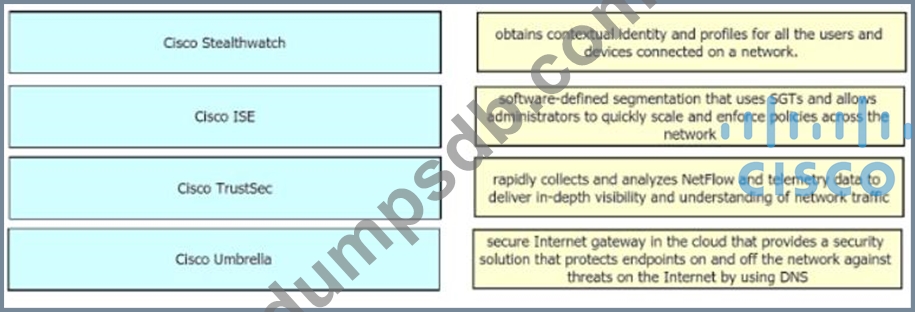
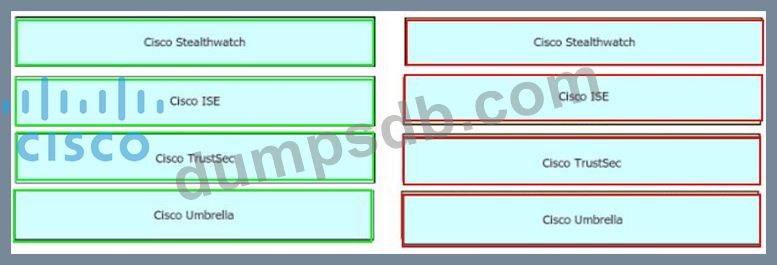
Drag and drop the solutions from the left onto the solution's benefits on the right.