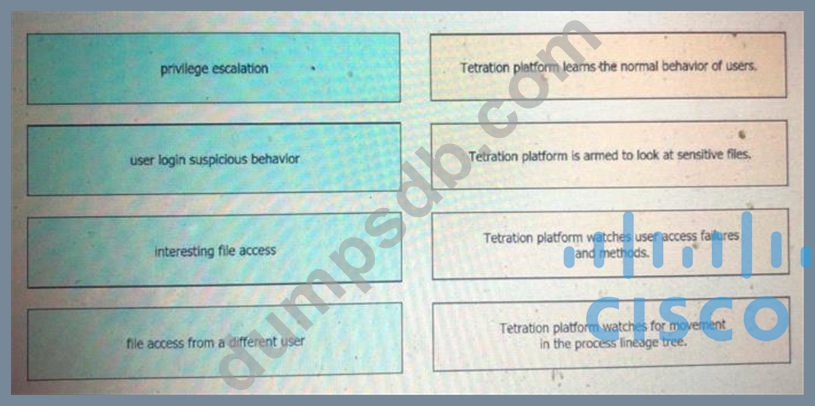
Drag and drop the suspicious patterns for the Cisco Tetration platform from the left onto the correct definitions on the right.
Correct Answer:
Question 457
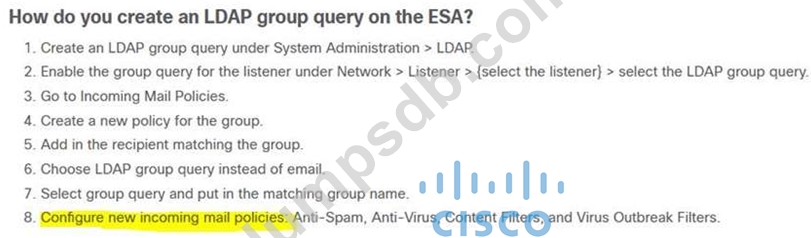
An engineer has enabled LDAP accept queries on a listener. Malicious actors must be prevented from quickly identifying all valid recipients. What must be done on the Cisco ESA to accomplish this goal?
Correct Answer: D
Question 458
What are two benefits of Flexible NetFlow records? (Choose two)
Correct Answer: A,C
Explanation Explanation NetFlow is typically used for several key customer applications, including the following: ... Billing and accounting. NetFlow data provides fine-grained metering (for instance, flow data includes details such as IP addresses, packet and byte counts, time stamps, type of service (ToS), and application ports) for highly flexible and detailed resource utilization accounting. Service providers may use the information for billing based on time of day, bandwidth usage, application usage, quality of service, and so on. Enterprise customers may use the information for departmental charge back or cost allocation for resource utilization. Reference: https://www.cisco.com/c/en/us/td/docs/ios-xml/ios/fnetflow/configuration/15-mt/fnf-15-mt-book/fnffnetflow.html If the predefined Flexible NetFlow records are not suitable for your traffic requirements, you can create a userdefined (custom) record using the Flexible NetFlow collect and match commands. Before you can create a customized record, you must decide the criteria that you are going to use for the key and nonkey fields. Reference: https://www.cisco.com/en/US/docs/ios/fnetflow/configuration/guide/ cust_fnflow_rec_mon_external_docbase_0900e4b18055d0d2_4container_external_docbase_0900e4b181b413 d9.html#wp1057997 Note: Traditional NetFlow allows us to monitor from Layer 2 to 4 but Flexible NetFlow goes beyond these layers. Explanation NetFlow is typically used for several key customer applications, including the following: ... Billing and accounting. NetFlow data provides fine-grained metering (for instance, flow data includes details such as IP addresses, packet and byte counts, time stamps, type of service (ToS), and application ports) for highly flexible and detailed resource utilization accounting. Service providers may use the information for billing based on time of day, bandwidth usage, application usage, quality of service, and so on. Enterprise customers may use the information for departmental charge back or cost allocation for resource utilization. Reference: If the predefined Flexible NetFlow records are not suitable for your traffic requirements, you can create a userdefined (custom) record using the Flexible NetFlow collect and match commands. Before you can create a customized record, you must decide the criteria that you are going to use for the key and nonkey fields. cust_fnflow_rec_mon_external_docbase_0900e4b18055d0d2_4container_external_docbase_0900e4b181b413 d9.html#wp1057997 Note: Traditional NetFlow allows us to monitor from Layer 2 to 4 but Flexible NetFlow goes beyond these Explanation Explanation NetFlow is typically used for several key customer applications, including the following: ... Billing and accounting. NetFlow data provides fine-grained metering (for instance, flow data includes details such as IP addresses, packet and byte counts, time stamps, type of service (ToS), and application ports) for highly flexible and detailed resource utilization accounting. Service providers may use the information for billing based on time of day, bandwidth usage, application usage, quality of service, and so on. Enterprise customers may use the information for departmental charge back or cost allocation for resource utilization. Reference: https://www.cisco.com/c/en/us/td/docs/ios-xml/ios/fnetflow/configuration/15-mt/fnf-15-mt-book/fnffnetflow.html If the predefined Flexible NetFlow records are not suitable for your traffic requirements, you can create a userdefined (custom) record using the Flexible NetFlow collect and match commands. Before you can create a customized record, you must decide the criteria that you are going to use for the key and nonkey fields. Reference: https://www.cisco.com/en/US/docs/ios/fnetflow/configuration/guide/ cust_fnflow_rec_mon_external_docbase_0900e4b18055d0d2_4container_external_docbase_0900e4b181b413 d9.html#wp1057997 Note: Traditional NetFlow allows us to monitor from Layer 2 to 4 but Flexible NetFlow goes beyond these layers.
Question 459
Refer to the exhibit. What does the number 15 represent in this configuration?
Correct Answer: A
Question 460
What is a commonality between DMVPN and FlexVPN technologies?
Correct Answer: D
Explanation In its essence, FlexVPN is the same as DMVPN. Connections between devices are still point-to-point GRE tunnels, spoke-to-spoke connectivity is still achieved with NHRP redirect message, IOS routers even run the same NHRP code for both DMVPN and FlexVPN, which also means that both are Cisco's proprietary technologies. Reference: https://packetpushers.net/cisco-flexvpn-dmvpn-high-level-design/ In its essence, FlexVPN is the same as DMVPN. Connections between devices are still point-to-point GRE tunnels, spoke-to-spoke connectivity is still achieved with NHRP redirect message, IOS routers even run the same NHRP code for both DMVPN and FlexVPN, which also means that both are Cisco's proprietary technologies. Explanation In its essence, FlexVPN is the same as DMVPN. Connections between devices are still point-to-point GRE tunnels, spoke-to-spoke connectivity is still achieved with NHRP redirect message, IOS routers even run the same NHRP code for both DMVPN and FlexVPN, which also means that both are Cisco's proprietary technologies. Reference: https://packetpushers.net/cisco-flexvpn-dmvpn-high-level-design/