An organization has noticed an increase in malicious content downloads and wants to use Cisco Umbrella to prevent this activity for suspicious domains while allowing normal web traffic. Which action will accomplish this task?
Correct Answer: B
Obviously, if you allow all traffic to these risky domains, users might access malicious content, resulting in an infection or data leak. But if you block traffic, you can expect false positives, an increase in support inquiries, and thus, more headaches. By only proxying risky domains, the intelligent proxy delivers more granular visibility and control. The intelligent proxy bridges the gap by allowing access to most known good sites without being proxied and only proxying those that pose a potential risk. The proxy then filters and blocks against specific URLs hosting malware while allowing access to everything else. Reference: https://docs.umbrella.com/deployment-umbrella/docs/what-is-the-intelligent-proxy The intelligent proxy bridges the gap by allowing access to most known good sites without being proxied and only proxying those that pose a potential risk. The proxy then filters and blocks against specific URLs hosting malware while allowing access to everything else. Obviously, if you allow all traffic to these risky domains, users might access malicious content, resulting in an infection or data leak. But if you block traffic, you can expect false positives, an increase in support inquiries, and thus, more headaches. By only proxying risky domains, the intelligent proxy delivers more granular visibility and control. The intelligent proxy bridges the gap by allowing access to most known good sites without being proxied and only proxying those that pose a potential risk. The proxy then filters and blocks against specific URLs hosting malware while allowing access to everything else. Reference: https://docs.umbrella.com/deployment-umbrella/docs/what-is-the-intelligent-proxy
Question 682
An engineer migrates a web server to the cloud in a platform as a service model. Which security measure must be implemented next to protect the resources?
Correct Answer: A
In a Platform as a Service (PaaS) model, the cloud provider manages the underlying infrastructure and operating system, including physical security and OS patching. The customer's responsibility lies in securing the application and data layers. Since the application is exposed on the web, Intrusion Prevention System (IPS) scanning helps detect and block malicious traffic and exploits targeting application vulnerabilities. This is a crucial security measure in the shared responsibility model for PaaS environments.
Question 683
An engineer is trying to decide between using L2TP or GRE over IPsec for their site-to-site VPN implementation. What must be un solution?
Correct Answer: C
L2TP and GRE are both tunneling protocols that can be used to create site-to-site VPNs. However, they have some differences in how they encapsulate and transport data. L2TP is a layer 2 protocol that uses IP packet encapsulation to carry PPP frames over an IP network. L2TP does not add any additional header to the IP packet, but relies on IPsec to provide encryption and authentication. GRE is a layer 3 protocol that adds its own header to the IP packet, which contains information such as the protocol type, checksum, and key. GRE can be used to carry any type of payload over an IP network, not just PPP frames. GRE also requires IPsec to provide security for the tunnel. Therefore, the correct answer is C, because GRE over IPsec adds its own header, and L2TP does not1234 References := 1: Implementing and Operating Cisco Security Core Technologies (SCOR) v1.0 - Module 5: Secure Connectivity 2: What is the difference between L2TP vs GRE 3: GRE over IPSec vs L2TP over IPSEC 4: difference between L2TP/GRE/MPLS
Question 684
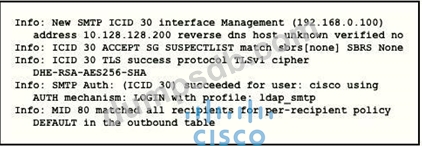
Refer to the exhibit. Which type of authentication is in use?
Correct Answer: D
Question 685
Which two components do southbound APIs use to communicate with downstream devices? (Choose two.)
Correct Answer: B,E
Southbound APIs are used to communicate between the SDN Controller and the switches and routers of the network. They can be open-source or proprietary. They facilitate control over the network and enable the SDN Controller to dynamically make changes according to real-time demands and needs. OpenFlow and OpFlex are two examples of southbound APIs. OpenFlow, which was developed by the Open Networking Foundation (ONF), is the first and probably most well-known southbound interface. OpenFlow defines the way the SDN Controller should interact with the forwarding plane to make adjustments to the network, so it can better adapt to changing business requirements. With OpenFlow, entries can be added and removed to the internal flow-table of switches and routers to make the network more responsive to real-time traffic demands. OpFlex, which was proposed by Cisco, is another southbound interface that uses a declarative model to communicate policies and state between the controller and the network devices. OpFlex allows the network devices to retain some intelligence and autonomy, while still being managed by the controller. OpFlex is designed to be flexible and extensible, and can support different types of network devices and services. Services running over the network, external application APIs, and applications running over the network are not southbound APIs, as they do not directly communicate between the controller and the network devices. Therefore, the correct answer is B and E. References := Some possible references are: * What are SDN Southbound APIs? - Where they are used. - SDxCentral * SDN North-bound and South-bound APIs and Interfaces * Cisco Application Centric Infrastructure Fundamentals