Latest 350-701 Exam Premium Dumps provide by TrainingQuiz.com to help you Passing 350-701 Exam! TrainingQuiz.com offers the updated 350-701 exam dumps, the TrainingQuiz.com 350-701 exam questions has been updated to correct Answer. Get the latest TrainingQuiz.com 350-701 pdf dumps with Exam Engine here:
(964 Q&As Dumps, 40%OFF Special Discount: DumpsDB)
An engineer must monitor the behavior of devices on an on-premises network and send the data to the Cisco Secure Cloud Analytics platform for analysis. The engineer will perform this task on a virtual machine. What must be configured next?
Correct Answer: D
To monitor on-premises network behavior and send data to Cisco Secure Cloud Analytics (formerly Stealthwatch Cloud), you need to configure a Cloud PNM (Private Network Monitoring) sensor. This sensor is deployed on a virtual machine within the on-premises network and is responsible for collecting and sending network traffic data (such as NetFlow, IPFIX, or other telemetry) to the Secure Cloud Analytics platform for analysis.
Question 18
What is the function of SDN southbound API protocols?
Correct Answer: A
Reference:
Question 19
Which technology should be used to help prevent an attacker from stealing usernames and passwords of users within an organization?
Correct Answer: D
Multifactor authentication (MFA) is an authentication method that requires the user to provide two or more verification factors to gain access to a resource such as an application, online account, or a VPN1. MFA is a core component of a strong identity and access management (IAM) policy. MFA can help prevent an attacker from stealing usernames and passwords of users within an organization by adding an extra layer of security beyond the traditional username and password. For example, a user may need to enter a one-time code sent to their phone or email, scan their fingerprint, or use a hardware token to prove their identity. This way, even if an attacker obtains the user's credentials, they cannot access the resource without the second factor2. The other options are not technologies that can help prevent an attacker from stealing usernames and passwords of users within an organization. RADIUS-based REAP is a protocol that allows wireless clients to authenticate with a RADIUS server, but it does not provide MFA3. Fingerprinting is a technique that identifies the operating system or application of a device based on its network characteristics, but it does not provide MFA4. Dynamic ARP Inspection is a security feature that prevents ARP spoofing attacks by validating ARP packets, but it does not provide MFA5. References := 1: What is Multi-Factor Authentication (MFA)? | OneLogin(https://www.onelogin.com/learn /what-is-mfa) 2: What is: Multifactor Authentication - Microsoft Support(https://support.microsoft.com/en-us /topic/what-is-multifactor-authentication-e5e39437-121c-be60-d123-eda06bddf661) 3: Implementing and Operating Cisco Security Core Technologies (SCOR) v1.0, Module 3: Securing the Network, Lesson 3.3: Secure Wireless Connectivity, Topic 3.3.1: Wireless Security Protocols, page 3-40. 4: Implementing and Operating Cisco Security Core Technologies (SCOR) v1.0, Module 2: Securing the Cloud, Lesson 2.2: Cloud Security Assessment, Topic 2.2.1: Cloud Security Concepts, page 2-13. 5: Implementing and Operating Cisco Security Core Technologies (SCOR) v1.0, Module 3: Securing the Network, Lesson 3.2: Secure Network Access, Topic 3.2.2: Layer 2 Security Features, page 3-19.
Question 20
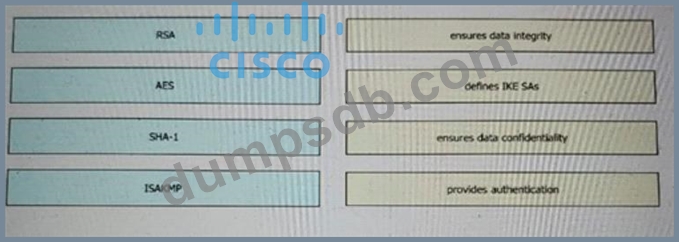
Drag and drop the VPN functions from the left onto the description on the right.