What are two advantages of using Cisco Any connect over DMVPN? (Choose two)
Correct Answer: C,E
Cisco AnyConnect is a client-based VPN solution that provides secure remote access for individual users from their machines. It allows customization of access policies based on user identity, such as group membership, device posture, or location. This enables granular control over who can access what resources on the network. Cisco AnyConnect also supports various authentication methods, such as certificates, multifactor authentication, or single sign-on. Cisco AnyConnect can be deployed with Cisco Adaptive Security Appliance (ASA) or Cisco Firepower Threat Defense (FTD) as the VPN headend. Cisco DMVPN is a network-based VPN solution that provides dynamic, on-demand, and scalable connectivity for branch offices, teleworkers, and business partners. It uses multipoint GRE (mGRE) tunnels and Next Hop Resolution Protocol (NHRP) to establish direct spoke-to-spoke communications without traversing the hub. It also supports IPsec encryption and various routing protocols over the tunnel. Cisco DMVPN can be deployed with Cisco IOS routers as the VPN headend. The advantages of using Cisco AnyConnect over DMVPN are: * It enables VPN access for individual users from their machines, which is useful for mobile workers or telecommuters who need to connect to the network from anywhere. * It allows customization of access policies based on user identity, which is useful for enforcing security and compliance requirements for different types of users or devices. The advantages of using DMVPN over Cisco AnyConnect are: * It provides spoke-to-spoke communications without traversing the hub, which reduces latency and bandwidth consumption for traffic between remote sites. * It allows different routing protocols to work over the tunnel, which provides flexibility and scalability for network design and management. References: * Cisco Dynamic Multipoint VPN: Simple and Secure Branch-to-Branch Communications Data Sheet * [Cisco AnyConnect Secure Mobility Client Data Sheet] * Cisco Get VPN vs DMVPN: Difference and Comparison * Comparing Cisco SD-WAN to DMVPN * What are two advantages of using Cisco AnyConnect over DMVPN?
Question 332
What is the difference between a vulnerability and an exploit?
Correct Answer: A
Question 333
What is a difference between out-of-band SQL injection attacks and bind SQL injection attacks?
Correct Answer: A
Out-of-band SQL injection retrieves data through an external channel, such as DNS or HTTP callbacks, which allows the attacker to extract information even when the primary application channel does not return results directly. Blind SQL injection cannot return data directly; instead, an attacker infers database structure and content by observing how the application behaves in response to crafted inputs.
Question 334
When a Cisco WSA checks a web request, what occurs if it is unable to match a user-defined policy?
Correct Answer: A
Question 335
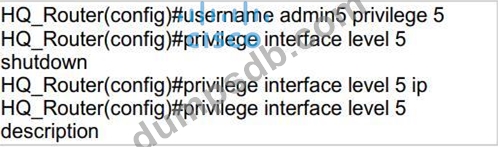
Refer to the exhibit. A network administrator configures command authorization for the admin5 user. What is the admin5 user able to do on HQ_Router after this configuration?
Correct Answer: B
The user "admin5" was configured with privilege level 5. In order to allow configuration (enter global configuration mode), we must type this command: (config)#privilege exec level 5 configure terminal Without this command, this user cannot do any configuration. Note: Cisco IOS supports privilege levels from 0 to 15, but the privilege levels which are used by default are privilege level 1 (user EXEC) and level privilege 15 (privilege EXEC)