What are two ways a network administrator transparently identifies users using Active Directory on the Cisco WSA? (Choose two.)
Correct Answer: B,C
A network administrator can transparently identify users using Active Directory on the Cisco WSA in two ways: * Create NTLM or Kerberos authentication realm and enable transparent user identification. This option allows the WSA to use the NTLM or Kerberos protocol to authenticate users without prompting them for credentials. The WSA must join the Active Directory domain and have a valid service principal name (SPN) for this option to work1. * Deploy a separate Active Directory agent such as Cisco Context Directory Agent (CDA). This option allows the WSA to receive user-to-IP mappings from the CDA, which monitors the Active Directory domain controllers for user logon events. The CDA must be installed on a Windows server and have access to the domain controllers and the WSA2. The other options are not ways to transparently identify users using Active Directory on the Cisco WSA. Creating an LDAP authentication realm and disabling transparent user identification will require users to enter their credentials manually. Installing the eDirectory client on each client workstation or deploying a separate eDirectory server are not related to Active Directory, but to Novell eDirectory, which is a different directory service3. References := 1: User Guide for AsyncOS 11.0 for Cisco Web Security Appliances, Chapter: Acquire End-User Credentials, Topic: Active Directory/Kerberos, page 4-3. 2: User Guide for AsyncOS 11.0 for Cisco Web Security Appliances, Chapter: Acquire End-User Credentials, Topic: Active Directory Agent, page 4-5. 3: User Guide for AsyncOS 11.0 for Cisco Web Security Appliances, Chapter: Acquire End-User Credentials, Topic: eDirectory, page 4-8.
Question 488
An administrator is configuring a DHCP server to better secure their environment. They need to be able to ratelimit the traffic and ensure that legitimate requests are not dropped. How would this be accomplished?
Correct Answer: A
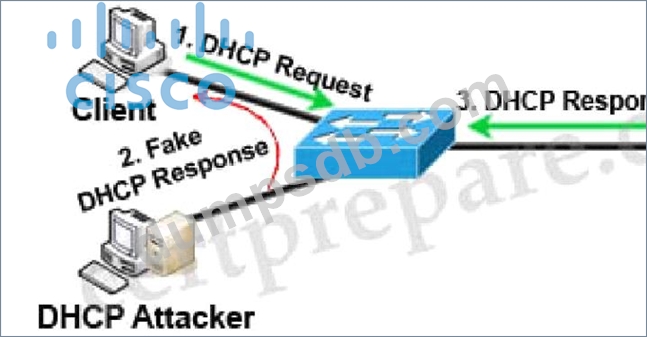
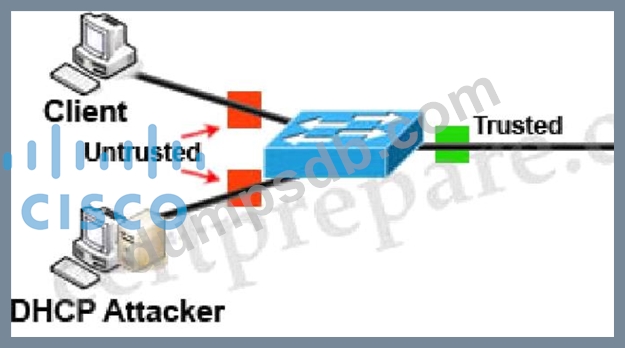
To understand DHCP snooping we need to learn about DHCP spoofing attack first. DHCP spoofing is a type of attack in that the attacker listens for DHCP Requests from clients and answers them with fake DHCP Response before the authorized DHCP Response comes to the clients. The fake DHCP Response often gives its IP address as the client default gateway -> all the traffic sent from the client will go through the attacker computer, the attacker becomes a "man-in-the-middle". The attacker can have some ways to make sure its fake DHCP Response arrives first. In fact, if the attacker is "closer" than the DHCP Server then he doesn't need to do anything. Or he can DoS the DHCP Server so that it can't send the DHCP Response. DHCP snooping can prevent DHCP spoofing attacks. DHCP snooping is a Cisco Catalyst feature that determines which switch ports can respond to DHCP requests. Ports are identified as trusted and untrusted. Only ports that connect to an authorized DHCP server are trusted, and allowed to send all types of DHCP messages. All other ports on the switch are untrusted and can send only DHCP requests. If a DHCP response is seen on an untrusted port, the port is shut down.
Question 489
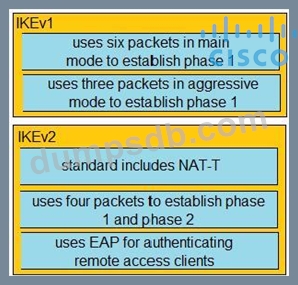
Drag and drop the descriptions from the left onto the correct protocol versions on the right.
Correct Answer:
Explanation
Question 490
Which exfiltration method does an attacker use to hide and encode data inside DNS requests and queries?
Correct Answer: A
Explanation DNS Tunneling is a method of cyber attack that encodes the data of other programs or protocols in DNS queries and responses. DNS tunneling often includes data payloads that can be added to an attacked DNS server and used to control a remote server and applications.