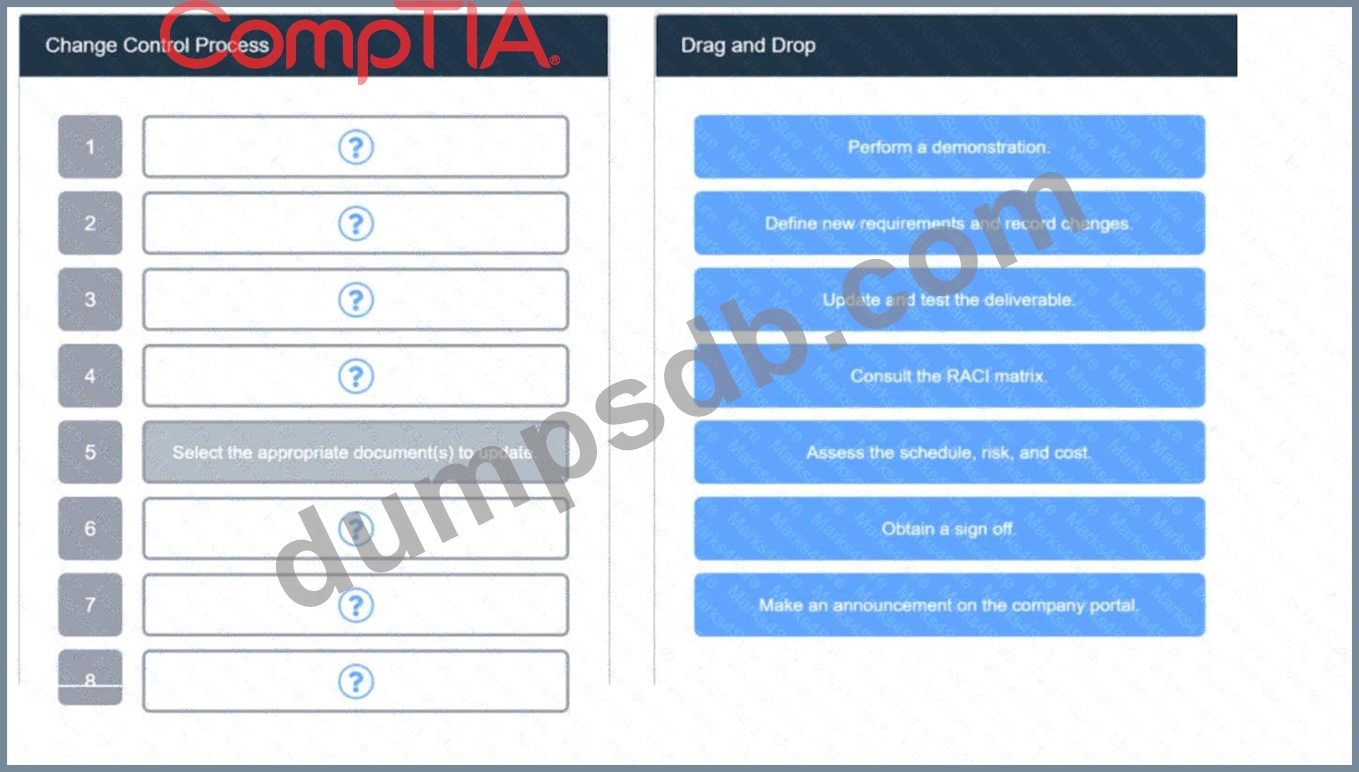
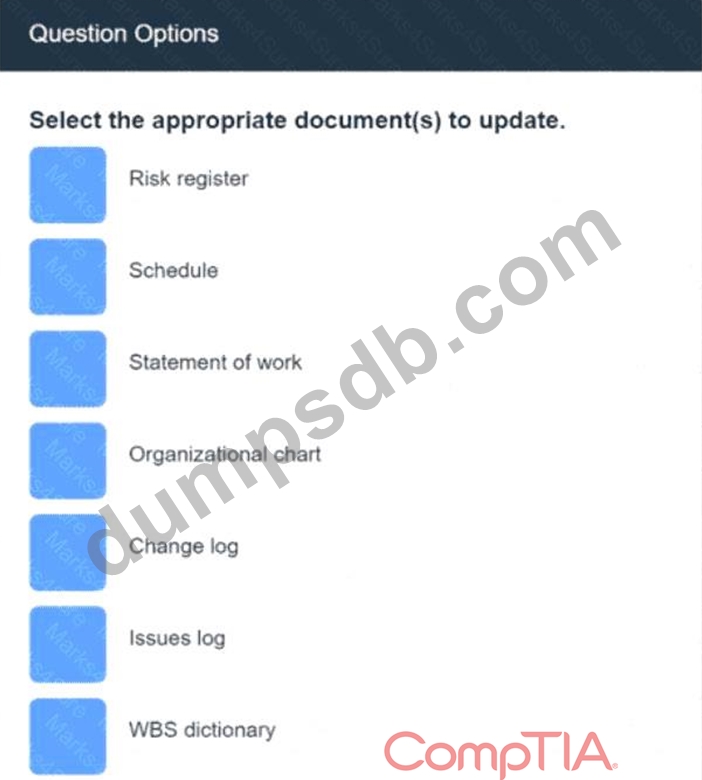
During a gate review meeting, the deliverable was rejected by the customer. INSTRUCTIONS Review the dashboard. * Part 1: Drag and drop each task, placing them in the correct order based on the project change control process. * Part 2: Select the proper document(s) to be updated. If at any time you would like to bring back the initial state of the simulation, please click the Reset All button. Part 1: Part 2:
Correct Answer:
See the Explanation for the solution. Explanation: Part 1: Change Control Process: Consult the RACI matrix. Define new requirements and record changes. Assess the schedule, risk, and cost. Perform a demonstration. Obtain a sign off. Update and test the deliverable. Make an announcement on the company portal. The change control process is a sequence of steps that helps to manage and document any changes or modifications to a project scope, schedule, cost, quality, or resources. The change control process typically involves the following steps: Consult the RACI matrix. A RACI matrix is a tool that defines and clarifies the roles and responsibilities of each team member for each task or activity in a project. RACI stands for responsible, accountable, consulted, and informed. Consulting the RACI matrix can help to identify who needs to be involved or informed about the change request and how to communicate with them. Define new requirements and record changes. The new requirements and changes are the details of what needs to be modified or added to the project deliverables or objectives based on the customer feedback or request. Defining and recording the new requirements and changes can help to communicate and justify the need and rationale for the change and its implications on the project scope and quality. Assess the schedule, risk, and cost. The schedule, risk, and cost are the aspects of the project that may be affected by the change request. Assessing the schedule, risk, and cost can help to determine the impact and feasibility of the change and identify any possible alternatives or corrective actions to minimize or avoid its negative effects. Perform a demonstration. A demonstration is a presentation or show of how the modified or updated deliverable works or meets the customer expectations or requirements. Performing a demonstration can help to validate and verify that the change request has been implemented correctly and effectively and to obtain feedback or approval from the customer or stakeholders. Obtain a sign off. A sign off is a formal acceptance and approval of the change request and its deliverables from the customer or stakeholders. Obtaining a sign off can help to confirm that the change request has been completed successfully and satisfactorily and to close the change control process. Update and test the deliverable. The deliverable is the product or service that is produced or provided by the project. Updating and testing the deliverable can help to ensure that it meets the quality standards and criteria and that it works as expected after implementing the change request. Make an announcement on the company portal. The company portal is a platform or channel that allows internal communication and collaboration among employees within an organization. Making an announcement on the company portal can help to inform and update other team members or departments about the change request and its outcomes and to share any lessons learned or best practices from the change control process. Part2: Risk register: A risk register is a document that identifies, analyzes, and records the potential risks or uncertainties that may affect a project. Updating the risk register can help to capture any new or modified risks that may arise from the change request and to plan and implement appropriate risk responses. Schedule: A schedule is a document that shows the planned start and end dates, durations, dependencies, and progress of each task or activity in a project. Updating the schedule can help to reflect any changes or adjustments to the project timeline or milestones that may result from the change request and to monitor and control the project performance and delivery. Statement of work: A statement of work (SOW) is a document that defines the scope, deliverables, schedule, and terms and conditions of a project or contract. Updating the SOW can help to document any changes or additions to the project scope or deliverables that may be requested or agreed upon by the customer or stakeholders and to ensure alignment and agreement on what needs to be done and how it will be done. Change log: A change log is a document that tracks and records any changes or modifications that are made to the project scope, schedule, cost, quality, or resources during a project. Updating the change log can help to document the change request, approval, implementation, and impact of each change and ensure traceability and transparency.
Question 2
One of the key steps in controlling changes lo software is obtaining approval. Which of the following statements best describes the reason for this key objective?
Correct Answer: B
Obtaining approval for changes to software is crucial to ensure that the changes do not negatively impact other functionalities of the software. Approval processes typically involve a review that assesses the potential impacts of the change, which helps in mitigating risks associated with the change. References = The answer is based on standard project management practices and the typical use of change control processes in software development. For detailed information, please refer to the CompTIA Project+ Study Guide and other official CompTIA resources.
Question 3
Which of the following software programs would be BEST to use lo store information related to business transactions?
Correct Answer: B
Customer relationship management (CRM) software would be the best to use to store information related to business transactions. CRM software is a type of software that helps businesses manage their interactions and relationships with current and potential customers. CRM software can store and organize information such as customer contact details, purchase history, preferences, feedback, complaints, etc. CRM software can help businesses improve customer service, satisfaction, loyalty, retention, and revenue1
Question 4
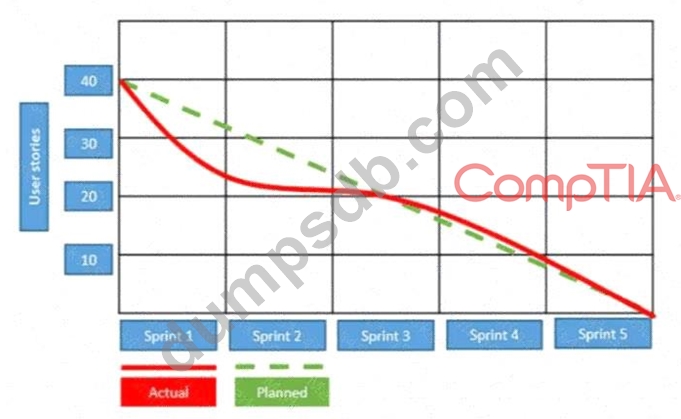
A project manager is reviewing sprint performance in a retrospective meeting. Given the following chart, which of the following sprints shows the highest velocity?
Correct Answer: A
Sprint 1 shows the highest velocity because velocity measures the amount of work completed during a sprint. In a burndown chart, this is shown by how much the actual remaining work decreases from the beginning to the end of the sprint. The red actual line drops most sharply during Sprint 1, moving from about 40 user stories to the mid-20s. This indicates the team completed the largest number of user stories during that sprint compared with the other sprints. Sprint 2 and Sprint 3 show smaller decreases, meaning lower completed work. Sprint 4 and Sprint 5 also show progress, but their reductions are not as large as Sprint 1. Therefore, Sprint 1 reflects the highest team velocity.
Question 5
An IT intern was assigned to set up workstations as part of a project. The IT intern was very careful to do the task well and initially referred to notes while performing the task. By the end of the two-week rotation, the IT intern no longer needed the notes and completed more set-ups in less time. Which of the following MOST likely represents the observed relationship in this scenario?
Correct Answer: C
Option C shows a graph that most likely represents the observed relationship in this scenario. The graph shows a learning curve, which is a graphical representation of the relationshipbetween a learner's performance on a task and the number of attempts or time required to complete the task. The learning curve theory proposes that a learner's efficiency in a task improves over time the more the learner performs the task. In this case, the IT intern was able to complete more set-ups in less time as they gained more experience and proficiency over the two-week rotation12