What is the purpose of the PrivateArk Database service?
Correct Answer: D
Explanation The purpose of the PrivateArk Database service is to maintain the Vault metadata, which includes the information about the Safes, accounts, policies, users, groups, and audit records that are stored in the Vault. The PrivateArk Database service is a Windows service that manages the database files that contain the Vault data. The PrivateArk Database service is responsible for creating, updating, deleting, and backing up the database files, as well as performing encryption and compression operations on the data1. The PrivateArk Database service is installed automatically as part of the Vault server installation and can be configured using the DBParm.ini file2. The other options are not the purpose of the PrivateArk Database service, although they may be related to other services or components of the Vault. The PrivateArk Server service is the service that communicates with the components, such as the PVWA, the CPM, the PSM, and the PTA, and handles the requests from the clients and components3. The Event Notification Engine service is the service that sends email alerts from the Vault, based on predefined events and recipients4. The Central Policy Manager component is the component that executes password changes, verifications, and reconciliations for the accounts that are managed by the Vault. References: * Server Components - CyberArk, section "The PrivateArk Server process (Dbmain)" * DBParm.ini - CyberArk, section "Main parameters" * Server Components - CyberArk, section "The PrivateArk Server process (Dbmain)" * Event Notification Engine - CyberArk, section "Event Notification Engine" * [Change Passwords - CyberArk], section "Change Passwords"
Question 92
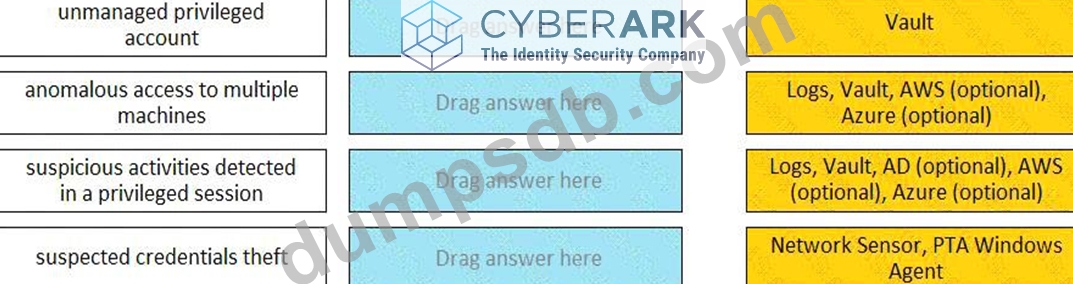
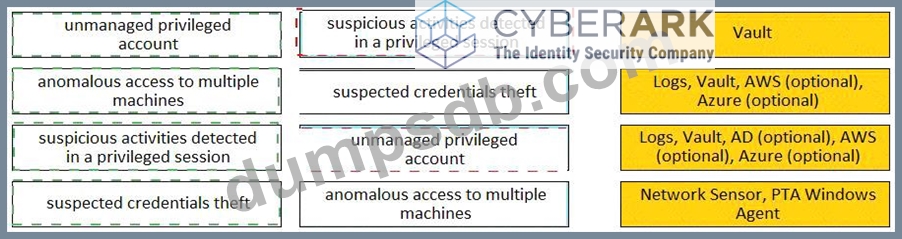
Match each PTA alert category with the PTA sensors that collect the data for it.
Correct Answer:
Question 93
In accordance with best practice, SSH access is denied for root accounts on UNIX/LINUX system. What is the BEST way to allow CPM to manage root accounts.
Correct Answer: D
Question 94
Select the best practice for storing the Master CD.
Correct Answer: C
Explanation The best practice for storing the Master CD is to store it in a secure location, such as a physical safe. The Master CD contains the server key, the public recovery key, and the private recovery key, which are essential for starting, operating, and recovering the Vault. These keys are sensitive and should be protected from unauthorized access, loss, or damage. Therefore, storing the CD in a physical safe ensures that the keys are kept in a secure location when not in use, and that they are available when needed. This is the recommended option by CyberArk1. The other options are not best practices and should be avoided, as they expose the keys to potential risks, such as theft, corruption, or deletion. Copying the files to the Vault server and discarding the CD is not secure, as it makes the keys accessible to anyone who can access the Vault server or compromise its security. Copying the contents of the CD to a Hardware Security Module (HSM) and discarding the CD is not feasible, as the HSM can only store the server key, not the recovery keys2. Storing the CD in a secure location, such as a physical safe, and copying the contents of the CD to a folder secured with NTFS permissions on the Vault is not necessary, as it creates redundant copies of the keys that may not be synchronized or updated. Moreover, NTFS permissions are not sufficient to protect the keys from malicious or accidental actions. References: * Server Keys - CyberArk, section "Server Keys" * Store the Server Key in an HSM - CyberArk, section "Store the Server Key in an HSM"
Question 95
What is required to enable access over SSH to a Unix account through both PSM and PSMP?