

Question 6
What is the recommended namespace path for the access zone on a new Isilon cluster with SyncIQ license?
Question 7
-- Exhibit --
A European Sports TV network is considering Isilon for their Media Edit Storage for their editing workloads.
They are also considering Isilon for near-line media archiving.
The network receives XDCAM HD footage which is loaded onto their existing Transcoding Storage platform. New footage that needs to be edited will be transferred from their Transcoding Storage platform to the proposed Media Edit Storage platform at the rate of ten simultaneous XDCAM HD files via FTP.
Edited files will be transferred back to the Transcoding Storage platform at the rate of ten simultaneous XDCAM HD files via FTP.
The network currently has 15 Final Cut Pro edit stations, 15 Avid edit stations. Proxy software will be used to allow Isilon to act as the storage for the Final Cut Pro and Avid media. Three of those edit stations will be performing content compositing as needed.
The network expects 70 hours of new content per week, and 50 hours of edited content per week. They intend to keep the new and edited content on the proposed Media Edit Storage as a performance tier for
30 days. They would like to retain all new and edited footage proposed Media Edit Storage as a near-line tier for two years.
In addition to the current workloads, the network expects to implement a new Media Asset Management (MAM) solution and has requested the Isilon cluster be capable of supporting 120 MBps read and 120 MBps write to support the MAM requirements.
-- Exhibit --
Refer to the exhibit.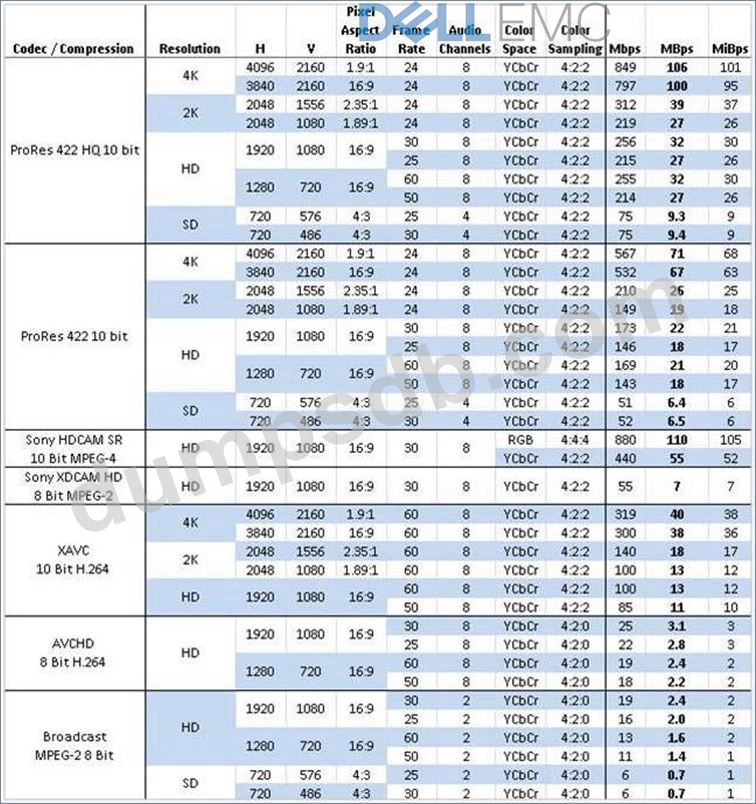
Based on the described use of the cluster, which node combination is the appropriate choice for the customer's requirements?
Question 8
An existing customer has two NAS systems providing NFS storage in their main datacenter - one is an Isilon cluster and the second is an array from another vendor. Both systems are four years old, and the customer would like to consolidate the storage into a single solution. According to the customer, both systems support identical workloads with similar performance and utilization, and they want the new solution to support 50% performance growth.
Which method can model the workload requirements, and what multiplier will capture the requirements for the new solution?
Question 9
Your customer's site uses an old X-Series cluster, and they are interested in consolidating their two primary workflows. iostat shows that one of the applications is sensitive to latency, while isi statistics indicates sensitivity to disk response times.
There are approximately 1000 users accessing 70 TB of file data.
Which node type would you recommend?
Question 10
Which node type provides CPU, memory, and Fibre Channel connectivity?