

Question 141
You are collecting loT sensor data from millions of devices across the world and storing the data in BigQuery. Your access pattern is based on recent data tittered by location_id and device_version with the following query: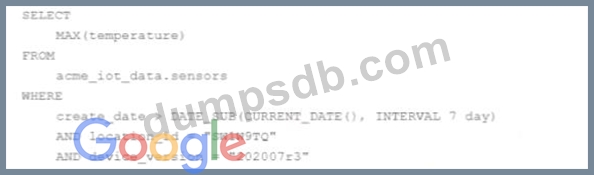
You want to optimize your queries for cost and performance. How should you structure your data?
Question 142
You work for a shipping company that uses handheld scanners to read shipping labels. Your company has strict data privacy standards that require scanners to only transmit recipients' personally identifiable information (PII) to analytics systems, which violates user privacy rules. You want to quickly build a scalable solution using cloud-native managed services to prevent exposure of PII to the analytics systems.
What should you do?
Question 143
Your company maintains a hybrid deployment with GCP, where analytics are performed on your anonymized customer data. The data are imported to Cloud Storage from your data center through parallel uploads to a data transfer server running on GCP. Management informs you that the daily transfers take too long and have asked you to fix the problem. You want to maximize transfer speeds. Which action should you take?
Question 144
You work for a large financial institution that is planning to use Dialogflow to create a chatbot for the company's mobile app You have reviewed old chat logs and lagged each conversation for intent based on each customer's stated intention for contacting customer service About 70% of customer requests are simple requests that are solved within 10 intents The remaining 30% of inquiries require much longer, more complicated requests Which intents should you automate first?
Question 145
Flowlogistic Case Study
Company Overview
Flowlogistic is a leading logistics and supply chain provider. They help businesses throughout the world manage their resources and transport them to their final destination. The company has grown rapidly, expanding their offerings to include rail, truck, aircraft, and oceanic shipping.
Company Background
The company started as a regional trucking company, and then expanded into other logistics market.
Because they have not updated their infrastructure, managing and tracking orders and shipments has become a bottleneck. To improve operations, Flowlogistic developed proprietary technology for tracking shipments in real time at the parcel level. However, they are unable to deploy it because their technology stack, based on Apache Kafka, cannot support the processing volume. In addition, Flowlogistic wants to further analyze their orders and shipments to determine how best to deploy their resources.
Solution Concept
Flowlogistic wants to implement two concepts using the cloud:
Use their proprietary technology in a real-time inventory-tracking system that indicates the location of
their loads
Perform analytics on all their orders and shipment logs, which contain both structured and unstructured
data, to determine how best to deploy resources, which markets to expand info. They also want to use predictive analytics to learn earlier when a shipment will be delayed.
Existing Technical Environment
Flowlogistic architecture resides in a single data center:
Databases
- 8 physical servers in 2 clusters
- SQL Server - user data, inventory, static data
- 3 physical servers
- Cassandra - metadata, tracking messages
10 Kafka servers - tracking message aggregation and batch insert
Application servers - customer front end, middleware for order/customs
- 60 virtual machines across 20 physical servers
- Tomcat - Java services
- Nginx - static content
- Batch servers
Storage appliances
- iSCSI for virtual machine (VM) hosts
- Fibre Channel storage area network (FC SAN) - SQL server storage
Network-attached storage (NAS) image storage, logs, backups
10 Apache Hadoop /Spark servers
- Core Data Lake
- Data analysis workloads
20 miscellaneous servers
- Jenkins, monitoring, bastion hosts,
Business Requirements
Build a reliable and reproducible environment with scaled panty of production.
Aggregate data in a centralized Data Lake for analysis
Use historical data to perform predictive analytics on future shipments
Accurately track every shipment worldwide using proprietary technology
Improve business agility and speed of innovation through rapid provisioning of new resources
Analyze and optimize architecture for performance in the cloud
Migrate fully to the cloud if all other requirements are met
Technical Requirements
Handle both streaming and batch data
Migrate existing Hadoop workloads
Ensure architecture is scalable and elastic to meet the changing demands of the company.
Use managed services whenever possible
Encrypt data flight and at rest
Connect a VPN between the production data center and cloud environment
SEO Statement
We have grown so quickly that our inability to upgrade our infrastructure is really hampering further growth and efficiency. We are efficient at moving shipments around the world, but we are inefficient at moving data around.
We need to organize our information so we can more easily understand where our customers are and what they are shipping.
CTO Statement
IT has never been a priority for us, so as our data has grown, we have not invested enough in our technology. I have a good staff to manage IT, but they are so busy managing our infrastructure that I cannot get them to do the things that really matter, such as organizing our data, building the analytics, and figuring out how to implement the CFO' s tracking technology.
CFO Statement
Part of our competitive advantage is that we penalize ourselves for late shipments and deliveries. Knowing where out shipments are at all times has a direct correlation to our bottom line and profitability.
Additionally, I don't want to commit capital to building out a server environment.
Flowlogistic's management has determined that the current Apache Kafka servers cannot handle the data volume for their real-time inventory tracking system. You need to build a new system on Google Cloud Platform (GCP) that will feed the proprietary tracking software. The system must be able to ingest data from a variety of global sources, process and query in real-time, and store the data reliably. Which combination of GCP products should you choose?