

Question 1
The architect designs a spine and leaf network for a single data center that will use multiple leaf switches as Virtual Tunnel End Points (VTEP). The architect needs to select the type of Integrated Routing & Bridging (IRB) for the solution.
Is this statement about the IRB type true?
Solution: Asymmetric IRB requires a third L3 VNI to route packets between ingress and egress VTEPs.
Question 2
Refer to the exhibits.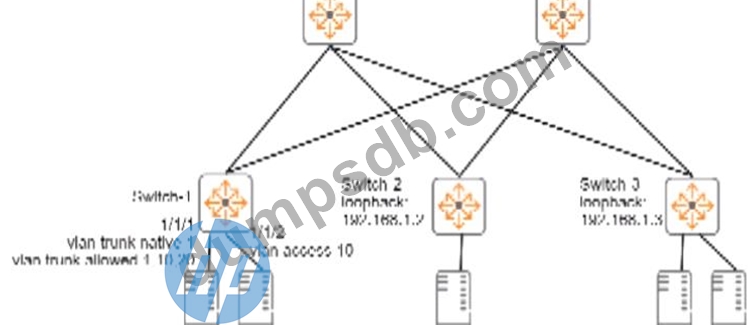

Is this how the switch-1 handles the traffic?
Solution: A broadcast arrives in VLAN 10 on Switch-1. Switch 1 forwards the frame on all interfaces assigned to VLAN10. except the incoming interface. It replicates the broadcast, encapsulates each broadcast with VXLAN. and sends the VXLAN traffic to 192.168.1.2 and 192.168.1.3.
Question 3
Switch-1 and Switch-2 are AruDaOS-CX switches, which ate part of a Virtual Switching Extension (VSX) fabric. Switch-2 is the primary member. Switch-2 experiences a power failure while Switch-l remains up. Switch-2's power recovers, and Switch-2 reboots.
Solution: Switch-2 wails a period called the link-up delay before it enables Switched Virtual Interfaces (SVls) on its VSX LAGs.
Question 4
Is this correct positioning of AtubaOS-CX switches in the data center?
Solution: Aruba CX 6300 switches are an appropriate choice for leaf switches in a leaf-spine topology that uses Virtual Extensible LAN (VXLAN) with Ethernet VPN (EVPN).
Question 5
Is this how you should position switches in the ArubaOS-CX portfolio tor data center networks?
Solution: Deploy Aruba 83xx switches as data center leaf switches.