

Question 46
Refer to the exhibit.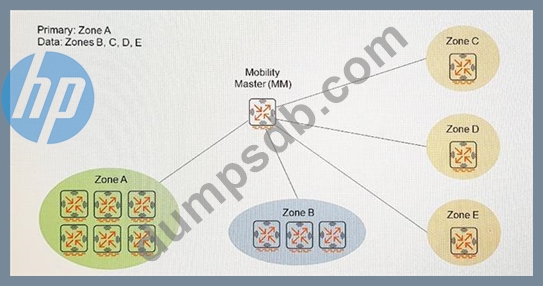
An administrator implements the MultiZone feature. The administrator sets up five zones as shown in the exhibit.
-Zone A has six controllers that form a cluster.
-Zone B has three controllers that from a cluster.
-Zones C, D, and E have a single standalone controller each.
A total of 13 VAPs are created across the five zones. Azone needs to accept RAP connections form branch offices. All zones have the same AP Group name. One of the zones will not accept connections from the MultiZone APs.
Which could be a cause of this problem?
Question 47
An administrator adds local administrative accounts to manage the Aruba Mobility Controllers (MCs). Which role should the administrator assign to an administrator who should havethe same privileges as the default admin account?
Question 48
An administrator configures Unified Communications and Collaboration (UCC) heuristics mode on an Aruba Mobility Master (MM). What should be modified in order to send items such as VoIP sessions and monitored information about adds, updates, deletions, and periodic snapshots of those VoIP sessions on the MM or the Aruba Mobility Controller (MC)?
Question 49
The administrator expects the AP to connect to a cluster, but the AP fails to connect. The administrator examines the configuration of an AP from apboot mode shown in the exhibit. What can the administrator determine about the configuration of the AP?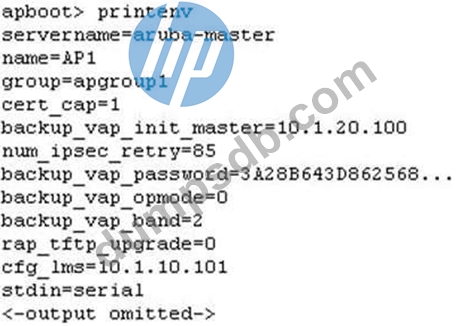
Question 50
Refer to the exhibit.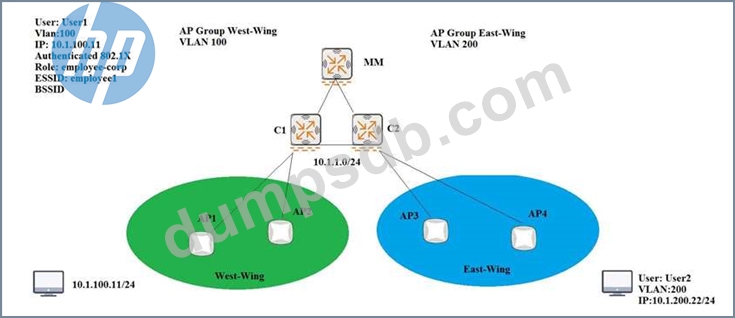
Two Aruba Mobility Controllers (MC) are managed by a Mobility Master (MM) in a non-cluster deployment as shown in the exhibit.
* The C1 controller is connected to AP1 and AP2.
* The C2controller is connected to AP3 and AP4.
* VLAN mobility is enabled in the VAPs of both AP Groups.
* Both C1 and C2 support the same VLANs.
* User1's wireless device supports BSS Fast Transitioning and is currently connected to AP1.
What happens if User1 roams across the network and the user's device associates to AP3?