

Question 56
Exhibit.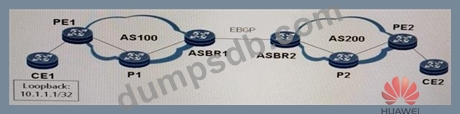
As shown in the figure, inter-AS VPN Option A is used. CE 1 and CE 2 belong to the same VPNAS 100 and
AS 200 run IGP and LDP, respectively.
ASBRs communicate with each other through EBGP. the loopback interface address of CE 1 is 10.1.1.1/24
Suppose VPNs configured on the PE and ASBR are both named vpn-1 and CE 2 can ping CE1. Which
command can be ruin on ASBR 2 to find out route 10.1.1.1/24?
Question 57
Exhibit:
As shown in the figure, RTA connects to RTB and RTC A TE tunnel is configure on RTA to reach RTC. The TE tunnel cannot be successfully established. However, CSPF-based calculation is successful and RTA does not receives any PathErro messages. What are possible causes?
Question 58
Exhibit.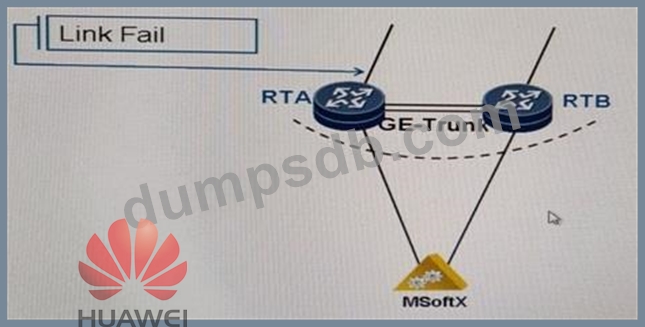
The figure shows the typically mode in which a commonsoftswitchaccess the bearer network. VRRP is
enabled on RTA and RTB. In normal cases, RTA is the VRRP master router and RTB is the VRRP is the
VRRP salve router. The ETH_trunk is enabled between RTA RTB. IF VRRP is not bounded to BFD and each
[parameter uses their default settings, which statement is the true when the upstream link of RTA is faulty?
Question 59
As shown in the figure, the costs of paths from RTA to RT 11, RT 12, RT
13, RT 14, and RT 15 are all 10 and the available bandwidth is 200 Mbit/s.
The costs of paths from RTB to RT 31, RT 32, RT 33, RT 34, and RT 35 are all 10 and the available bandwidth is 200 Mbit/s.
The costs of paths from RT 11 to RT 21 and from RT 21 to RT 31 are both 5. The available bandwidth is 200 Mbit/s.
The cost of the path from RT 12 to RT 32 is 5 and the available bandwidth is 120 Mbit/s. The cost of the path from RT 13 to RT 33 is 10 and the available bandwidth is 80 Mbit/s.
The cost of the path from RT 14 to RT 34 is 10 and the available bandwidth is 100 Mbit/s.
The cost of the path from RT 15 to RT 35 is 10 and the available bandwidth is 100 Mbit/s.
The load balancing rule of Constraint Shortest Path First (CSPF) is set to Random on RTA.
Which path will a 100 Mbit/s tunnel from RTA to RTB take?
Question 60
RTA is a provider edge (PE) router. OSPF is deployed between RTA and a customer edge (CE). Which of the following can be used to avoid routing loops when RTA generate an autonomy system-external (ASE) link-state advertisement (LSA) and sends it to the CE?