

Question 61
SCENARIO
Kyle is a new security compliance manager who will be responsible for coordinating and executing controls to ensure compliance with the company's information security policy and industry standards. Kyle is also new to the company, where collaboration is a core value. On his first day of new-hire orientation, Kyle's schedule included participating in meetings and observing work in the IT and compliance departments.
Kyle spent the morning in the IT department, where the CIO welcomed him and explained that her department was responsible for IT governance. The CIO and Kyle engaged in a conversation about the importance of identifying meaningful IT governance metrics. Following their conversation, the CIO introduced Kyle to Ted and Barney. Ted is implementing a plan to encrypt data at the transportation level of the organization's wireless network. Kyle would need to get up to speed on the project and suggest ways to monitor effectiveness once the implementation was complete. Barney explained that his short-term goals are to establish rules governing where data can be placed and to minimize the use of offline data storage.
Kyle spent the afternoon with Jill, a compliance specialist, and learned that she was exploring an initiative for a compliance program to follow self-regulatory privacy principles. Thanks to a recent internship, Kyle had some experience in this area and knew where Jill could find some support. Jill also shared results of the company's privacy risk assessment, noting that the secondary use of personal information was considered a high risk.
By the end of the day, Kyle was very excited about his new job and his new company. In fact, he learned about an open position for someone with strong qualifications and experience with access privileges, project standards board approval processes, and application-level obligations, and couldn't wait to recommend his friend Ben who would be perfect for the job.
Which data practice is Barney most likely focused on improving?
Question 62
SCENARIO
Please use the following to answer the next question:
Light Blue Health (LBH) is a healthcare technology company developing a new web and mobile application that collects personal health information from electronic patient health records. The application will use machine learning to recommend potential medical treatments and medications based on information collected from anonymized electronic health records. Patient users may also share health data collected from other mobile apps with the LBH app.
The application requires consent from the patient before importing electronic health records into the application and sharing it with their authorized physicians or healthcare provider. The patient can then review and share the recommended treatments with their physicians securely through the app. The patient user may also share location data and upload photos in the app. The patient user may also share location data and upload photos in the app for a healthcare provider to review along with the health record. The patient may also delegate access to the app.
LBH's privacy team meets with the Application development and Security teams, as well as key business stakeholders on a periodic basis. LBH also implements Privacy by Design (PbD) into the application development process.
The Privacy Team is conducting a Privacy Impact Assessment (PIA) to evaluate privacy risks during development of the application. The team must assess whether the application is collecting descriptive, demographic or any other user related data from the electronic health records that are not needed for the purposes of the application. The team is also reviewing whether the application may collect additional personal data for purposes for which the user did not provide consent.
What is the best way to ensure that the application only collects personal data that is needed to fulfill its primary purpose of providing potential medical and healthcare recommendations?
Question 63
SCENARIO
Clean-Q is a company that offers house-hold and office cleaning services. The company receives requests from consumers via their website and telephone, to book cleaning services. Based on the type and size of service, Clean-Q then contracts individuals that are registered on its resource database - currently managed in-house by Clean-Q IT Support. Because of Clean-Q's business model, resources are contracted as needed instead of permanently employed.
The table below indicates some of the personal information Clean-Q requires as part of its business operations: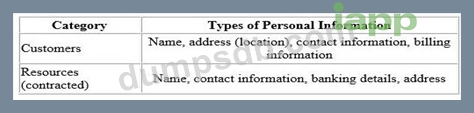
Clean-Q has an internal employee base of about 30 people. A recent privacy compliance exercise has been conducted to align employee data management and human resource functions with applicable data protection regulation. Therefore, the Clean-Q permanent employee base is not included as part of this scenario.
With an increase in construction work and housing developments, Clean-Q has had an influx of requests for cleaning services. The demand has overwhelmed Clean-Q's traditional supply and demand system that has caused some overlapping bookings.
Ina business strategy session held by senior management recently, Clear-Q invited vendors to present potential solutions to their current operational issues. These vendors included Application developers and Cloud-Q's solution providers, presenting their proposed solutions and platforms.
The Managing Director opted to initiate the process to integrate Clean-Q's operations with a cloud solution (LeadOps) that will provide the following solution one single online platform: A web interface that Clean-Q accesses for the purposes of resource and customer management. This would entail uploading resource and customer information.
A customer facing web interface that enables customers to register, manage and submit cleaning service requests online.
A resource facing web interface that enables resources to apply and manage their assigned jobs.
An online payment facility for customers to pay for services.
Considering that LeadOps will host/process personal information on behalf of Clean-Q remotely, what is an appropriate next step for Clean-Q senior management to assess LeadOps' appropriateness?
Question 64
What is the main privacy threat posed by Radio Frequency Identification (RFID)?
Question 65
What can be used to determine the type of data in storage without exposing its contents?