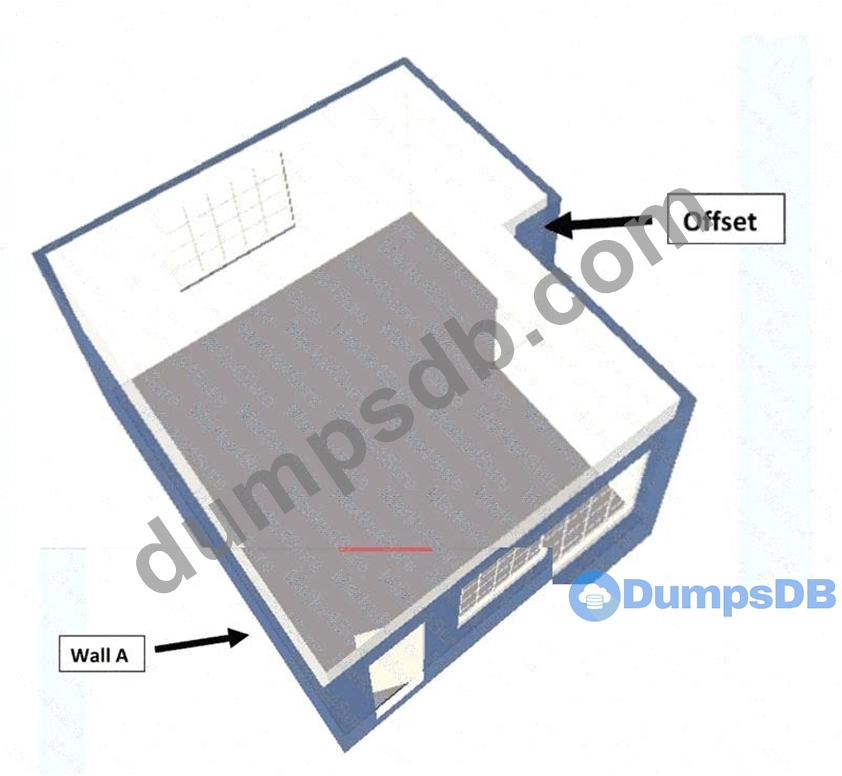
SCENARIO: Use the diagram and information below to answer this question. . The living room measures 20 feet x 16 feet, with an offset measuring 10 feet x 2 feet. . The ceiling height is 8 feet. . The entire floor area is wet, and moisture has been detected as high as 21 inches on all walls except Wall A. . Water escaped from a broken pipe located behind Wall A. The entire area of wall A is wet. . The ceiling is not affected. Important information: . The total square footage of the floor, including the offset, is 340 square feet . The total square footage of Wall A after deducting the bottom 2 feet is 120 square feet (USE THE SCENARIO) What is the total number of airmovers a restorer should install?
Correct Answer: B
Based on IICRC WRT initial air mover placement guidelines: * Floor area:340 sq ft # typically1 air mover per 50-70 sq ft * Low range # 5-7 * High range # 7-9 * Wall drying required: * All walls affected up to 21 inchesexcept Wall A * Wall A fully wet(above 2 ft deduction = 120 sq ft requiring full wall drying) * Offsets and irregular geometryincrease airflow demand. When combining: * Floor drying requirement * Additional air movers forsignificantly wet walls * One fully saturated wall (Wall A) * One offset area
Question 27
Which material loses most of its structural integrity when wet but regains its strength when dry?
Correct Answer: B
Gypsum board (drywall) is identified in the WRT body of knowledge as highly vulnerable to moisture exposure, yet capable of recovering strength when dried-provided it has not sustained irreversible primary damage. The WRT manual explains that gypsum wallboard is among the most moisture-sensitive common building materials, showing rapid and dramatic change with elevated moisture levels. However, it also states that gypsum has a greater ability to recover than many other engineered products. Critically, the WRT guidance distinguishes between primary damage (immediate structural failure) and recoverable wetting. For example, overhead or horizontally installed gypsum that becomes wet can lose structural integrity, sag, and create a significant safety concern; this sagging is considered permanent damage and requires removal. In contrast, when gypsum board installed vertically on walls is wet but has not experienced primary damage (e.g., not structurally compromised, not severely deteriorated, and appropriate contamination considerations are addressed), the WRT manual notes that it can restore: during the drying process, gypsum's original strength is restored, and after drying it may even be slightly stronger (though sometimes more brittle). This recovery characteristic is what makes gypsum board the best match to the question's description-losing structural integrity when wet yet regaining strength when properly dried. This material behavior is central to WRT decision-making: whether to dry in place, perform limited disruption (e.g., baseboard removal and cavity airflow), or remove materials for safety/health reasons. The WRT body of knowledge treats gypsum as potentially restorable depending on installation orientation, degree of damage, and contamination risk, which is why it is specifically described as losing integrity when wet and regaining strength when dry.
Question 28
When should carpet cushion (pad, underlay) be removed and discarded?
Correct Answer: A
The IICRC WRT body of knowledge states thatcarpet cushion (pad, underlay) must be removed and discarded when affected by Category 2 or Category 3 water. Carpet cushion is a porous material that readily absorbs and retains contaminants, making effective cleaning and decontamination impractical under these conditions. The WRT manual explains that even if the overlying carpet may be cleanable in some situations, cushion acts like a sponge and can harbor microorganisms, nutrients, and moisture deep within its structure. Attempting to dry or disinfect contaminated cushion poses a health risk and increases the likelihood of secondary damage or odor problems. While certain cushion types (such as synthetic felt or cushions with skins) influence restorability in Category 1 losses, contamination level takes precedence. The presence of Category 2 or 3 water alone is sufficient to require removal, regardless of cushion construction or subfloor type. This guidance reflects the WRT emphasis on protecting occupant health and preventing hidden contamination. Removing and discarding contaminated cushion is considered the appropriate and defensible standard of care.