Which one of the following statements regarding performance testing is MOST correct?
Correct Answer: B
Question 27
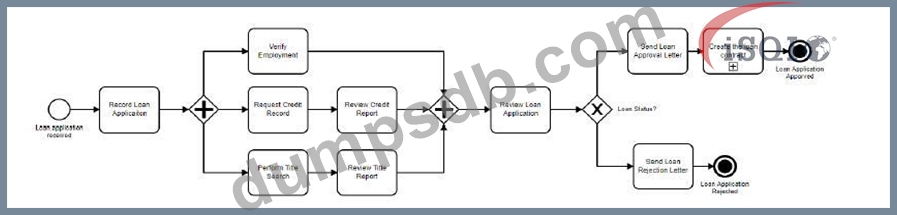
Assume you would like to create a model describing a loan request process in a bank. The loan request process starts when the customer submits a loan application. The bank then reviews the application. Regardless of whether the loan request is approved or not, a letter is sent to inform the customer of the decision. If the request is approved, the loan contract is created. You have drawn the following business process model using BPMN 2.0. Which one of the following sentences is true with respect to this process model?
Correct Answer: B
Comprehensive Detailed Explanation (Approx. 200-220 words): In the first BPMN diagram (Loan Request Process), the process starts with the receipt of a loan application. Then, parallel gateways (indicated by the "+" symbols) are used to trigger three separate evaluations: verifying employment, requesting and reviewing a credit record, and performing and reviewing a title search. These are executed concurrently, not sequentially. After all checks are completed, the loan application is reviewed. A decision gateway (diamond with an "X") checks whether the loan is approved. Depending on the decision: If approved: a loan approval letter is sent, and a sub-process is triggered (represented by the rectangle with a "+" symbol inside), which is the creation of the loan contract. This is what identifies it as a BPMN "sub- process." If rejected: a rejection letter is sent. In both cases, the process ends after customer notification. Evaluation of answer options: A: Incorrect - the verification steps occur before the loan status is determined. B: Correct - the "Create the loan contract" activity has a "+" symbol, indicating a sub-process. C: Incorrect - the parallel gateway means these tasks are executed concurrently, not sequentially. D: Incorrect - all review activities are mandatory prior to application review. Therefore, B is the correct answer.
Question 28
Which of the following pillars of UX requirement analysis is described BEST?
Correct Answer: B
User Experience (UX) requirement analysis is a critical component of acceptance testing and product development. According to ISTQB Acceptance Testing syllabus and industry-aligned UX design methodologies (e.g., ISO 9241-210 and BABOK guidelines), UX requirement analysis is typically structured around the following pillars: User Analysis - Understanding who the users are (roles, goals, experience levels) Task Analysis - Understanding what users do (tasks, workflows, pain points) Context Analysis - Understanding where and how users interact with the product (environmental and contextual factors) Competitor Analysis - Understanding how similar problems are solved in the market Option B best describes Task Analysis, one of the most practical and impactful pillars. In task analysis, business analysts and UX researchers observe how users interact with current or comparable systems to understand workflow patterns, user frustrations, needs, and required system functionality. This method helps uncover implicit needs that users may not articulate in interviews. This approach is aligned with ISTQB's emphasis on understanding real-world usage and business processes as a foundation for deriving acceptance criteria and tests. It supports the creation of realistic scenarios that reflect actual user behavior, which is essential for verifying system fitness for use. The other options are inaccurate: A refers to psychological disposition, which is more aligned with user profiling or persona development, not a core focus of user analysis in requirement engineering. C incorrectly ties context analysis with deriving security requirements, which is not its purpose. D describes an unrealistic or incorrect method for competitor analysis. Therefore, Option B is the best description of a key pillar of UX requirement analysis per industry and ISTQB standards.
Question 29
Which one of the following scenarios characterizes UX context analysis BEST?
Correct Answer: A
UX context analysis evaluates the environment and conditions in which users interact with a product. This includes: External conditions: lighting, noise, device constraints Psychological conditions: cognitive load, stress, motivation These factors influence usability, accessibility, and overall experience. Option A is correct as it reflects the essence of UX context analysis - understanding the broader user environment to inform design and testing. Other options: B describes personas, which are user archetypes used for behavior modeling - more aligned with user profiling. C focuses on competitor analysis - useful for inspiration, not context analysis. D involves use cases and workflows - useful for behavior modeling, but not specifically context analysis. A). External conditions and psychological conditions are analyzed to derive design decisions
Question 30
Which one of the following usability testing techniques matches the test objective BEST?
Correct Answer: D
Usability testing involves evaluating a product by observing real users performing tasks. The "think-aloud" method is a cornerstone of qualitative usability testing. Test participants verbalize their thoughts while interacting with the system, revealing what they understand, find confusing, or expect. This method helps identify usability problems tied to user behavior and thought processes. Option D is correct because it directly reflects this principle - walkthroughs and think-aloud sessions highlight pain points users face while performing tasks. Other options: A describes expert reviews but incorrectly attributes user insight, which is less direct. B misunderstands biometrics - they measure physiological responses (e.g., stress, eye movement) but don't explain behavior retrospectively. C is incorrect - log files show user actions, but identifying "strong points" like visual attraction requires observation, not just logs. D). Walkthrough and thinking aloud methods can indicate difficulties users experience with certain tasks. =======