

Question 11
You are designing a solution for a company with a central office with several branch locations geographically dispersed. You are given the following requirements:
- provides a different bandwidth at each location,
- has any-to-any connectivity,
- offloads some network responsibility.
- is inherently isolated.
- has a simple network design.
Which statement satisfies these requirements?
Question 12
Exhibit.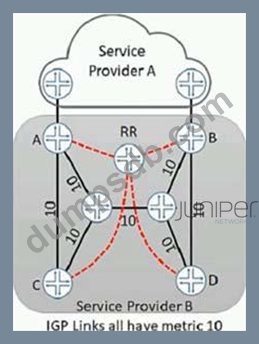
You work for service provider B that wants to implement a hot potato routing policy on the network so that router C uses link C-A to reach service provider A's advertised routes and router D uses link D-B to reach Service Provider A's advertised routes Currently traffic from router C is traversing the core to exit the network on router B.
Referring to the exhibit, what are two design actions that would satisfy the requirements? (Choose two.)
Question 13
Your company's automation team is testing a controller-based solution for dynamic LSP management They do not want the topology acquisition process to allow the controller to become a transit node of the core network's.
Which solution would fulfill the requirements?
Question 14
You want to implement Source Packet Routing in Networking (SPRING) in your network core using MPLS as the data plane for traffic engineering purposes.
In this scenario what are two protocols that would be used to distribute the segment IDs? (Choose two )
Question 15
You are designing several MPLS virtual routing and forwarding (VRF) instances on all provider edge (PE) routers. Routes within each VRF should be exchanged between all PE routers provisioned for that VRF.
For each VRF routing instance which two attributes must match on all related PE routers? (Choose two )