A company wants an agent to retrieve real-time answers from a large, frequently updated document repository stored outside Dataverse, with strong relevance ranking. Which knowledge source should you configure?
Correct Answer: B
Azure AI Search provides indexed, relevance-ranked retrieval over large and frequently updated content, making it the preferred grounding source for enterprise-scale RAG scenarios compared to static file uploads.
Question 82
A team is preparing to assess an agent in Copilot Studio before expanding access to additional users. The team requires an evaluation that provides controlled, repeatable, and consistently measured test runs. The evaluation must: Be triggered directly by the team to control when testing occurs. Determine success based on clearly established acceptance criteria. Rely on a predefined set of inputs that ensures consistency across repeated runs.
Correct Answer:
Question 83
You need to enable Operations Concierge to delegate shipment tracking inquiries according to Fabrikam Inc.'s defined architecture and technical requirements. Which integration approach should you use?
Correct Answer: D
Comprehensive and Detailed Explanation From Microsoft AB-620 Study Guide: The partner capability is described as an agent available only through a standardized agent-to-agent endpoint. That is the defining use case for an Agent2Agent connection. In Copilot Studio, the primary agent is configured with the external agent's A2A message endpoint and the applicable authentication details, after which orchestration can delegate shipment-tracking requests to it. An MCP server exposes tools or resources rather than an independently orchestrated partner agent, so option C changes the integration contract. An indexed knowledge source is also unsuitable because shipment status is dynamic and the requirement is delegation, not retrieval from a copied corpus. Generative responses in the primary agent would have no authoritative live shipment source and would violate the defined architecture. The A2A description should identify shipment tracking precisely so that it does not compete with unrelated agents or tools. Because external-agent support can be preview functionality, Fabrikam should also validate regional availability, authentication, error behavior, latency, and governance before production use. Study Guide alignment: Integrate and extend agents in Copilot Studio > Configure multi-agent collaboration from Copilot Studio > Create a multi-agent solution by using A2A protocol. Topic 1, Fabrikam inc. Background Current Environment: Fabrikam Inc. is a Canada-based manufacturer with a growing service organization that supports field technicians and internal operations teams. Fabrikam Inc. plans to launch a new internal agent solution named Operations Concierge to reduce time spent searching policy content, retrieving operational metrics, and executing routine transactions. The agent will be used by three groups: Service coordinators who triage incoming service requests Field technicians who need guided procedures and parts availability Operations managers who monitor KPIs and exceptions The agent solution must work in real-world operational conditions. Users often ask questions mid-call with a customer or while coordinating parts shipments. The agents require quick, reliable outcomes. As a result, Fabrikam Inc. requires the solution to: Provide grounded answers with traceability when it provides guidance. Retrieve real-time metrics when users ask for operational status, Execute authenticated updates when users initiate a flow (such as creating a parts request). Fabrikam Inc. also expects the solution to be maintained by multiple makers and developers across the year. The company has experienced duplicated logic and inconsistent behavior across different agents. This project emphasizes reuse, governance, and maintainability across teams. Business Requirements: Fabrikam Inc. runs three Microsoft Power Platform environments for agent development and release: Dev, Test, and Prod. The team plans to build the agent and validate it in Dev and Test, then promote to Prod by using a controlled release process that supports repeatable deployments. Fabrikam Inc. already has two assets the team wants to reuse: A partially completed Copilot Studio agent named Service Desk Agent, used by IT to create internal tickets and route requests A Microsoft Foundry agent created by a central AI team that performs specialized summarization and classification for long-form text (for example, summarizing call transcripts into an incident narrative) Fabrikam Inc. also has operational and knowledge data sources: A curated policy library (internal SOPs, service warranty rules, escalation criteria, and standard operating procedures) A set of indexed documents and procedures in an Azure AI Search service that supports vector search for the policy library A Microsoft Fabric workspace that includes a semantic model used by operations leadership for reporting Business Requirements: Fabrikam Inc. requires Operations Concierge to meet the following business requirements: Traceability requirement: When the agent provides policy guidance or procedural recommendations, users must be able to see where the answer came from. Metrics requirement: When users ask about service performance (backlog, SLA risk, parts shortages, dispatch delays), the solution must return up-to-date metrics in a structured format that operations managers can use in weekly reviews. Transaction requirement: The solution must support authenticated updates initiated during conversations, including creating a parts request and updating a service case status. In addition, Fabrikam Inc. wants to avoid duplicating common assets across agents: The team must reuse the same set of escalation topics, MCP tool definitions, and a standard safety disclaimer across three different agents. Only the platform engineering group is allowed to edit shared assets. However, all agent authors must be able to use them. Technical Requirements: The Fabrikam Inc.'s solution architecture uses a multi-agent approach so that specialist responsibilities are isolated and can evolve independently. The Operations Concierge (primary agent) must coordinate the following specialist capabilities: Policy and procedure Q&A: Use an enterprise knowledge source that supports indexed retrieval across the curated policy library and service procedures. Operational metrics: Delegate metric queries to a Fabric Data Agent that reads governed business data through the Fabric semantic model. Authenticated updates: Use tools exposed by an existing internal Model Context Protocol (MCP) server that provides transactional operations for the service organization. Specialized processing: Delegate summarization and classification requests to an existing Microsoft Foundry agent. Fabrikam Inc. will onboard two MCP servers as tools: PartsOps MCP server: exposes tools for parts availability checks and parts request creation. The server requires per-user authentication because actions must be traceable to the requesting user. WarrantyRules MCP server: exposes a read-only tool for validating warranty coverage. The server uses an API key shared by the agent team. Fabrikam Inc. has also defined a collaboration requirement with the existing Service Desk Agent: The primary agent must delegate IT-specific requests to the existing Service Desk Agent rather than reimplement ticket creation logic. Finally, Fabrikam Inc. plans to support a partner integration: For shipment tracking inquiries, Fabrikam Inc. will delegate to a partner-provided agent that is only available through a standardized agent-to-agent endpoint. Issues and constraints During early testing, Fabrikam Inc. found three recurring problems: Makers are copying and modifying the same components across agents, resulting in inconsistent disclaimers and duplicated tools. Users can obtain a correct answer, but the response is not consistently traceable to a source when the agent uses knowledge. The primary agent can route some requests, but specialist capabilities are not consistently delegated (for example, some metric questions are answered generatively instead of being routed to the Fabric Data Agent). You are part of the engineering team responsible for correcting the design and configuration to meet the preceding requirements and constraints.
Question 84
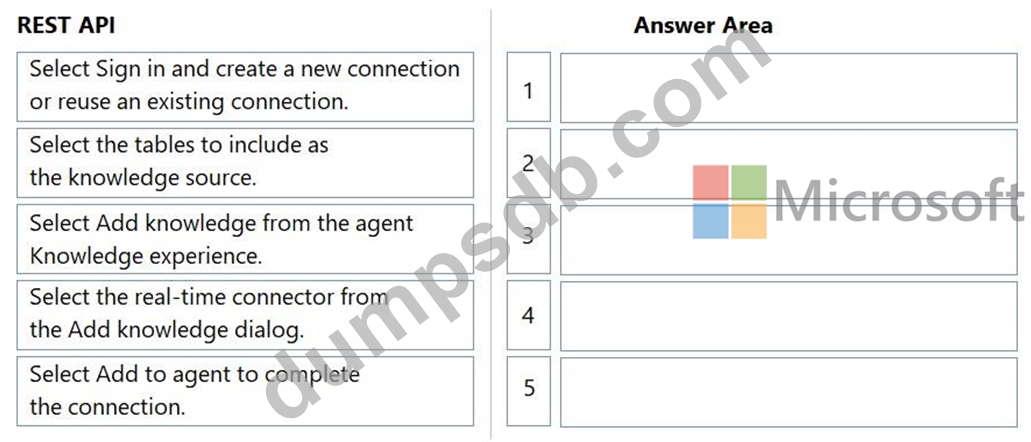
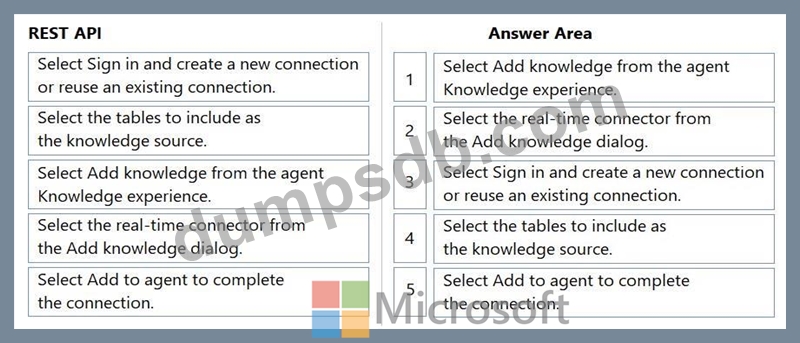
Drag and Drop Question A company needs to ground an agent in Copilot Studio answers using live enterprise data from a supported system via a Microsoft Power Platform connector. To meet the business needs, the builder must meet the following requirements: - Authenticate using a valid connection. - Add the connector as a real-time knowledge source. - Select the tables for knowledge grounding. You need to add a Power Platform connector as a real-time knowledge source for the agent. In which order should you perform the actions? To answer, move all actions from the list of actions to the answer area and arrange them in the correct order.
Correct Answer:
Explanation: Step 1: Select Add knowledge from the agent Knowledge experience Initiate: You start in the Knowledge tab to trigger the addition. Step 2: Select the real-time connector from the Add knowledge dialog Identify: You pick the specific system/connector from the menu. Step 3: Select Sign in and create a new connection or reuse an existing connection Authenticate: You log in to ensure permissions to the enterprise data. Step 4: Select the tables to include as the knowledge source Configure: You isolate the exact tables needed for grounding. Step 5: Select Add to agent to complete the connection Finalize: You save and bind the source to your agent. Reference: https://learn.microsoft.com/en-us/microsoft-copilot-studio/knowledge-real-time-connectors
Question 85
A company uses an agent in Copilot Studio to answer questions based on enterprise content. The content is indexed in Azure AI Search. Responses must be generated by a Microsoft Foundry model. To meet the business needs, the solution must meet the following requirements: Users must be able to trace each answer back to its source. The agent must retrieve information from a centralized data index. Responses must be generated by an enterprise-approved foundation model. You need to configure generative answers for the agent. What should you configure for each requirement? To answer, move the appropriate configurations to the correct requirements. You may use each configuration once, more than once, or not at all. NOTE: Each correct selection is worth one point.