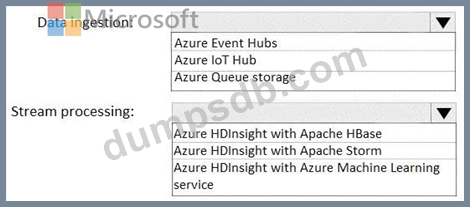
You are developing an application that will perform clickstream analysis. The application will ingest and analyze millions of messages in the real time. You need to ensure that communication between the application and devices is bidirectional. What should you use for data ingestion and stream processing? To answer, select the appropriate options in the answer area. NOTE: Each correct selection is worth one point.
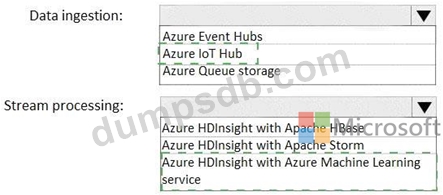
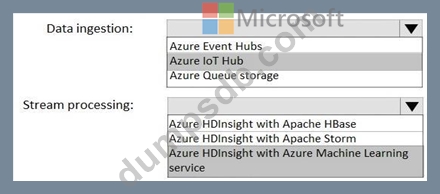
Correct Answer:
Explanation Box 1: Azure IoT Hub Azure IoT Hub is the cloud gateway that connects IoT devices to gather data and drive business insights and automation. In addition, IoT Hub includes features that enrich the relationship between your devices and your backend systems. Bi-directional communication capabilities mean that while you receive data from devices you can also send commands and policies back to devices. Note on why not Azure Event Hubs: An Azure IoT Hub contains an Event Hub and hence essentially is an Event Hub plus additional features. An important additional feature is that an Event Hub can only receive messages, whereas an IoT Hub additionally can also send messages to individual devices. Further, an Event Hub has access security on hub level, whereas an IoT Hub is aware of the individual devices and can grand and revoke access on device level. Box 2: Azure Hdinsight with Azure Machine Learning service References: https://docs.microsoft.com/en-us/azure/iot-hub/iot-hub-compare-event-hubs https://docs.microsoft.com/en-us/azure/hdinsight/hdinsight-machine-learning-overview
Question 7
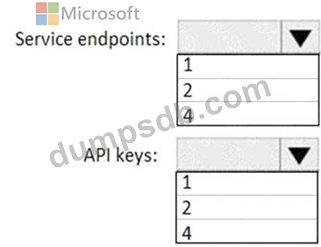
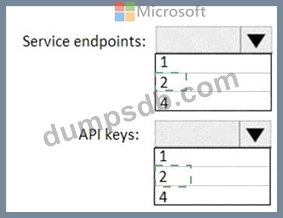
You plan to deploy the Text Analytics and Computer Vision services. The Azure Cognitive Services will be deployed to the West US and East Europe Azure regions. You need to identify the minimum number of service endpoints and API keys required for the planned deployment. What should you identify? To answer, select the appropriate options in the answer area. NOTE: Each correct selection is worth one point.
Correct Answer:
Explanation Box 1: 2 After creating a Cognitive Service resource in the Azure portal, you'll get an endpoint and a key for authenticating your applications. You can access Azure Cognitive Services through two different resources: A multi-service resource, or a single-service one. Multi-service resource: Access multiple Azure Cognitive Services with a single key and endpoint. Note: You need a key and endpoint for a Text Analytics resource. Azure Cognitive Services are represented by Azure resources that you subscribe to. Each request must include your access key and an HTTP endpoint. The endpoint specifies the region you chose during sign up, the service URL, and a resource used on the request Box 2: 2 You need at least one key per region. References: https://docs.microsoft.com/en-us/azure/cognitive-services/cognitive-services-apis-create-account
Question 8
You plan to implement a bot that will require user authentication. You need to recommend a secure solution that provides encryption for the authentication of the bot. Which two security solutions should you include in the recommendation? Each correct answer presents a complete solution. NOTE: Each correct selection is worth one point.
Correct Answer: B,E
Your bot communicates with the Bot Connector service using HTTP over a secured channel (SSL/TLS). JSON Web Tokens are used to encode tokens that are sent to and from the bot. References: https://docs.microsoft.com/en-us/azure/bot-service/rest-api/bot-framework-rest-connector-authentication Design solutions Testlet 2 Overview Contoso, Ltd. has an office in New York to serve its North American customers and an office in Paris to serve its European customers. Existing Environment Infrastructure Each office has a small data center that hosts Active Directory services and a few off-the-shelf software solutions used by internal users. The network contains a single Active Directory forest that contains a single domain named contoso.com. Azure Active Directory (Azure AD) Connect is used to extend identity management to Azure. The company has an Azure subscription. Each office has an Azure ExpressRoute connection to the subscription. The New York office connects to a virtual network hosted in the US East 2 Azure region. The Paris office connects to a virtual network hosted in the West Europe Azure region. The New York office has an Azure Stack Development Kit (ASDK) deployment that is used for development and testing. Current Business Model Contoso has a web app named Bookings hosted in an App Service Environment (ASE). The ASE is in the virtual network in the East US 2 region. Contoso employees and customers use Bookings to reserve hotel rooms. Data Environment Bookings connects to a Microsoft SQL Server database named hotelDB in the New York office. The database has a view named vwAvailability that consolidates columns from the tables named Hotels, Rooms, and RoomAvailability. The database contains data that was collected during the last 20 years. Problem Statements Contoso identifies the following issues with its current business model: * European users report that access to Booking is slow, and they lose customers who must wait on the phone while they search for available rooms. * Users report that Bookings was unavailable during an outage in the New York data center for more than 24 hours. Requirements Contoso identifies the following issues with its current business model: * European users report that access to Bookings is slow, and they lose customers who must wait on the phone while they search for available rooms. * Users report that Bookings was unavailable during on outage in the New York data center for more than 24 hours. Business Goals Contoso wants to provide a new version of the Bookings app that will provide a highly available, reliable service for booking travel packages by interacting with a chatbot named Butler. Contoso plans to move all production workloads to the cloud. Technical requirements Contoso identifies the following technical requirements: * Data scientists must test Butler by using ASDK. * Whenever possible, solutions must minimize costs. * Butler must greet users by name when they first connect. * Butler must be able to handle up to 10,000 messages a day. * Butler must recognize the users' intent based on basic utterances. * All configurations to the Azure Bot Service must be logged centrally. * Whenever possible, solutions must use the principle of least privilege. * Internal users must be able to access Butler by using Microsoft Skype for Business. * The new Bookings app must provide a user interface where users can interact with Butler. * Users in an Azure AD group named KeyManagers must be able to manage keys for all Azure Cognitive Services. * Butler must provide users with the ability to reserve a room, cancel a reservation, and view existing reservations. * The new Bookings app must be available to users in North America and Europe if a single data center or Azure region fails. * For continuous improvement, you must be able to test Butler by sending sample utterances and comparing the chatbot's responses to the actual intent. * You must maintain relationships between data after migration.
Question 9
Your plan to design a bot that will be hosted by using Azure Bot Service. Your company identifies the following compliance requirements for the bot: Payment Card Industry Data Security Standards (PCI DSS) General Data Protection Regulation (GDPR) ISO 27001 You need to identify which compliance requirements are met by hosting the bot in the bot service. What should you identify?
Correct Answer: B
Explanation Azure Bot service is compliant with ISO 27001:2013, ISO 27019:2014, SOC 1 and 2, Payment Card Industry Data Security Standard (PCI DSS), and Health Insurance Portability and Accountability Act Business Associate Agreement (HIPAA BAA). Microsoft products and services, including Azure Bot Service, are available today to help you meet the GDPR requirements. References: https://docs.microsoft.com/en-us/azure/bot-service/bot-service-compliance https://blog.botframework.com/2018/04/23/general-data-protection-regulation-gdpr/
Question 10
You plan to design an application that will use data from Azure Data Lake and perform sentiment analysis by using Azure Machine Learning algorithms. The developers of the application use a mix of Windows- and Linux-based environments. The developers contribute to shared GitHub repositories. You need all the developers to use the same tool to develop the application. What is the best tool to use? More than one answer choice may achieve the goal.