

Question 41
You have an Azure subscription that contains a virtual network named VNET1. VNET1 contains the subnets shown in the following table.
Each virtual machine uses a static IP address.
You need to create network security groups (NSGs) to meet following requirements:
* Allow web requests from the internet to VM3, VM4, VM5, and VM6.
* Allow all connections between VM1 and VM2.
* Allow Remote Desktop connections to VM1.
* Prevent all other network traffic to VNET1.
What is the minimum number of NSGs you should create?
Question 42
You have an Azure subscription that contains two virtual networks named VNet1 and VNet2. VNet1 contains two virtual machines named VM1 and VM2. VM1 and VM2 host an application named App1.
The resources on VNet2 only access App1 through the internal network.
You need to ensure that inbound traffic from VNet2 to App1 is evenly distributed between VM1 and VM2.
The solution must ensure that the virtual machines are NOT exposed to the internet.
What should you use?
Question 43
You have the Azure virtual machines shown in the following table: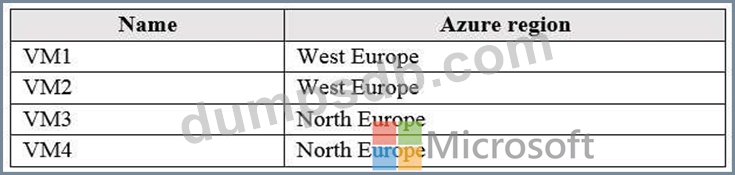
You have a Recovery Services vault that protects VM1 and VM2.
You need to protect VM3 and VM4 by using Recovery Services.
What should you do first?
Question 44
Hotspot Question
You have an Azure subscription named Sub1 that contains the resources shown in the following table.
The subscription contains the users shown in the following table.
VNet2 was created by using the following cmdlet.
For VNet2, Access control (IAM) settings are configured as shown in the following exhibit.
For each of the following statements, select Yes if the statement is true. Otherwise, select No.
NOTE: Each correct selection is worth one point.

Question 45
You have a virtual network named VNET1 that contains the subnets shown in the following table:
You have two Azure virtual machines that have the network configurations shown in the following table:
For NSG1, you create the inbound security rule shown in the following table:
For NSG2, you create the inbound security rule shown in the following table:
For each of the following statements, select Yes if the statement is true. Otherwise, select No.
NOTE: Each correct selection is worth one point.
