

Question 56
You plan to deploy an SAP environment on Azure that will use Azure Availability Zones.
Which load balancing solution supports the deployment?
Question 57
You have an Azure subscription.
Your company has an SAP environment that runs on SUSE Linux Enterprise Server (SLES) servers and SAP HANA. The environment has a primary site and a disaster recovery site. Disaster recovery is based on SAP HANA system replication. The SAP ERP environment is 4 TB and has a projected growth of 5% per month.
The company has an uptime Service Level Agreement (SLA) of 99.99%, a maximum recovery time objective (RTO) of four hours, and a recovery point objective (RPO) of 10 minutes.
You plan to migrate to Azure.
You need to design an SAP landscape for the company.
Which options meet the company's requirements?
Question 58
You are deploying an SAP production landscape to Azure.
Your company's chief information security officer (CISO) requires that the SAP deployment complies with ISO 27001.
You need to generate a compliance report for ISO 27001.
What should you use?
Question 59
You have an SAP production landscape on Azure that contains the virtual machines shown in the following table.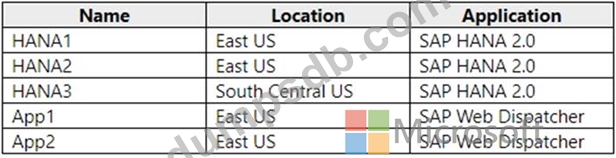
You configure HANA system replication as shown in the following table.
You configure two load balancers as shown in the following table.
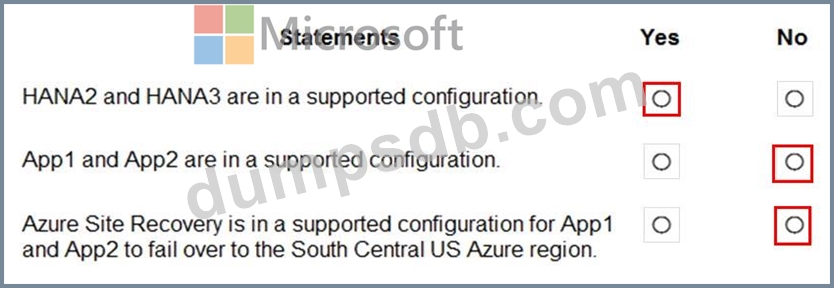
For each of the following statements, select Yes if the statement is true. Otherwise, select No.
NOTE: Each correct selection is worth one point.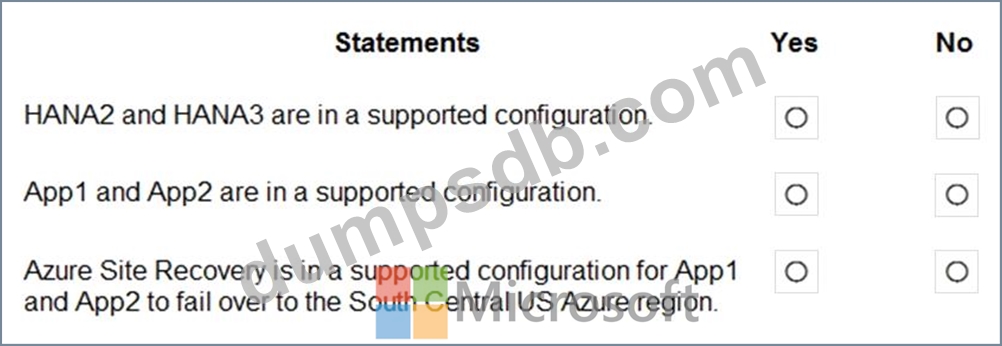
Question 60
You have an SAP environment on Azure.
You use Azure Recovery Services to back up an SAP application server.
You need to test the restoration process of a file on the server.
Which three actions should you perform in sequence? To answer, move the appropriate actions from the list of actions to the answer area and arrange them in the correct order.

