You are planning the Azure network infrastructure to support the disaster recovery requirements. What is the minimum number of virtual networks required for the SAP deployed?
Correct Answer: B
Explanation Scenario: Ensure that all the production databases can withstand the failure of an Azure region. Note: Use Azure Site Recovery to replicate applications across regions. Azure Site Recovery replicates workloads running on physical and virtual machines from a primary site (either on-premises or in Azure) to a secondary location (in Azure). When an outage occurs at the customer's primary site, a failover can be triggered to quickly return the customer to an operational state. After the primary location is restored, customers can then fail back. References: https://docs.microsoft.com/en-us/azure/architecture/resiliency/recovery-loss-azure-region Topic 2, Litware, inc Case Study This is a case study. Case studies are not timed separately. You can use as much exam time as you would like to complete each case. However, there may be additional case studies and sections on this exam. You must manage your time to ensure that you are able to complete all question include on this exam in the time provided. To answer the question included in a case study, you will need to reference information that is provided in the case study. Case studies might contain and other resources that provide information about the scenario that is describe in the case study. Each question is independent of the other question in this case study. At the end of this case study, a review screen will appear. This screen allows you to review your answer and to make changes before you move to the next section of the exam. After you begin a new section, you cannot return to this section. To Start the case study To display the first question in this case study, click the Next button. Use the buttons in the left pane to explore the content of the case study before you answer the questions. Clicking these buttons displays information such the content requirements, existing environment, and problem statements, if the case study has an All Information tab, note that the information displayed its identical to the information displayed on the subsequence tabs. When you are ready to answer a question click the Question button to return to the question. Overview Litware, inc. is an international manufacturing company that has 3,000 employees. Litware has two main offices. The offices are located in Miami, FL, and Madrid Spain. Existing Environment Infrastructure Litware currently uses a third-party provider to host a datacenter in Miami and a disaster recovery datacenter in Chicago, it. The network contains an Active Directory domain named litware.com.Litware has two third-party applications hosted in Azure. Litware already implemented a site-to-site VPN connection between the on-premises network and Azure. SAP Environment Litware currently runs the following SAP products: * Enhancement Pack 6 for SAP ERP Central Component 6.0 (SAP ECC 6.0) * SAP Extended Warehouse Management (SAP EWM) * SAP Business Warehouse (SAP BW) * SAP NetWeaver Process Integration (PI) * SAP Solution Manager All users run on the Windows Server platform. All databases use Microsoft SQL Server. Currently, you have 20 production servers. You have 30 non-production servers including five testing severs, five development servers, five quality assurance (QA) servers, and 15 pre=production servers. Currently, all SAP applications are in the litware.com domain. Problem Statements The current version of SAP ECC has a transaction that, when run in batches overnight, tables eight hours to complete. You confirm that upgrading to SAP Business Suite on HANA will improve performance because of code changes and the SAP HANA database platform. Litware is dissatisfied with the performance of its current hosted infrastructure vendor. Litware experienced several hardware failures and the vendor struggled to adequately its 24/7 business operation. Business Goals Litware identifies the following business goals: * Increase the performance of SAP ECC application by moving to SAP HANA. All other database will remain on SQL Server. * Move away from the current infrastructure vendor to increase the stability and availability of the SAP services. * Use the new Environment, Health and Safety (EH&S) in Recipe Management function. * Ensure that any migration activities can be completed within a 48-hour period during a weekend. Planned Changes Litware identifies the following planned changes: * Migrate SAP to Azure. * Upgrade and migrate SAP ECC to SAP business Suite on HANA Enhancement Pack 8. Technical requirements Litware identifies the following technical requirements: * Implement automated backups. * Support load testing during the migrate. * Identify opportunities to reduces costs during the migration. * Continue to use the Litware.com domain for all SAP landscapes. * Ensure that all SAP applications and databases are highly available. * Remove all SAP components from the on-premises network once the migrate is complete. * Minimize the purchase of additional SAP licenses. SAP HANA license were already purchased. * Ensure that SAP can provide technical support for all the SAP landscapes deployed to Azure.
Question 112
For each of the following statements, select Yes if the statement is true. Otherwise, select No. NOTE: Each correct selection is worth one point.
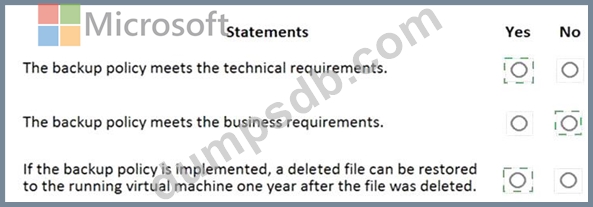
You are evaluating the proposed backup policy. For each of the following statements, select Yes if the statement is true. otherwise, select No. NOTE: Each correct selection is worth one point.
Correct Answer:
Explanation Box 1: Yes Scenario: Technical requirements: Ensure that an application server can be restored from a backup created during the last five days within 15 minutes. Instant Restore has 'The instance recovery snapshot(s) for 5 Day(s)'. Box 2: No Scenario: Ensure that all the production application servers can restore daily backups from the last 21 days. The Retention of daily backup point is set to for 14 days only. Box 3: Yes Reference: https://docs.microsoft.com/en-us/azure/backup/backup-instant-restore-capability
Question 114
Note: This question is part of a series of questions that present the same scenario. Each question in the series contains a unique solution that might meet the stated goals. Some question sets might have more than one correct solution, while others might not have a correct solution. After you answer a question in this section, you will NOT be able to return to it. As a result, these questions will not appear in the review screen. You have an SAP production landscape on-premises and an SAP development landscape on Azure. You deploy a network virtual appliance to act as a firewall between the Azure subnets and the on-premises network. You need to ensure that all traffic is routed through the network virtual appliance. Solution: You create an Azure Traffic Manager profile. Does this meet the goal?
Correct Answer: A
Question 115
You deploy an SAP environment on Azure. Your company has a Service Level Agreement (SLA) of 99.99% for SAP. You implement Azure Availability Zones that have the following components: Redundant SAP application servers ASCS/ERS instances that use a failover cluster Database high availability that has a primary instance and a secondary instance You need to validate the high availability configuration of the ASCS/ERS cluster. What should you use?
Correct Answer: B
C: You can use SAPControl to start or stop an SAP system from the command line. References: https://docs.microsoft.com/en-us/azure/architecture/reference-architectures/sap/sap-netweaver