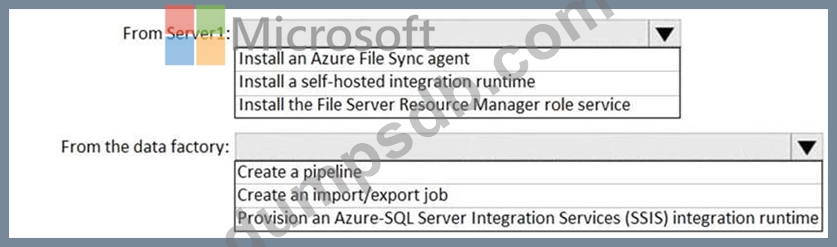
Your on-premises network contains a file server named Server1 that stores 500 GB of data. You need to use Azure Data Factory to copy the data from Server1 to Azure Storage. You add a new data factory. What should you do next? To answer, select the appropriate options in the answer area. NOTE: Each correct selection is worth one point.
Your company has the infrastructure shown in the following table. The on-premises Active Directory domain syncs to Azure Active Directory (Azure AD). Server1 runs an application named Appl that uses LDAP queries to verify user identities in the on-premises Active Directory domain. You plan to migrate Server1 to a virtual machine in Subscription1. A company security policy states that the virtual machines and services deployed to Subscription! must be prevented from accessing the on-premises network. You need to recommend a solution to ensure that Appl continues to function after the migration. The solution must meet the security policy. What should you include in the recommendation?
Correct Answer: D
You can join a Windows Server virtual machine to an Azure Active Directory Domain Services managed domain. Reference: https://docs.microsoft.com/en-us/azure/active-directory-domain-services/join-windows-vm
Question 43
You have an application named App1. App1 generates log files that must be archived for five years. The log files must be readable by App1 but must not be modified. Which storage solution should you recommend for archiving?
Correct Answer: B
Explanation Immutable storage for Azure Blob storage enables users to store business-critical data objects in a WORM (Write Once, Read Many) state. Immutable storage supports: Time-based retention policy support: Users can set policies to store data for a specified interval. When a time-based retention policy is set, blobs can be created and read, but not modified or deleted. After the retention period has expired, blobs can be deleted but not overwritten. Reference: https://docs.microsoft.com/en-us/azure/storage/blobs/storage-blob-immutable-storage
Question 44
You have an Azure subscription that is linked to an Azure Active Directory (Azure AD) tenant. The subscription contains 10 resource groups, one for each department at your company. Each department has a specific spending limit for its Azure resources. You need to ensure that when a department reaches its spending limit, the compute resources of the department shut down automatically. Which two features should you include in the solution? Each correct answer presents part of the solution. NOTE: Each correct selection is worth one point.
Correct Answer: C,D
C: The spending limit in Azure prevents spending over your credit amount. All new customers who sign up for an Azure free account or subscription types that include credits over multiple months have the spending limit turned on by default. The spending limit is equal to the amount of credit and it can't be changed. D: Turn on the spending limit after removing This feature is available only when the spending limit has been removed indefinitely for subscription types that include credits over multiple months. You can use this feature to turn on your spending limit automatically at the start of the next billing period. 1. Sign in to the Azure portal as the Account Administrator. 2. Search for Cost Management + Billing. 3. Etc. Reference: https://docs.microsoft.com/en-us/azure/cost-management-billing/manage/spending-limit Design Identity and Security Testlet 1 Case Study This is a case study. Case studies are not timed separately. You can use as much exam time as you would like to complete each case. However, there may be additional case studies and sections on this exam. You must manage your time to ensure that you are able to complete all questions included on this exam in the time provided. To answer the questions included in a case study, you will need to reference information that is provided in the case study. Case studies might contain exhibits and other resources that provide more information about the scenario that is described in the case study. Each question is independent of the other questions in this case study. At the end of this case study, a review screen will appear. This screen allows you to review your answers and to make changes before you move to the next section of the exam. After you begin a new section, you cannot return to this section. To start the case study To display the first question in this case study, click the Next button. Use the buttons in the left pane to explore the content of the case study before you answer the questions. Clicking these buttons displays information such as business requirements, existing environment, and problem statements. If the case study has an All Information tab, note that the information displayed is identical to the information displayed on the subsequent tabs. When you are ready to answer a question, click the Question button to return to the question. Existing Environment. Active Directory Environment The network contains two Active Directory forests named corp.fabrikam.com and rd.fabrikam.com. There are no trust relationships between the forests. Corp.fabrikam.com is a production forest that contains identities used for internal user and computer authentication. Rd.fabrikam.com is used by the research and development (R&D) department only. Existing Environment. Network Infrastructure Each office contains at least one domain controller from the corp.fabrikam.com domain. The main office contains all the domain controllers for the rd.fabrikam.com forest. All the offices have a high-speed connection to the Internet. An existing application named WebApp1 is hosted in the data center of the London office. WebApp1 is used by customers to place and track orders. WebApp1 has a web tier that uses Microsoft Internet Information Services (IIS) and a database tier that runs Microsoft SQL Server 2016. The web tier and the database tier are deployed to virtual machines that run on Hyper-V. The IT department currently uses a separate Hyper-V environment to test updates to WebApp1. Fabrikam purchases all Microsoft licenses through a Microsoft Enterprise Agreement that includes Software Assurance. Existing Environment. Problem Statements The use of WebApp1 is unpredictable. At peak times, users often report delays. At other times, many resources for WebApp1 are underutilized. Requirements. Planned Changes Fabrikam plans to move most of its production workloads to Azure during the next few years. As one of its first projects, the company plans to establish a hybrid identity model, facilitating an upcoming Microsoft Office 365 deployment. All R&D operations will remain on-premises. Fabrikam plans to migrate the production and test instances of WebApp1 to Azure and to use the S1 plan. Requirements. Technical Requirements Fabrikam identifies the following technical requirements: * Web site content must be easily updated from a single point. * User input must be minimized when provisioning new web app instances. * Whenever possible, existing on-premises licenses must be used to reduce cost. * Users must always authenticate by using their corp.fabrikam.com UPN identity. * Any new deployments to Azure must be redundant in case an Azure region fails. * Whenever possible, solutions must be deployed to Azure by using the Standard pricing tier of Azure App Service. * An email distribution group named IT Support must be notified of any issues relating to the directory synchronization services. * Directory synchronization between Azure Active Directory (Azure AD) and corp.fabrikam.com must not be affected by a link failure between Azure and the on-premises network. Requirements. Database Requirements Fabrikam identifies the following database requirements: * Database metrics for the production instance of WebApp1 must be available for analysis so that database administrators can optimize the performance settings. * To avoid disrupting customer access, database downtime must be minimized when databases are migrated. * Database backups must be retained for a minimum of seven years to meet compliance requirements. Requirements. Security Requirements Fabrikam identifies the following security requirements: * Company information including policies, templates, and data must be inaccessible to anyone outside the company. * Users on the on-premises network must be able to authenticate to corp.fabrikam.com if an Internet link fails. * Administrators must be able authenticate to the Azure portal by using their corp.fabrikam.com credentials. * All administrative access to the Azure portal must be secured by using multi-factor authentication. * The testing of WebApp1 updates must not be visible to anyone outside the company.
Question 45
You plan to migrate App1 to Azure. The solution must meet the authentication and authorization requirements. Which type of endpoint should App1 use to obtain an access token?
Correct Answer: D
Scenario: To access the resources in Azure, App1 must use the managed identity of the virtual machines that will host the app. Managed identities provide an identity for applications to use when connecting to resources that support Azure Active Directory (Azure AD) authentication. Applications may use the managed identity to obtain Azure AD tokens. Reference: https://docs.microsoft.com/en-us/azure/active-directory/managed-identities-azure-resources/overview