

Question 21
Exhibit.
You have a Fabric workspace that contains a write-intensive warehouse named DW1. DW1 stores staging tables that are used to load a dimensional model. The tables are often read once, dropped, and then recreated to process new data.
You need to minimize the load time of DW1.
What should you do?
Question 22
HOTSPOT
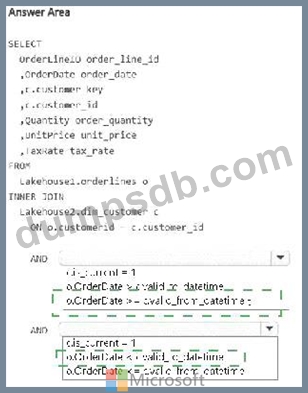
You have a Fabric workspace that contains two lakehouses named Lakehouse1 and Lakehouse2. Lakehouse1 contains staging data in a Delta table named Orderlines. Lakehouse2 contains a Type 2 slowly changing dimension (SCD) dimension table named Dim_Customer.
You need to build a query that will combine data from Orderlines and Dim_Customer to create a new fact table named Fact_Orders. The new table must meet the following requirements:
Enable the analysis of customer orders based on historical attributes.
Enable the analysis of customer orders based on the current attributes.
How should you complete the statement? To answer, select the appropriate options in the answer area.
NOTE: Each correct selection is worth one point.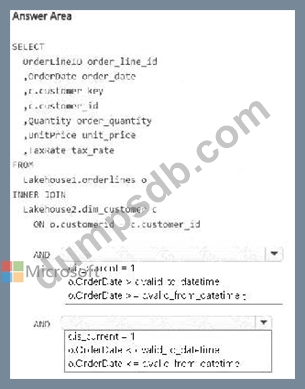

Question 23
Note: This question is part of a series of questions that present the same scenario. Each question in the series contains a unique solution that might meet the stated goals. Some question sets might have more than one correct solution, while others might not have a correct solution.
After you answer a question in this section, you will NOT be able to return to it. As a result, these questions will not appear in the review screen.
You have a Fabric eventstream that loads data into a table named Bike_Location in a KQL database. The table contains the following columns:
BikepointID
Street
Neighbourhood
No_Bikes
No_Empty_Docks
Timestamp
You need to apply transformation and filter logic to prepare the data for consumption. The solution must return data for a neighbourhood named Sands End when No_Bikes is at least 15. The results must be ordered by No_Bikes in ascending order.
Solution: You use the following code segment:
Does this meet the goal?
Question 24
You have a Fabric workspace named Workspace1 that contains a warehouse named DW1 and a data pipeline named Pipeline1.
You plan to add a user named User3 to Workspace1.
You need to ensure that User3 can perform the following actions:
View all the items in Workspace1.
Update the tables in DW1.
The solution must follow the principle of least privilege.
You already assigned the appropriate object-level permissions to DW1.
Which workspace role should you assign to User3?
Question 25
HOTSPOT
You are building a data loading pattern for Fabric notebook workloads.
You have the following code segment:
For each of the following statements, select Yes if the statement is true. Otherwise, select No.
NOTE: Each correct selection is worth one point.

