

Question 101
Your network contains an on-premises Active Directory domain that syncs to an Azure Active Directory (Azure AD) tenant- Users sign in to computers that run Windows 10 and are joined to the domain.
You plan to implement Azure AD Seamless Single Sign-On (Azure AD Seamless SSO).
You need to configure the computers for Azure AD Seamless SSO.
What should you do?
Question 102
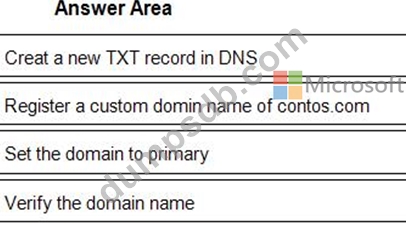
You have a new Microsoft 365 tenant that uses a domain name of contoso.conmicrosoft.com.
You register the name contoso.com with a domain registrar.
You need to use contoso.com as the default domain name for new Microsoft 365 users.
Which four actions should you perform in sequenced? To answer, move the appropriate actions from the list of actions to the answer area and arrange them in the correct order.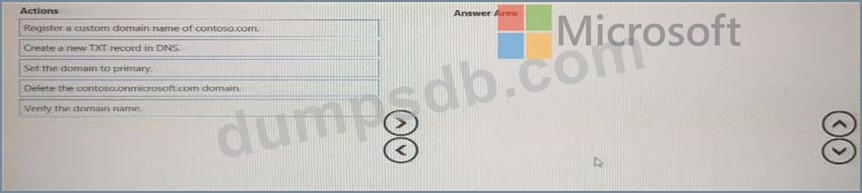
Question 103
You need to sync the ADatum users. The solution must meet the technical requirements.
What should you do?
Question 104
You have a Microsoft 365 tenant.
All users must use the Microsoft Authenticator app for multi-factor authentication (MFA) when accessing Microsoft 365 services.
Some users report that they received an MFA prompt on their Microsoft Authenticator app without initiating a sign-in request.
You need to block the users automatically when they report an MFA request that they did not Initiate.
Solution: From the Azure portal, you configure the Fraud alert settings for multi-factor authentication (MFA).
Does this meet the goal?
Question 105
Note: This question is part of a series of questions that present the same scenario. Each question in the series contains a unique solution that might meet the stated goals. Some question sets might have more than one correct solution, while others might not have a correct solution.
After you answer a question in this section, you will NOT be able to return to it. As a result, these questions will not appear in the review screen.
You have an Active Directory forest that syncs to an Azure Active Directory (Azure AD) tenant.
You discover that when a user account is disabled in Active Directory, the disabled user can still authenticate to Azure AD for up to 30 minutes.
You need to ensure that when a user account is disabled in Active Directory, the user account is immediately prevented from authenticating to Azure AD.
Solution: You configure Azure AD Password Protection.
Does this meet the goal?