

Question 21
An Order microservice and a Fulfillment microservice are being designed to communicate with their dients through message-based integration (and NOT through API invocations).
The Order microservice publishes an Order message (a kind of command message) containing the details of an order to be fulfilled. The intention is that Order messages are only consumed by one Mute application, the Fulfillment microservice.
The Fulfilment microservice consumes Order messages, fulfills the order described therein, and then publishes an OrderFulfilted message (a kind of event message). Each OrderFulfilted message can be consumed by any interested Mule application, and the Order microservice is one such Mute application.
What is the most appropriate choice of message broker(s) and message destination(s) in this scenario?
Question 22
A Mule application is deployed to a cluster of two(2) cusomter-hosted Mule runtimes. Currently the node name Alice is the primary node and node named bob is the secondary node. The mule application has a flow that polls a directory on a file system for new files.
The primary node Alice fails for an hour and then restarted.
After the Alice node completely restarts, from what node are the files polled, and what node is now the primary node for the cluster?
Question 23
A Mule application is synchronizing customer data between two different database systems.
What is the main benefit of using XA transaction over local transactions to synchronize these two database system?
Question 24
Refer to the exhibit.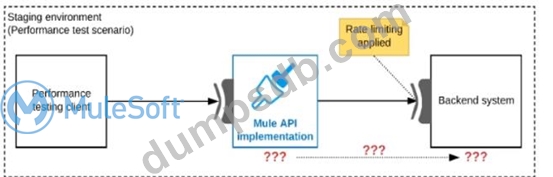
One of the backend systems invoked by an API implementation enforces rate limits on the number of requests a particular client can make. Both the backend system and the API implementation are deployed to several non-production environments in addition to production.
Rate limiting of the backend system applies to all non-production environments. The production environment, however, does NOT have any rate limiting.
What is the most effective approach to conduct performance tests of the API implementation in a staging (non-production) environment?
Question 25
An organization has decided on a cloudhub migration strategy that aims to minimize the organizations own IT resources. Currently, the organizational has all of its Mule applications running on its own premises and uses an premises load balancer that exposes all APIs under the base URL https://api.acme.com As part of the migration strategy, the organization plans to migrate all of its Mule applications and load balancer to cloudhub What is the most straight-forward and cost effective approach to the Mule applications deployment and load balancing that preserves the public URLs?