

Question 16
You must configure an Oracle Data Guard environment consisting of:
1. A primary database
2. Three Physical Standby Databases
You must meet these requirements:
1. A designated physical standby database should become the primary database automatically whenever the primary database fails.
2. The chosen protection mode should provide the highest level of protection possible without violating the other requirement.
Which redo transport mode and protection mode would you configure to meet these requirements?
Question 17
Examine the Data Guard configuration:
DGMGRL> show configuration;
Configuration -Animals
Protection Mode: MaxAvailability
Databases:
dogs- Primary database
cats- Snapshot standby database
sheep- Snapshot standby database
Fast-Start Failover: DISABLED
Configuration Status:
ORA-01034: ORACLE not available
ORA-16625: cannot reach database "dogs"
DGM-17017: unable to determine configuration status
You wish to perform a failover to Sheep.
Which command, or sequence of commands, should you issue to the broker before executing "failover to sheep", using the broker?
Question 18
Examine the Data Guard configuration:
DGMGRL> show configuration;
Configuration Animals
Protection Mode: MaxAvailability
Databases:
dogs Primary database
cats Physical standby database
sheep Logical standby database
Fast-Start Failover: DISABLED
Configuration Status:
SUCCESS
Which three will be true after a switchover to Sheep? (Choose three.)
Question 19
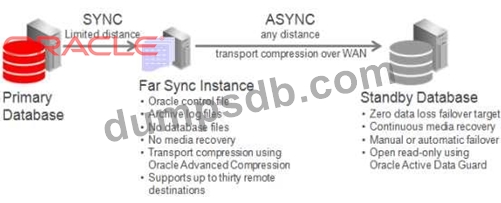
A customer has these requirements for their potential Data Guard implementation:
1. Zero data loss must still be guaranteed through the loss of any one configuration component.
2. The primary database must be protected against a regional disaster.
3. Performance overheads on the primary should be minimized as much as possible given these requirements.
4. Downtime on the primary database for any reason must be kept to a minimum.
Components referred to in the broker commands are: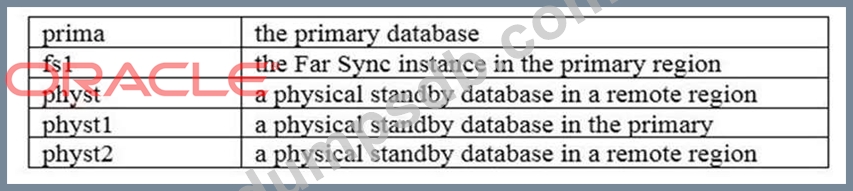
Which Data Guard broker commands are needed to implement these requirements?
Question 20
Examine this list of possible steps:
1 Raise the compatibility level on both databases
2 .Restart SQL Apply on the upgraded logical standby database
3 Start SQL Apply on the old primary database.
4 . Perform a Switchover to the logical standby database
5 . Upgrade the logical standby database.
6 . Upgrade the old primary database.
Which is the minimum number of steps in the correct order, to perform a rolling release upgrade of a data guard environment using an existing logical standby database and to enable the new functionality?