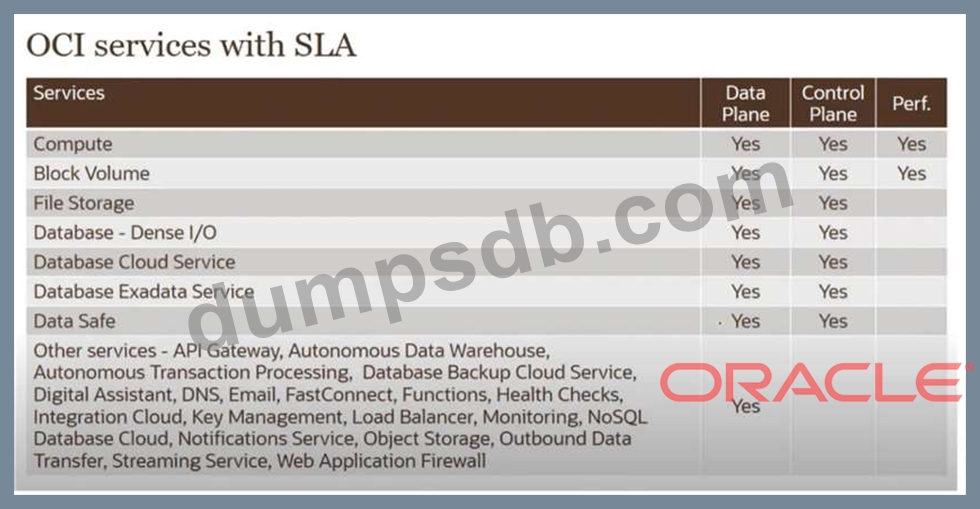
Why OCI is unique with SLA compared to other Cloud vendors like AWS,GCP and Azure?
Correct Answer: C
Only Oracle offers end-to-end SLAs covering performance, availability, and manageability Oracle Cloud Infrastructure SLA Only Oracle offers end-to-end SLAs covering performance, availability, and manageability: * Availability/Data Plane: services are in operation with uptime and connectivity commitments * Manageability/Control Plane: ability to manage, monitor, and modify Oracle Cloud Infrastructure resources * Performance: services consistently perform as expected Reference: https://www.youtube.com/watch?v=KP6EOGlRTvk&list=PLKCk3OyNwIzuHYigVbdtDOZOfChcotfj2&index =11
Question 57
Which Oracle Cloud Infrastructure (OCI) service leverages Terraform to configure infrastructure-as- code?
Correct Answer: E
Question 58
Which SLA type is not offered by Oracle Cloud Infrastructure compute service?
Correct Answer: C
Explanation Service Plane is NOT an SLA provided by OCI. See the table below:
Question 59
Which service level agreement type is NOT offered by Oracle Cloud Infrastructure Compute service?
Correct Answer: C
Explanation Oracle offers several different service level agreements as defined in this section (Service Level Agreements).Service level agreements range from least restrictive (data plane) to more restrictive (control plane) to most restrictive (performance).
Question 60
What two statements regarding the Virtual Cloud Network(VCN) are true?
Correct Answer: A,B
Explanation When you work with Oracle Cloud Infrastructure, one of the first steps is to set up a virtual cloud network (VCN) for your cloud resources. VIRTUAL CLOUD NETWORK (VCN) : A virtual, private network that you set up in Oracle data centers. It closely resembles a traditional network, with firewall rules and specific types of communication gateways that you can choose to use. A VCN resides in a singleOracle Cloud Infrastructure region and covers a single, contiguous IPv4 CIDR block of your choice. See Allowed VCN Size and Address Ranges. The terms virtual cloud network, VCN, and cloud network are used interchangeably in this documentation. For more information, see VCNs and Subnets. SUBNETS : Subdivisions you define in a VCN (for example, 10.0.0.0/24 and 10.0.1.0/24). Subnets contain virtual network interface cards (VNICs), which attach to instances. Each subnet consists of a contiguous range of IP addresses that do not overlap withother subnets in the VCN. You can designate a subnet to exist either in a single availability domainavailability domain or across an entire region (regional subnets are recommended). Subnets act as a unit of configuration within the VCN: All VNICs in a given subnet use the same route table, security lists, and DHCP options (see the definitions that follow). You can designate a subnet as either public or private when you create it. Private means VNICs in the subnet can't have public IP addresses. Public means VNICs in the subnet can have public IP addresses at your discretion. See Access to the Internet.