

Question 106
View the exhibit and examine the structure of the SALES, CUSTOMERS, PRODUCTS and TIMES tables.
The PROD_ID column is the foreign key in the SALES tables, which references the PRODUCTS table.
Similarly, the CUST_ID and TIME_ID columns are also foreign keys in the SALES table referencing the CUSTOMERS and TIMES tables, respectively.
Evaluate the following CREATE TABLE command:
CREATE TABLE new_sales (prod_id, cust_id, order_date DEFAULT SYSDATE)
AS
SELECT prod_id, cust_id, time_id
FROM sales;
Which statement is true regarding the above command?
Question 107
The ORDERS table has a primary key constraint on the ORDER_ID column.
The ORDER_ITEMS table has a foreign key constraint on the ORDER_ID column, referencing the primary key of the ORDERS table.
The constraint is defined with ON DELETE CASCADE.
There are rows in the ORDERS table with an ORDER_TOTAL of less than 1000.
Which three DELETE statements execute successfully?
Question 108
View the Exhibit and examine the structure of the EMP table which is not partitioned and not an index-organized table. (Choose two.)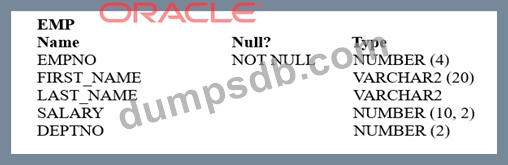
Evaluate this SQL statement:
ALTER TABLE emp
DROP COLUMN first_name;
Which two statements are true?
Question 109
Which three actions can you perform on an existing table containing data? (Choose three.)
Question 110
Which three statements are true about GLOBAL TEMPORARY TABLES?