

Question 11
You created an entity called "the person". You have written the following rule: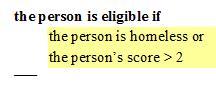
You test your rules in the Debugger with three entity instances of the person:
- Jane is not homeless; Jane's score is 3.
- Bill is homeless; Bill's score is 1.
- Angela is not homeless; Angela's score is 2.
What is the total score of all the persons who are eligible?
Question 12
Your policy model includes this rule:
the user is a minor if
the user's age < 18
Which two statements are true?
Question 13
What are three typical benefits of modeling business rules isomorphically (in a way that matches the source material) in Oracle Policy Automation?
Question 14
The federal poverty level for a family is the minimum amount of gross income that a family needs for certain basic necessities, such as transportation, food and shelter. This level is determined according to the number of members in the household.
A household of one member has a federal poverty level of $11,700.00, while a household with two members has a federal poverty level of $15,930 and a household of three members has a federal poverty level of
$20,090.
Your policy model needs to determine the federal poverty level for the family.
Which option is the input attribute based on the above source material?
Question 15
You are working on a new project with other policy modelers to build an interview where data will be saved to a connected application. Each policy modeler, including yourself, is working from their own machine. Place these development steps in order from first to last step undertaken. If a step is undertaken multiple times, note only the first time the step is taken. Some development steps have been omitted.
1: Deploy the project.
2: Add the project to a repository.
3: Download policy modeling.
4: Review the work of other policy modelers.
5: View interview usage statistics.
6: Map data to the data source.
7: Add connections.
8: Download changes.
9: Log in to the Hub.