You want to leverage a managed Real Application Cluster (RAC) offering in Oracle Cloud Infrastructure. which OCI Managed database service would you choose?
Correct Answer: B
There are 2 types of DB systems on virtual machines: A 1-node VM DB system consists of one VM. A 2-node VM DB system consists of two VMs clustered with RAC enabled. Reference: https://docs.cloud.oracle.com/en-us/iaas/Content/Database/Concepts/overview.htm Oracle Cloud Infrastructure offers single-node DB systems on either bare metal or virtual machines, and 2-node RAC DB systems on virtual machines. If you need to provision a DB system for development or testing purposes, then a special fast provisioning single-node virtual machine system is available. You can manage these systems by using the Console, the API, the Oracle Cloud Infrastructure CLI, the Database CLI (DBCLI), Enterprise Manager, Enterprise Manager Express, or SQL Developer.
Question 42
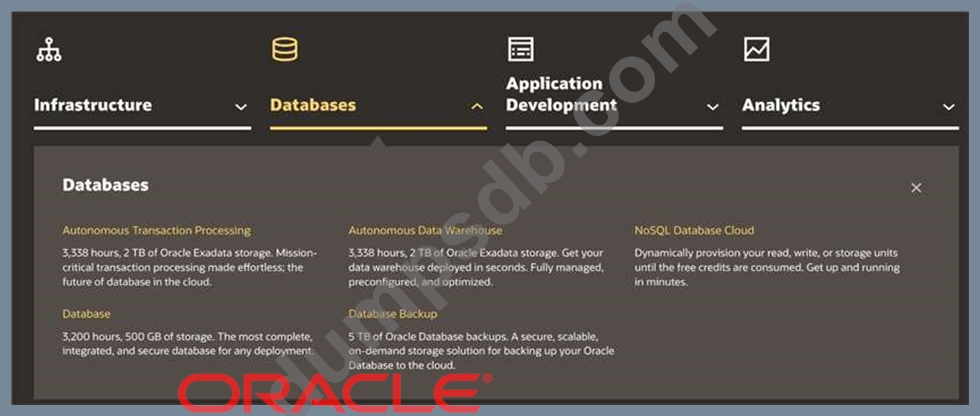
What service is NOT available as part of Oracle Cloud Free Tier?
Correct Answer: B
For more information on Oracle Cloud Infrastructure Free Tier refer below official documentation https://docs.cloud.oracle.com/en-us/iaas/Content/FreeTier/freetier.htm?Highlight=Free%20Tier Exadata DB Systems aren't a part of the free tier:
Question 43
Which Is NOT a supported target environment for deploying artifacts using the Oracle Cloud Infrastructure (OCI) DevOps service?
Correct Answer: C
Question 44
Which is NOT a valid business benefit for a customer considering migrating their infrastructure and apps to Oracle Cloud Infrastructure (OCI)?
Correct Answer: D
Oracle Cloud Infrastructure is a set of complementary cloud services that enable you to build and run a wide range of applications and services in a highly available hosted environment. Oracle Cloud Infrastructure offers high-performance compute capabilities (as physical hardware instances) and storage capacity in a flexible overlay virtual network that is securely accessible from your on-premises network. Reference: https://docs.cloud.oracle.com/en-us/iaas/Content/GSG/Concepts/baremetalintro.htm One of the major benefits of cloud computing is REDUCED TCO. Therefore, Increased TCO is the incorrect option.
Question 45
Which statement accurately describes an Oracle Cloud Infrastructure Region?
Correct Answer: B
Oracle Cloud Infrastructure is hosted in regions and availability domains. A region is a localized geographic area, and an availability domain is one or more data centers located within a region. A region is composed of one or more availability domains. Most Oracle Cloud Infrastructure resources are either region-specific, such as a virtual cloud network, or availability domain-specific, such as a compute instance. Traffic between availability domains and between regions is encrypted. Availability domains are isolated from each other, fault tolerant, and very unlikely to fail simultaneously. Because availability domains do not share infrastructure such as power or cooling, or the internal availability domain network, a failure at one availability domain within a region is unlikely to impact the availability of the others within the same region. The availability domains within the same region are connected to each other by a low latency, high bandwidth network, which makes it possible for you to provide high-availability connectivity to the internet and on-premises, and to build replicated systems in multiple availability domains for both high-availability and disaster recovery. A fault domain is a grouping of hardware and infrastructure within an availability domain. Each availability domain contains three fault domains. Fault domains provide anti-affinity: they let you distribute your instances so that the instances are not on the same physical hardware within a single availability domain. A hardware failure or Compute hardware maintenance event that affects one fault domain does not affect instances in other fault domains. In addition, the physical hardware in a fault domain has independent and redundant power supplies, which prevents a failure in the power supply hardware within one fault domain from affecting other fault domains.