

Question 41
See the Exhibit and examine the structure of the PROMOTIONS table: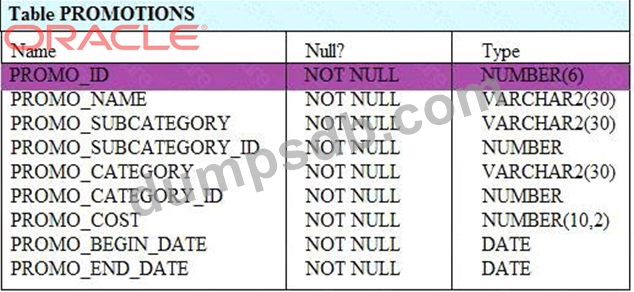
Using the PROMOTIONS table,
you need to find out the average cost for all promos in the range $0-2000 and $2000-5000 in category A.
You issue the following SQL statements: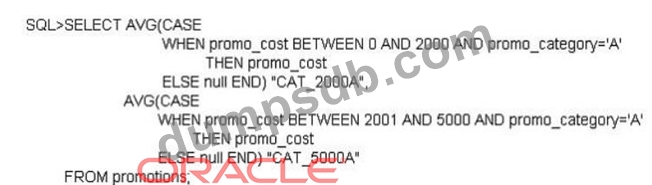
What would be the outcome?
Question 42
View the exhibit and examine the structure of the SALES, CUSTOMERS, PRODUCTS and TIMES tables.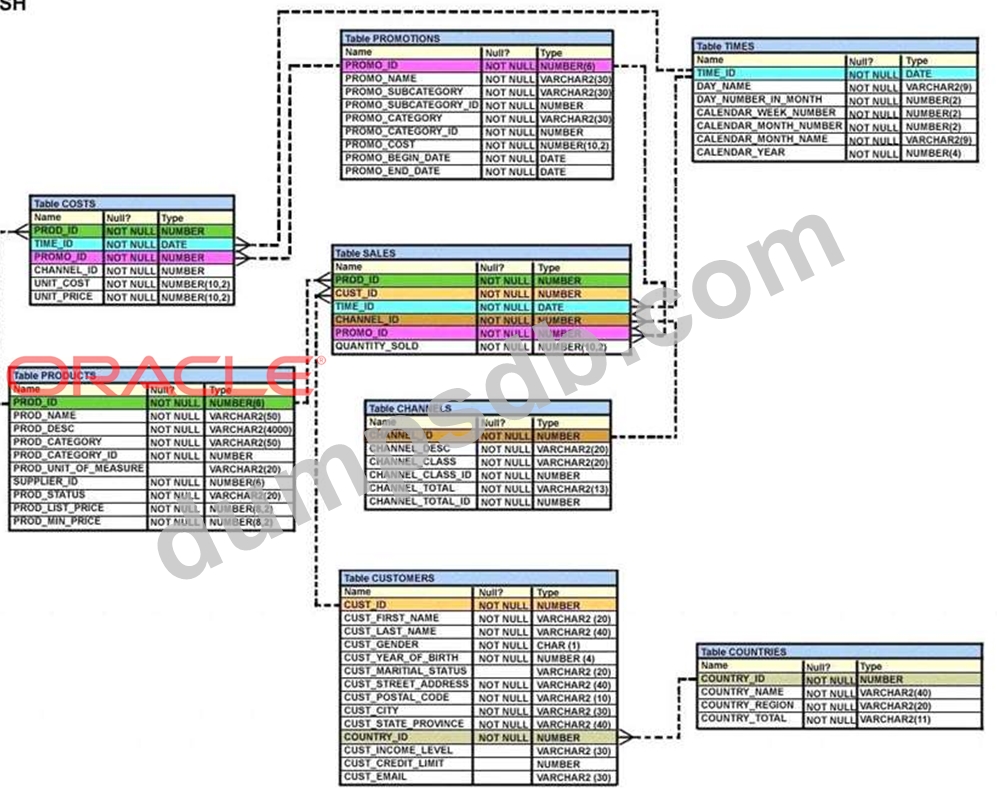
The PROD_ID column is the foreign key in the SALES table, which references the PRODUCTS table.
Similarly, the CUST_ID and TIME_ID columns are also foreign keys in the SALES table referencing the CUSTOMERS and TIMES tables, respectively.
Evaluate the following CREATE TABLE command:
CREATE TABLE new_sales (prod_id, cust_id, order_date DEFAULT SYSDATE)
AS
SELECT prod_id, cust_id, time_id
FROM sales;
Which statement is true regarding the above command?
Question 43
Evaluate the following SELECTstatement and view the exhibit to examine its output:
SELECT constraint_name, constraint_type, search_condition, r_constraint_name, delete_rule, status, FROM user_constraints WHERE table_name = 'ORDERS';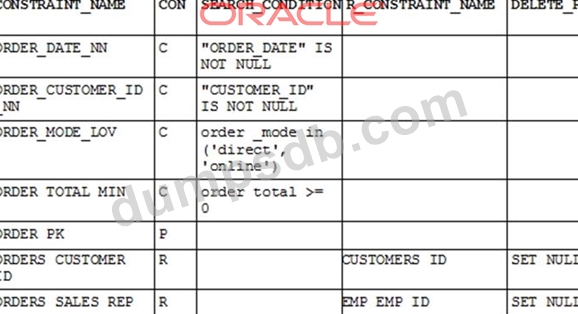
Which two statements are true about the output? (Choose two.)
Question 44
Examine this description of the PRODUCTS table:
You successfully execute this command:
CREATE TALE new_prices(prod_id NUBER(2),price NUMBER(8,2));
Which two statements execute without errors?
Question 45
View the Exhibit and examine the structure of the CUSTOMERStable.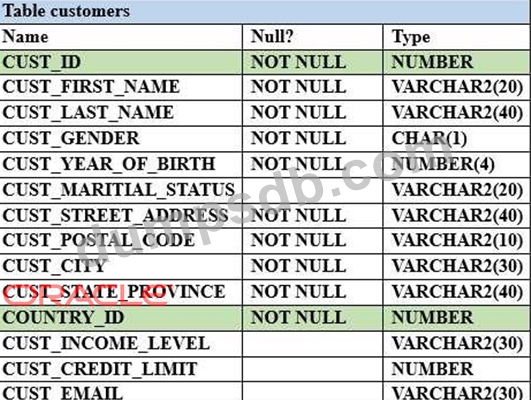
You want to generate a report showing the last names and credit limits of all customers whose last names start with A, B, or C, and credit limit is below 10,000.
Evaluate the following two queries:
SQL> SELECT cust_last_name, cust_credit_limit FROM customers
WHERE (UPPER(cust_last_name) LIKE 'A%' OR
UPPER (cust_last_name) LIKE 'B%' OR UPPER (cust_last_name) LIKE 'C%')
AND cust_credit_limit < 10000;
SQL>SELECT cust_last_name, cust_credit_limit FROM customers
WHERE UPPER (cust_last_name) BETWEEN 'A' AND 'C'
AND cust_credit_limit < 10000;
Which statement is true regarding the execution of the above queries?