

Question 211
The following are the steps for a correlated subquery, listed in random order:
1. The WHEREclause of the outer query is evaluated.
2. The candidate row is fetched from the table specified in the outer query.
3. The procedure is repeated for the subsequent rows of the table, till all the rows are processed.
4. Rows are returned by the inner query, after being evaluated with the value from the candidate row in the outer query.
Identify the option that contains the steps in the correct sequence in which the Oracle server evaluates a correlated subquery.
Question 212
Examine the structure of the MARKS table:
Which two statements would execute successfully? (Choose two.)
Question 213
Which two statements are true about the DUAL table? (Choose two.)
Question 214
View the Exhibit and examine the structure of the ORDERS table.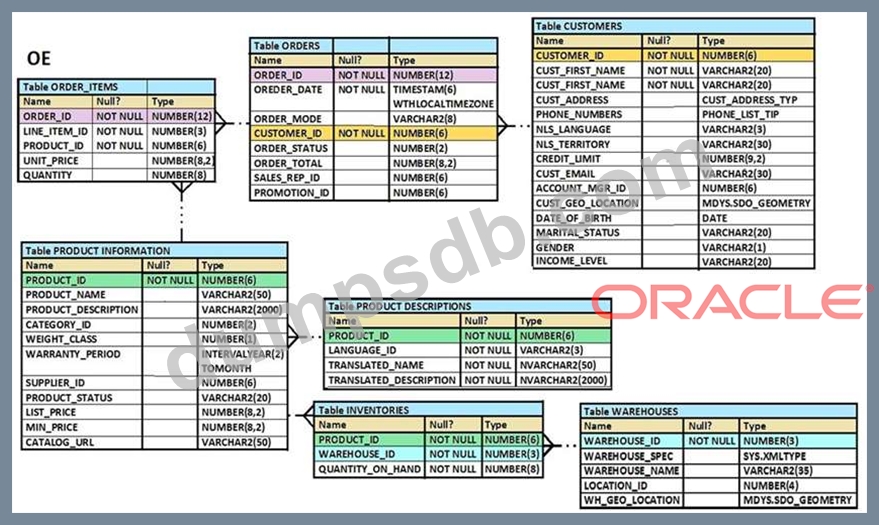
You must select ORDER_ID and ORDER_DATE for all orders that were placed after the last order placed by CUSTOMER_ID 101.
Which query would give you the desired result?
Question 215
Examine the structure of the EMPLOYEES table.
NameNull?Type
---------------------- ------------
EMPLOYEE_IDNOT NULLNUMBER(6)
FIRST_NAMEVARCHAR2(20)
LAST_NAMENOT NULLVARCHAR2(25)
EMAILNOT NULLVARCHAR2(25)
PHONE NUMBERVARCHAR2(20)
HIRE_DATENOT NULLDATE
JOB_IDNOT NULLVARCHAR2(10)
SALARYNUMBER(8,2)
COMMISSION_PCTNUMBER(2,2)
MANAGER_IDNUMBER(6)
DEPARTMENT_IDNUMBER(4)
There is a parent/child relationship between EMPLOYEE_ID and MANAGER_ID.
You want to display the last names and manager IDs of employees who work for the same manager as the employee whose EMPLOYEE_ID is 123.
Which query provides the correct output?