您詢問 IT 經理,為什麼組織仍在使用行動應用程序,而個人資料加密和假名化測試卻失敗了。此外,服務經理是否有權批准測試。 IT經理解釋說,根據軟體安全管理程序,測試結果應由他批准。加密和假名功能失敗的原因是這些功能嚴重降低了系統和服務效能。需要額外 150% 的資源來滿足這一點。服務經理同意存取控制足夠好並且可以接受。這就是服務經理簽署批准書的原因。 您正在準備審計結果。選擇正確的選項。
Correct Answer: B
According to ISO 27001:2022 Annex A Control 8.30, the organisation shall ensure that externally provided processes, products or services that are relevant to the information security management system are controlled. This includes developing and entering into licensing agreements that cover code ownership and intellectual property rights, and implementing appropriate contractual requirements related to secure design and coding in accordance with Annex A 8.25 and 8.2912 In this case, the organisation and the developer have performed security tests that failed, which indicates that the secure design and coding requirements of Annex A 8.29 were not met. The IT Manager explains that the encryption and pseudonymisation functions failed because they slowed down the system and service performance, and that an extra 150% of resources are needed to cover this. However, this does not justify the acceptance of the test results by the Service Manager, who is not authorised to approve the test according to the software security management procedure. The Service Manager should have consulted with the IT Manager, who is the owner of the process, and followed the procedure for handling nonconformities and corrective actions. The Service Manager's decision to continue the service based on access control alone exposes the organisation to the risk of compromising the confidentiality, integrity, and availability of personal data processed by the mobile app. Therefore, there is a nonconformity (NC) with clause 8.1, control A.8.30. Reference: 1: ISO/IEC 27001:2022 Lead Auditor (Information Security Management Systems) Course by CQI and IRCA Certified Training 1 2: ISO/IEC 27001 Lead Auditor Training Course by PECB 2
According to ISO 27001:2022 clause 8.1.4, the organisation shall ensure that externally provided processes, products or services that are relevant to the information security management system are controlled. This includes implementing appropriate contractual requirements related to information security with external providers, such as customers who send ICT equipment for reclamation12 In this case, the organisation offers ICT reclamation services, which involves processing customer ICT equipment that may contain sensitive or confidential information. The organisation should have a process in place to ensure that the customer ICT equipment is handled securely and in accordance with the customer's information security requirements. The process should include steps such as verifying the customer's identity and authorisation, checking the inventory and condition of the equipment, removing or destroying any labels or stickers that contain information about the equipment or the customer, wiping or erasing any data stored on the equipment, and documenting the actions taken and the results achieved12 The fact that the auditor noticed two servers on a bench with stickers that reveal the server's name, IP address and admin password indicates that the process for dealing with incoming shipments relating to customer IT security is not effective or not followed. This could pose a risk of unauthorised access, disclosure, or modification of the customer's information or systems. Therefore, the auditor should note the audit finding and check the process for dealing with incoming shipments relating to customer IT security, and determine whether there is a nonconformity with clause 8.1.4 of ISO 27001:202212 The other actions are not appropriate for the following reasons: A . Asking the ICT Manager to record an information security incident and initiate the information security incident management process is not appropriate because this is not an information security incident that affects the organisation's own information or systems. An information security incident is defined as a single or a series of unwanted or unexpected information security events that have a significant probability of compromising business operations and threatening information security12 In this case, the information security event affects the customer's information or systems, not the organisation's. Therefore, the organisation should follow the process for dealing with incoming shipments relating to customer IT security, not the process for information security incident management. C . Recording what the auditor has seen in the audit findings, but taking no further action is not appropriate because this would not address the root cause or the impact of the issue. The auditor has a responsibility to verify the effectiveness and compliance of the organisation's information security management system, and to report any nonconformities or opportunities for improvement12 Therefore, the auditor should check the process for dealing with incoming shipments relating to customer IT security, and determine whether there is a nonconformity with clause 8.1.4 of ISO 27001:2022. D . Raising a nonconformity against control 5.31 Legal, statutory, regulatory and contractual requirements is not appropriate because this control is not relevant to the issue. Control 5.31 requires the organisation to identify and comply with the legal, statutory, regulatory and contractual requirements that are applicable to the information security management system12 In this case, the issue is not about the organisation's compliance with the legal, statutory, regulatory and contractual requirements, but about the organisation's control of the externally provided processes, products or services that are relevant to the information security management system. Therefore, the auditor should check the process for dealing with incoming shipments relating to customer IT security, and determine whether there is a nonconformity with clause 8.1.4 of ISO 27001:2022. E . Raising a nonconformity against control 8.20 'network security' (networks and network devices shall be secured, managed and controlled to protect information in systems and applications) is not appropriate because this control is not relevant to the issue. Control 8.20 requires the organisation to secure, manage and control its own networks and network devices to protect the information in its systems and applications12 In this case, the issue is not about the organisation's network security, but about the organisation's control of the externally provided processes, products or services that are relevant to the information security management system. Therefore, the auditor should check the process for dealing with incoming shipments relating to customer IT security, and determine whether there is a nonconformity with clause 8.1.4 of ISO 27001:2022. F . Asking the auditee to remove the labels, then carry on with the audit is not appropriate because this would not address the root cause or the impact of the issue. The auditor should not interfere with the auditee's operations or suggest corrective actions during the audit, as this would compromise the auditor's objectivity and impartiality12 The auditor should check the process for dealing with incoming shipments relating to customer IT security, and determine whether there is a nonconformity with clause 8.1.4 of ISO 27001:2022. Reference: 1: ISO/IEC 27001:2022 Lead Auditor (Information Security Management Systems) Course by CQI and IRCA Certified Training 1 2: ISO/IEC 27001 Lead Auditor Training Course by PECB 2
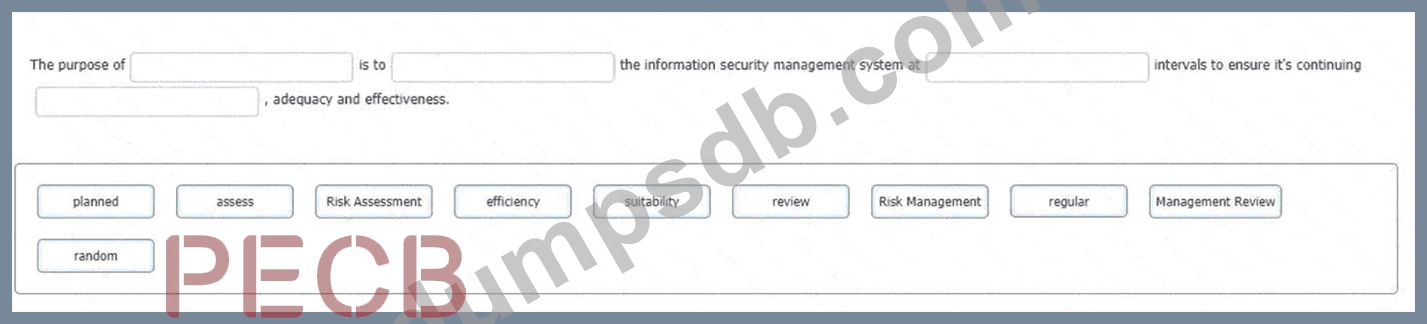
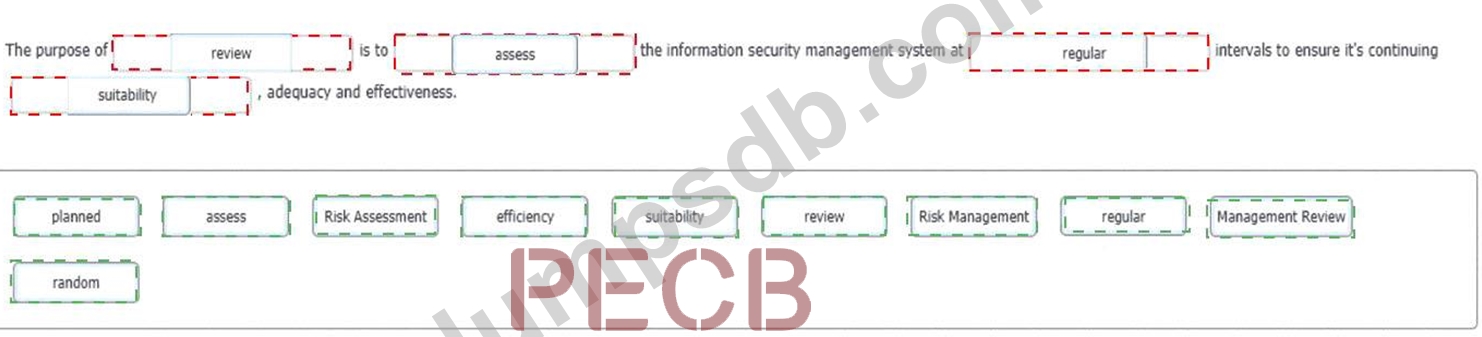
Explanation: * Review is the third stage of the Plan-Do-Check-Act (PDCA) cycle, which is a four-step model for implementing and improving an information security management system (ISMS) according to ISO /IEC 27001:202212. Review involves assessing and measuring the performance of the ISMS against the established policies, objectives, and criteria12. * Assess is the verb that describes the action of reviewing the ISMS. Assess means to evaluate, analyze, or measure something in a systematic and objective manner3. Assessing the ISMS involves collecting and verifying audit evidence, identifying strengths and weaknesses, and determining the degree of conformity or nonconformity12. * Regular is the adjective that describes the frequency or interval of reviewing the ISMS. Regular means occurring or done at fixed or uniform intervals4. Reviewing the ISMS at regular intervals means conducting internal audits and management reviews periodically, such as annually, quarterly, or monthly, depending on the needs and risks of the organization12. * Suitability is one of the attributes that describes the quality or outcome of reviewing the ISMS. Suitability means being appropriate or fitting for a particular purpose, person, or situation5. Reviewing the ISMS for suitability means ensuring that it is aligned with the organization's strategic direction, business objectives, and information security requirements12. References := * ISO/IEC 27001:2022 Information technology - Security techniques - Information security management systems - Requirements * ISO/IEC 27003:2022 Information technology - Security techniques - Information security management systems - Guidance * Assess | Definition of Assess by Merriam-Webster * Regular | Definition of Regular by Merriam-Webster * Suitability | Definition of Suitability by Merriam-Webster
The IRT's finding that FTP transmits authentication credentials in clear text represents a vulnerability in information security terms. A vulnerability is defined as a weakness in an asset, system, or control that can be exploited by a threat. In this scenario, FTP itself is not a threat, nor is it the risk; rather, it is the technical weakness that enabled the attackers to succeed. The attackers (hackers) are the threat, and the potential loss of proprietary information is the impact. The risk arises from the combination of the threat exploiting the vulnerability and causing harm. However, the question specifically asks what the IRT's finding about FTP represents, and that finding is the identification of a weakness in the system design. The use of clear-text authentication is a well-known security weakness, making it easier for attackers to capture credentials through network traffic interception. ISO/IEC 27001:2022 risk assessment logic requires organizations to distinguish clearly between threats, vulnerabilities, and risks during incident analysis. The IRT did exactly this by identifying that the protocol itself lacked encryption, which is a vulnerability. This is further supported by the corrective action taken: replacing FTP with SSH. SSH provides encrypted communication, which directly addresses the vulnerability by removing the weakness that allowed credential exposure. Therefore, the IRT's findings correctly identify FTP as a vulnerability, making option A the correct answer.
Question 140
在第三方認證審核期間,受審核方會提供您問題清單。下列哪四項構成 ISO 27001:2022 管理系統中的「內部」問題?
Correct Answer: C,D,E,G
According to ISO 27001:2022 clause 4.1, the organisation shall determine external and internal issues that are relevant to its purpose and that affect its ability to achieve the intended outcome(s) of its information security management system (ISMS)12 External issues are factors outside the organisation that it cannot control, but can influence or adapt to. They include political, economic, social, technological, legal, and environmental factors that may affect the organisation's information security objectives, risks, and opportunities12 Internal issues are factors within the organisation that it can control or change. They include the organisation's structure, culture, values, policies, objectives, strategies, capabilities, resources, processes, activities, relationships, and performance that may affect the organisation's information security management system12 Therefore, the following issues are considered 'internal' in the context of a management system to ISO 27001:2022: Poor levels of staff competence as a result of cuts in training expenditure: This is an internal issue because it relates to the organisation's capability, resource, and process of developing and maintaining the competence of its personnel involved in the ISMS. The organisation can control or change its training expenditure and its impact on staff competence12 Poor morale as a result of staff holidays being reduced: This is an internal issue because it relates to the organisation's culture, value, and relationship with its employees. The organisation can control or change its staff holiday policy and its impact on staff morale12 Increased absenteeism as a result of poor management: This is an internal issue because it relates to the organisation's performance, structure, and accountability of its management. The organisation can control or change its management practices and its impact on staff absenteeism12 A fall in productivity linked to outdated production equipment: This is an internal issue because it relates to the organisation's capability, resource, and process of ensuring the availability and suitability of its production equipment. The organisation can control or change its equipment maintenance and upgrade and its impact on productivity12 The following issues are considered 'external' in the context of a management system to ISO 27001:2022: Higher labour costs as a result of an aging population: This is an external issue because it relates to the social and demographic factor that affects the availability and cost of labour in the market. The organisation cannot control or change the aging population, but can influence or adapt to its impact on labour costs12 A rise in interest rates in response to high inflation: This is an external issue because it relates to the economic and monetary factor that affects the cost and availability of capital in the market. The organisation cannot control or change the interest rates or inflation, but can influence or adapt to its impact on capital costs12 A reduction in grants as a result of a change in government policy: This is an external issue because it relates to the political and legal factor that affects the availability and conditions of public funding for the organisation. The organisation cannot control or change the government policy, but can influence or adapt to its impact on grants12 Inability to source raw materials due to government sanctions: This is an external issue because it relates to the political and legal factor that affects the availability and cost of raw materials in the market. The organisation cannot control or change the government sanctions, but can influence or adapt to its impact on raw materials12 Reference: 1: ISO/IEC 27001:2022 Lead Auditor (Information Security Management Systems) Course by CQI and IRCA Certified Training 1 2: ISO/IEC 27001 Lead Auditor Training Course by PECB 2