

Question 21
In their legacy system. Universal Containers has a monthly accounts receivable report that compiles data from Accounts, Contacts, Opportunities, Orders. and Order Line Items. What difficulty will an architect run into when implementing this in Salesforce?
Question 22
Universal Containers (UC) loads bulk leads and campaigns from third-party lead aggregators on a weekly and monthly basis. The expected lead record volume is 500K records per week, and the expected campaign records volume is 10K campaigns per week. After the upload, Lead records are shared with various sales agents via sharing rules and added as Campaign members via Apex triggers on Lead creation. UC agents work on leads for 6 months, but want to keep the records in the system for at least 1 year for reference. Compliance requires them to be stored for a minimum of 3 years. After that, data can be deleted. What statement is true with respect to a data archiving strategy for UC?
Question 23
DreamHouse Realty has a data model as shown in the image. The Project object has a private sharing model, and it has Roll-Up summary fields to calculate the number of resources assigned to the project, total hours for the project, and the number of work items associated to the project.
There will be a large amount of time entry records to be loaded regularly from an external system into Salesforce.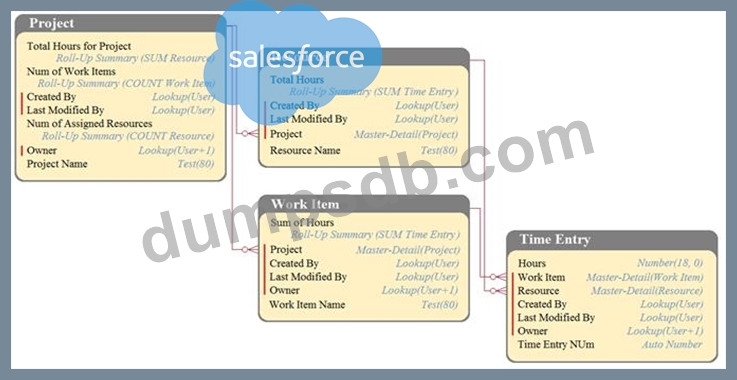
What should the Architect consider in this situation?
Question 24
Northern Trail Outfitters (NTO) has the following systems:
Customer master-source of truth for customer information
Service cloud-customer support
Marketing cloud-marketing support
Enterprise data warehouse-business reporting
The customer data is duplicated across all these system and are not kept in sync. Customers are also complaining that they get repeated marketing emails and have to call into update their information.
NTO is planning to implement master data management (MDM) solution across the enterprise.
Which three data will an MDM tool solve?
Choose 3 answers
Question 25
Northern Trail Outfitters (NTO) has outgrown its current Salesforce org and will be migrating to a new org shortly. As part of this process, NTO will be migrating all of its metadata and data. NTO's data model in the source org has a complex relationship hierarchy with several master-detail and lookup relationships across objects, which should be maintained in the target org.
Which three things should a data architect do to maintain the relationship hierarchy during migration? (Choose three.)