

Question 31
A Mule application uses APIkit for SOAP to implement a SOAP web service. The Mule application has been deployed to a CloudHub worker in a testing environment.
The integration testing team wants to use a SOAP client to perform Integration testing. To carry out the integration tests, the integration team must obtain the interface definition for the SOAP web service.
What is the most idiomatic (used for its intended purpose) way for the integration testing team to obtain the interface definition for the deployed SOAP web service in order to perform integration testing with the SOAP client?
Question 32
A new Mule application under development must implement extensive data transformation logic. Some of the data transformation functionality is already available as external transformation services that are mature and widely used across the organization; the rest is highly specific to the new Mule application.
The organization follows a rigorous testing approach, where every service and application must be extensively acceptance tested before it is allowed to go into production.
What is the best way to implement the data transformation logic for this new Mule application while minimizing the overall testing effort?
Question 33
Refer to the exhibit.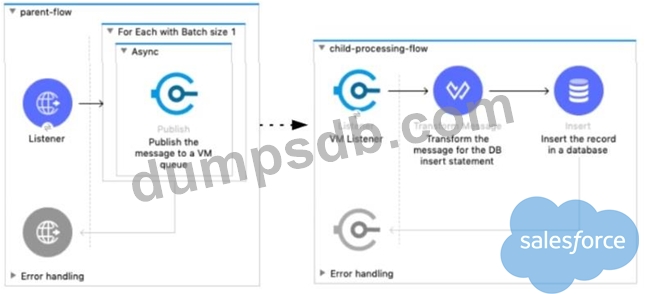
A Mule 4 application has a parent flow that breaks up a JSON array payload into 200 separate items, then sends each item one at a time inside an Async scope to a VM queue.
A second flow to process orders has a VM Listener on the same VM queue. The rest of this flow processes each received item by writing the item to a database.
This Mule application is deployed to four CloudHub workers with persistent queues enabled.
What message processing guarantees are provided by the VM queue and the CloudHub workers, and how are VM messages routed among the CloudHub workers for each invocation of the parent flow under normal operating conditions where all the CloudHub workers remain online?
Question 34
An application deployed to a runtime fabric environment with two cluster replicas is designed to periodically trigger of flow for processing a high-volume set of records from the source system and synchronize with the SaaS system using the Batch job scope After processing 1000 records in a periodic synchronization of 1 lakh records, the replicas in which batch job instance was started went down due to unexpected failure in the runtime fabric environment What is the consequence of losing the replicas that run the Batch job instance?
Question 35
According to the National Institute of Standards and Technology (NIST), which cloud computing deployment model describes a composition of two or more distinct clouds that support data and application portability?