Latest OGEA-101 Exam Premium Dumps provide by TrainingQuiz.com to help you Passing OGEA-101 Exam! TrainingQuiz.com offers the updated OGEA-101 exam dumps, the TrainingQuiz.com OGEA-101 exam questions has been updated to correct Answer. Get the latest TrainingQuiz.com OGEA-101 pdf dumps with Exam Engine here:
(168 Q&As Dumps, 40%OFF Special Discount: DumpsDB)
Refer to the table below: Which ADM Phase does this describe?
Correct Answer: B
Phase B of the ADM cycle is the Business Architecture phase. It describes the development of a Business Architecture to support an agreed Architecture Vision. The objectives of this phase are to describe the baseline and target Business Architecture, identify candidate Architecture Roadmap components based on gaps between the baseline and target, and determine whether an incremental approach is required. Reference: The TOGAF Standard | The Open Group Website, Section 3.2.2 Phase B: Business Architecture.
Question 17
In the ADM, what is the name for documents that are not finished and not approved?
Correct Answer: B
* In TOGAF, draft deliverables are those that are not yet finished or approved. They are work-in- progress versions that may have version numbers like 0.1, 0.5, or 0.9. * Once reviewed and approved, they become final deliverables. Reference: TOGAF Standard, Version 9.2, Deliverables, Artifacts, and Building Blocks.
Question 18
Consider the following statements: 1. Groups of countries, governments, or governmental organizations (such as militaries) working together to create common or shareable deliverables or infrastructures 2. Partnerships and alliances of businesses working together, such as a consortium or supply chain What are those examples of according to the TOGAF Standard?
Correct Answer: D
According to the TOGAF standard, the two statements provided refer to different scopes within which architecture can be developed: 1.Groups of countries, governments, or governmental organizations working together typically align with broader, often international, scopes of architecture that transcend individual enterprise boundaries. 1.Partnerships and alliances of businesses working together, such as a consortium or supply chain, refer to collaborative efforts that can define architecture at a scope involving multiple enterprises. In both cases, the term "Architectures Scopes" is appropriate because it reflects the varying levels and contexts in which architectures can be defined, ranging from single business units to collaborative inter-organizational efforts.
Question 19
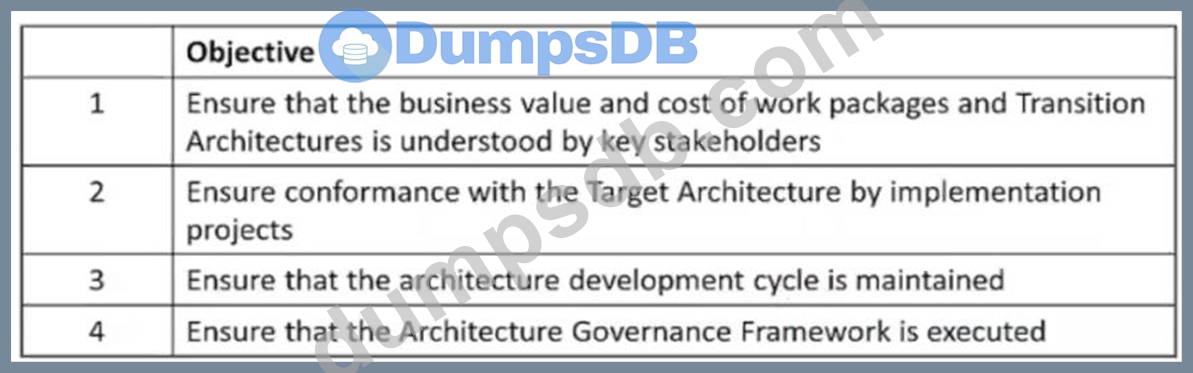
Consider the following ADM phases objectives. Which phase does each objective match?
Correct Answer: B
According to the TOGAF Standard, Version 9.2, the ADM phases and their objectives are as follows1: Preliminary Phase: To prepare and initiate the architecture development cycle, including defining the architecture framework, principles, and governance. Phase A: Architecture Vision: To define the scope, vision, and stakeholders of the architecture initiative, and to obtain approval to proceed. Phase B: Business Architecture: To describe the baseline and target business architecture, and to identify the gaps between them. Phase C: Information Systems Architectures: To describe the baseline and target data and application architectures, and to identify the gaps between them. Phase D: Technology Architecture: To describe the baseline and target technology architecture, and to identify the gaps between them. Phase E: Opportunities and Solutions: To identify and evaluate the opportunities and solutions for implementing the target architecture, and to define the work packages and transition architectures. Phase F: Migration Planning: To finalize the implementation and migration plan, and to ensure alignment with the enterprise portfolio and project management. Phase G: Implementation Governance: To provide architecture oversight and guidance for the implementation projects, and to manage any architecture change requests. Phase H: Architecture Change Management: To monitor the changes in the business and technology environment, and to assess the impact and performance of the architecture. Requirements Management: To manage the architecture requirements throughout the ADM cycle, and to ensure alignment with the business requirements. Based on the above definitions, we can match each objective with the corresponding phase as follows: Objective 1: Ensure that the business value and cost of work packages and transition architectures is understood by key stakeholders. This objective is achieved in Phase H: Architecture Change Management, where the value realization and cost-benefit analysis of the architecture are performed2. Objective 2: Ensure conformance with the Target Architecture by implementation projects. This objective is achieved in Phase F: Migration Planning, where the conformance requirements and criteria for the implementation projects are defined3. Objective 3: Ensure that the architecture development cycle is maintained. This objective is achieved in Phase F: Migration Planning, where the architecture roadmap and iteration cycle are maintained3. Objective 4: Ensure that the Architecture Governance Framework is executed. This objective is achieved in Phase G: Implementation Governance, where the architecture governance processes and procedures are applied to the implementation projects4. Reference: 1: The TOGAF Standard, Version 9.2, Chapter 5: Architecture Development Method (ADM) 2: The TOGAF Standard, Version 9.2, Chapter 21: Architecture Change Management 3: The TOGAF Standard, Version 9.2, Chapter 20: Migration Planning 4: The TOGAF Standard, Version 9.2, Chapter 19: Implementation Governance
Question 20
Consider the following ADM phases objectives. Which phase does each objective match?
Correct Answer: B
* According to the TOGAF Standard, Version 9.2, the ADM phases and their objectives are as follows1: * Preliminary Phase: To prepare and initiate the architecture development cycle, including defining the architecture framework, principles, and governance. * Phase A: Architecture Vision: To define the scope, vision, and stakeholders of the architecture initiative, and to obtain approval to proceed. * Phase B: Business Architecture: To describe the baseline and target business architecture, and to identify the gaps between them. * Phase C: Information Systems Architectures: To describe the baseline and target data and application architectures, and to identify the gaps between them. * Phase D: Technology Architecture: To describe the baseline and target technology architecture, and to identify the gaps between them. * Phase E: Opportunities and Solutions: To identify and evaluate the opportunities and solutions for implementing the target architecture, and to define the work packages and transition architectures. * Phase F: Migration Planning: To finalize the implementation and migration plan, and to ensure alignment with the enterprise portfolio and project management. * Phase G: Implementation Governance: To provide architecture oversight and guidance for the implementation projects, and to manage any architecture change requests. * Phase H: Architecture Change Management: To monitor the changes in the business and technology environment, and to assess the impact and performance of the architecture. * Requirements Management: To manage the architecture requirements throughout the ADM cycle, and to ensure alignment with the business requirements. * Based on the above definitions, we can match each objective with the corresponding phase as follows: * Objective 1: Ensure that the business value and cost of work packages and transition architectures is understood by key stakeholders. This objective is achieved in Phase H: Architecture Change Management, where the value realization and cost-benefit analysis of the architecture are performed2. * Objective 2: Ensure conformance with the Target Architecture by implementation projects. This objective is achieved in Phase F: Migration Planning, where the conformance requirements and criteria for the implementation projects are defined3. * Objective 3: Ensure that the architecture development cycle is maintained. This objective is achieved in Phase F: Migration Planning, where the architecture roadmap and iteration cycle are maintained3. * Objective 4: Ensure that the Architecture Governance Framework is executed. This objective is achieved in Phase G: Implementation Governance, where the architecture governance processes and procedures are applied to the implementation projects4.