

Question 1
A virtualization administrator has been tasked with migrating several business applications from physical to virtual. The administrator must also migrate the virtual machines from VMware Workstation to vSphere 6.5, using vCenter Converter Standalone 6.1.
In this scenario, when two source types are supported? (Choose two.)
Question 2
A company wants to deploy a new application based on containers. The application will be hosted on a dedicated cluster in order to guarantee resources and SLAs. Storage, networking, and compute requirements will scale linearly with the amount of users on the application.
Hardware should be minimized to reduce complexity and vendor engagement but NOT allow single points of failure.
Shift from CAPEX spending to OPEX.
Lowering TCO is a priority.
Which solution fulfill all of the customer's requirements?
Question 3
CORRECT TEXT
Customer Information
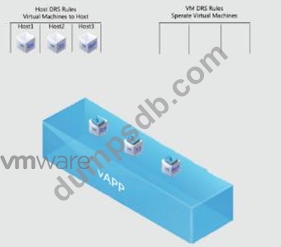
The Customer Labtown has a new vSphere 5 environment with one of their line of business applications recently being virtulized. Labtown requires that their Webserver, Database Server, and Fileserver for their line of business app be created into a vAPP. The VM's should start up in a specific order to insure the application starts correctly after an outage or reboot. Labtown also wants the best performance possible out of each VM. There is three hosts in the cluster each running the same CPU and Memory specifications. each host is running at 60% utilization right now. Labtown doesn't have any budget for more hosts.
Create a logical vAPP design for Labtowns Line of Business Application
Requirements
- The server must boot in the following order: DB, Fileserver, WebServer
- Each VM must perform the best it can with the current cluster configuration Instructions
- Place the three VM's on the vAPP
- Place the boot order boxes ontop of each VM to indicate the VM's boot order
- Place the VM stencil for each VM in the DRS rules section if you wish to apply DRS rules to the design
- As long as VM's are on the vAPP stencil marks will be scored
Question 4
A company has requested a new vSphere 6.5 design that will allow it to finally break the
80% virtualization barrier by virtualizing its resource-intensive application.
* The application is highly available by design and includes application-aware clustering software capable of operating as a fully distributed system.
* The company's Application Version 2.0 consists of 386 small applications and middleware with non-persistent storage and 24 database virtual machines at each data center.
* When coupled with a proper load balancing solution, this application can continue operating even with the loss of an entire data center, but the small applications and middleware tiers within a data center must exist within the same broadcast domain.
* The database tier is tightly controlled with a firewall policy that only allows middleware tier access, and is replicated to other sites using a dedicated circuit.
Which two application requirements apply to this scenario? (Choose two.)
Question 5
A solution architect has been tasked with designing a new environment that meets the growing needs of a company, and has obtained this information:
- Each new server will use a single 2-port 10Gb Converged Network Adapter (CNA) for both network and storage access.
- The network team has replaced all network equipment with a 10Gb fabric.
- The new environment will host both web servers and Oracle database servers.
- Resources will not be overcommitUid under regular upon at ions to mitigate performance issues.
- The business needs a tool to understand application failures.
- $lmillion has been budgeted for the data center expansion project.
Based this information, which two statements are requirements for the new design? (Choose two.)