

Question 41
If someone wanted to constrain a project's end date so that any project slippage would cause negative float, they would do so by using
Question 42
For activity 11001. why would the crashed direct cost be greater than the direct cost of the normal schedule?
Question 43
When resource leveling craft labor for a critical path schedule, the scheduler
Question 44
Why does activity 11001 not show successor activities?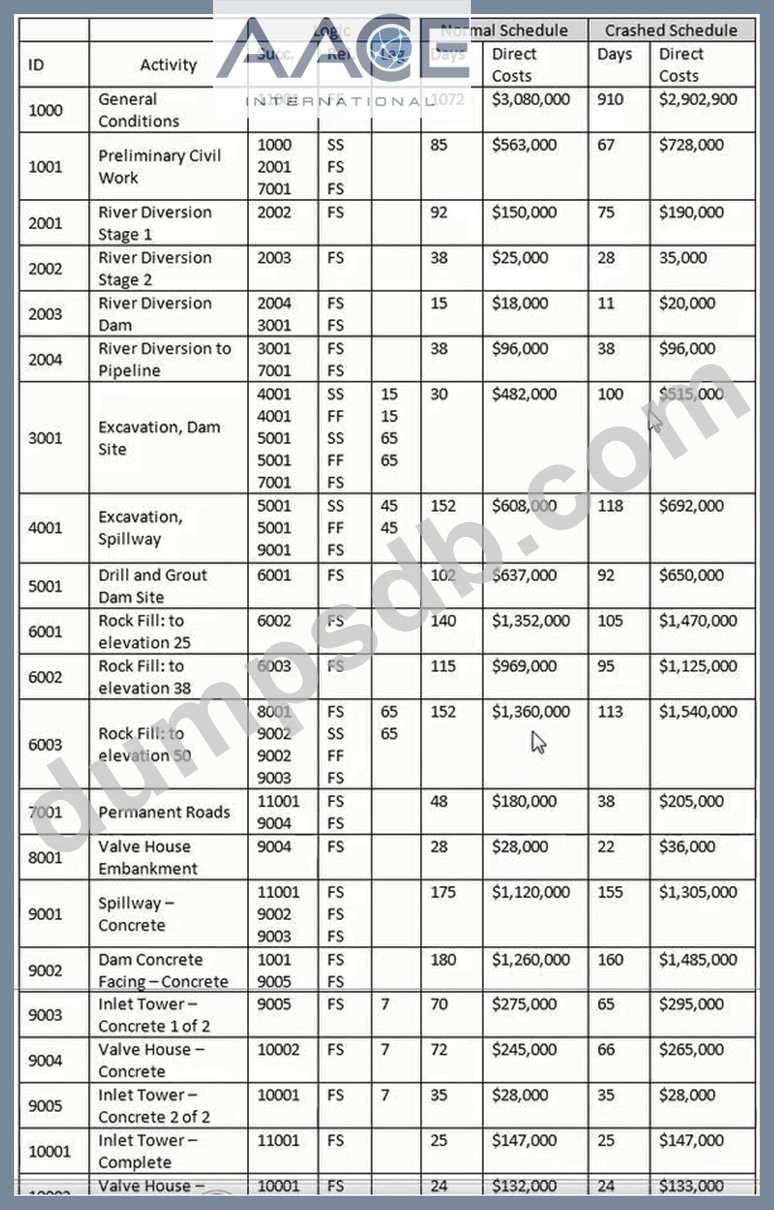
Question 45
Scenario:
The entire network consists of the following activities and relationships. Activity A is twenty days long and is tied to Activity B, a ten-day activity, with a finish-to-finish tie with a lag value of five Activity B is tied to Activity C, a twenty-day activity, with a start-to-start relationship with a lag value of five.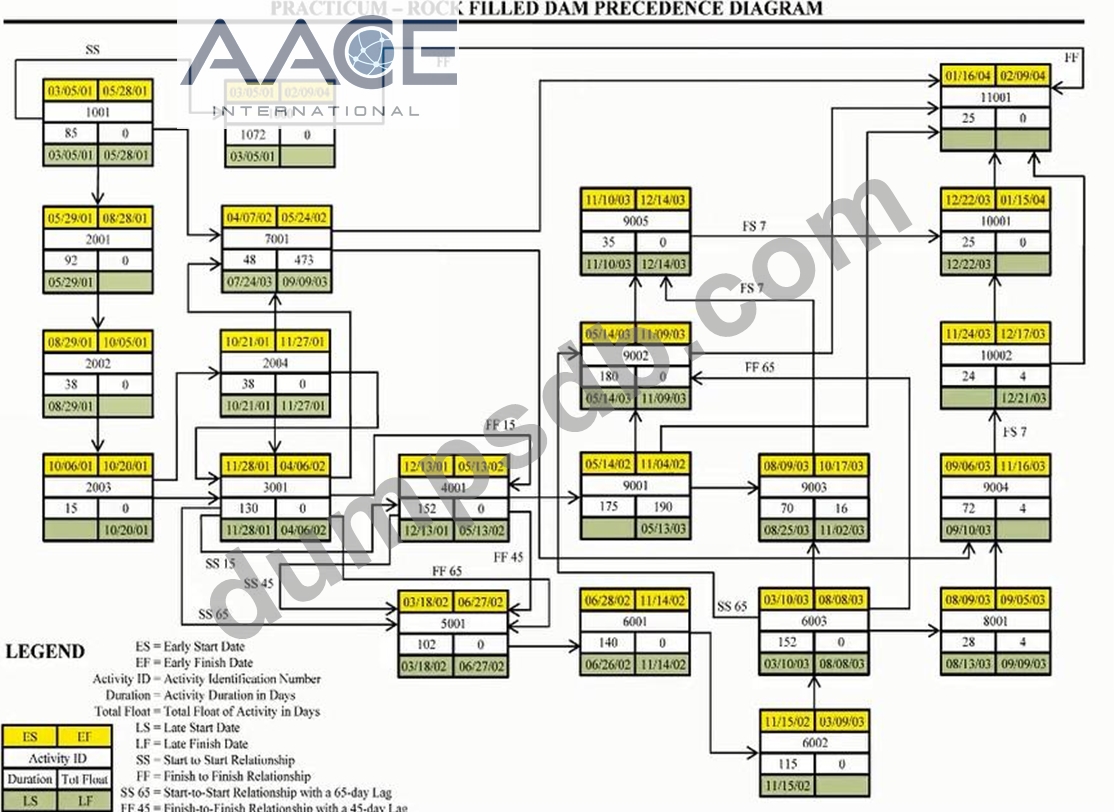
PSP Activities Table
Scope Known about Rock-Filled Dam Project:
The dam requires river diversion and work over two or more rainy seasons. The contract is lump sum, competitively bid, and will be self-performed. The owner has attempted to shift all risk to the contractor by employing "no differing sit conditions" and "no damage for delay" clauses. There is a bonus/penalty provision of $2,500 per calendar day for early or late delivery. The early completion bonus is capped at $500,000, with no cap for late delivery penalty.
Liquidated damages end at the finish of demobilization. Indirect costs per calendar day are $2,800 for the "normal" schedule and $3,200 for the "crashed" schedule. The winter/wet weather season is 151 days between October 15 and March 25 of each year, reduces the efficiency of the contractor's operations by 20% and costs the contractor $10,000 per day. Assume a start date of March 5, 2001 and use a 7-day work week.
The following table lists work activities as planned by the contractor.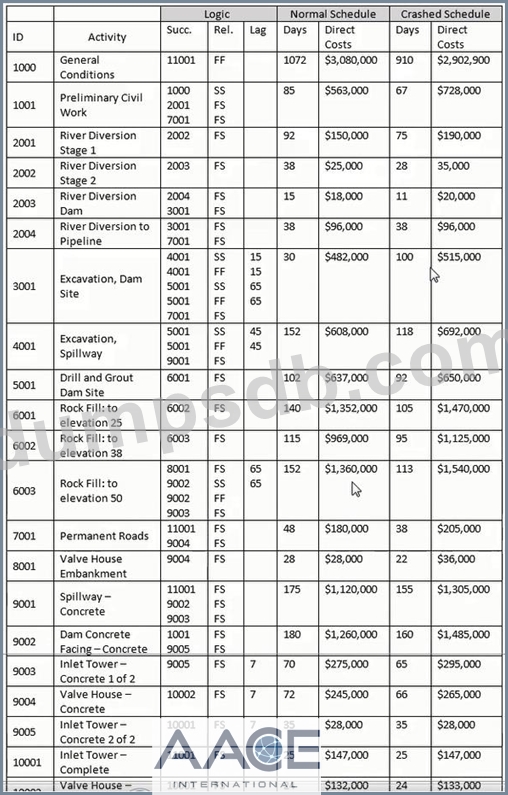
Theoretically construct a summary activity for only those activities with a finish-to-start relationship for Activities 8001 through 10001. Using the "normal" schedule, what is the cost of this hammock?