

Question 51
A Data Scientist is developing a machine learning model to classify whether a financial transaction is fraudulent. The labeled data available for training consists of 100,000 non-fraudulent observations and 1,000 fraudulent observations.
The Data Scientist applies the XGBoost algorithm to the data, resulting in the following confusion matrix when the trained model is applied to a previously unseen validation dataset. The accuracy of the model is 99.1%, but the Data Scientist has been asked to reduce the number of false negatives.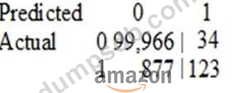
Which combination of steps should the Data Scientist take to reduce the number of false positive predictions by the model? (Choose two.)
Question 52
A retail company wants to update its customer support system. The company wants to implement automatic routing of customer claims to different queues to prioritize the claims by category.
Currently, an operator manually performs the category assignment and routing. After the operator classifies and routes the claim, the company stores the claim's record in a central database. The claim's record includes the claim's category.
The company has no data science team or experience in the field of machine learning (ML). The company's small development team needs a solution that requires no ML expertise.
Which solution meets these requirements?
Question 53
The chief editor for a product catalog wants the research and development team to build a machine learning system that can be used to detect whether or not individuals in a collection of images are wearing the company's retail brand. The team has a set of training data.
Which machine learning algorithm should the researchers use that BEST meets their requirements?
Question 54
A company is observing low accuracy while training on the default built-in image classification algorithm in Amazon SageMaker. The Data Science team wants to use an Inception neural network architecture instead of a ResNet architecture.
Which of the following will accomplish this? (Select TWO.)
Question 55
A data science team is planning to build a natural language processing (NLP) application. The application's text preprocessing stage will include part-of-speech tagging and key phase extraction. The preprocessed text will be input to a custom classification algorithm that the data science team has already written and trained using Apache MXNet.
Which solution can the team build MOST quickly to meet these requirements?