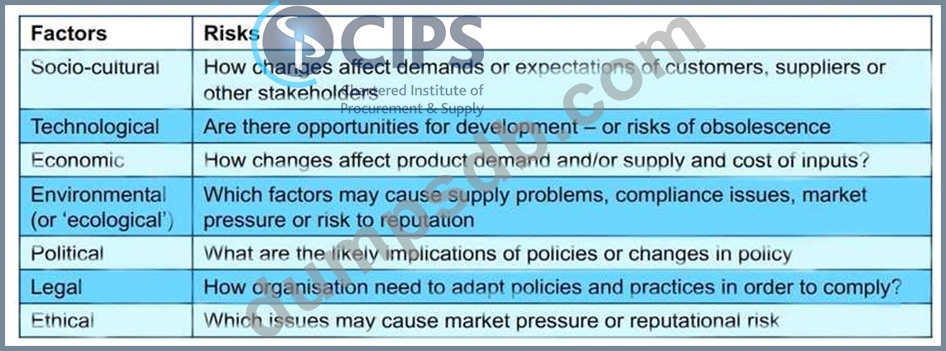
Representatives from South African Department of Health is negotiating the price of hospital drugs with US pharmaceutical companies. Which of the following are most likely to be macro factors that influence the outcomes of the negotiation? Select TWO that apply.
Correct Answer: B,D
Explanation All one-to-one commercial negotiations between a specific purchaser and a specific supplier take place within an industrial market and a larger business environment characterised by multiple forceswhich both parties typically have little control over. STEEPLE framework highlights the 6 main external influences on a business: Table Description automatically generated Particularly, pharmaceutical industry is a heavily regulated sector, therefore, legal and regulatory matters in theindustry is highly important. Otherwise, technological trends also permeate into pharmaceutical companies, technologies like digitalisation may transform the balance of power in such negotiation. LO 1, AC 1.3
Question 42
Which of the following is the first step in the development of negotiation strategies?
Correct Answer: D
Developing specific negotiation strategies in areas where risk or spend is high involves analysing a wide range of objectives and variables within the context of the organisation'sbusiness requirements. The first stage in any negotiation preparation is to define your overall objectives which may be related to a single variable such as price in the case of a standardised requirement, or many variables in the case of capital equipment. Your negotiating strategies and tactics will all be focused on achieving overall objectives.
Question 43
Which of the following can help both parties to break the vicious cycle of blame when a relationship needs repairing? Select TWO that apply.
Correct Answer: A,C
In order to break vicious cycle of blame, procurement will need to use their negotiation and conflict management skills,adopting a collaborative and integrative approach. Your first action should be to establish the facts that led to the situation where the relationship broke down. Most day-to-day relationship between buying organisations and suppliers do not of course involve procurement staff, so you will need to consult with your business partners internally to establish their point of view of where the issue and sources of conflict are. You should also contact the supplier and get their side of the story - this is particularly to when you have previously identified the supplier as critical or otherwise important to your operations. Ideally you will be able to apply principled negotiation here, separating the people from the issue, focusing on interests and not positions,and then looking for options of mutual benefits.
Question 44
Katie is preparing a negotiation with a strategic supplier. Through deep market analysis, she realises that her company and the supplier have equal bargaining power. Via regular communication, Katie knows that both parties are arguing on amount of liquidated damages and neither party shall concede all of their requirements but some are negotiable. Katie and her counterpart from supplying company still desire a long-term relationship and hope that the meeting between them will be a solution for current situation. Which of the following isthe most appropriate approach that Katie should adopt to achieve the above outcome?
Correct Answer: C
Explanation Competing is assertive anduncooperative, a power-oriented mode. When competing, an individual pursues his or her own concerns at the other person's expense, using whatever power seems appropriate to win his or her position. Competing might mean standing up for your rights, defending a position you believe is correct, or simply trying to win. Competing will not allow long-term relationship to flourish. Compromising is intermediate in both assertiveness and cooperativeness. When compromising, the objective is to find an expedient, mutually acceptable solution that partially satisfies both parties. Compromising falls on a middle ground between competing and accommodating, giving up more than competing but less than accommodating. Likewise, it addresses an issue more directly than avoiding but doesn't explore it in as much depth as collaborating. Compromising might mean splitting the difference, exchanging concessions, or seeking a quick middle-ground position. It is a valid approach when long-term relationships are at stake and it is important to find some common ground on which to base an agreement. Both sides get something but not everything. Therefore, this is the most appropriate for this scenario. Avoiding is unassertive and uncooperative. When avoiding, an individual does not immediately pursue his or her own concerns or those of the other person. He or she does not address the conflict. Avoiding might take the form of diplomatically sidestepping an issue, postponing an issue until a better time, or simply withdrawing from a threatening situation. In the scenario, both parties want to take the opportunity, then avoiding is not an appropriate solution. Accommodating is unassertive and cooperative-the opposite of competing. When accommodating, an individual neglects his or her own concerns to satisfy the concerns of the other person; there is an element of self-sacrifice in this mode. Accommodating might take the form of selfless generosity or charity, obeying another person's order when you would prefer not to, or yielding to another'spoint of view. In the scenario, neither party shall concede all of their requirements, it is unnecessary to adopt this approach. LO 1, AC 1.1
Question 45
Which of the following method should be used in negotiation if both parties want to communicate verbally and non-verbally without having to meet face-to-face?
Correct Answer: A
Explanation Using webcams in a web conference means you are able to communicate both verbally and non verbally. Over the phone, you cannot see TOP, the only cue/signal you have regarding their mood, interest and attitude is person's voice, intonation andany delay. A teleconference is a telephone meeting among two or more participants involving technology more sophisticated than a simple two-way phone connection. In-person meeting requires you team and TOP to be in the same place at the same time. LO 2, AC 2.4